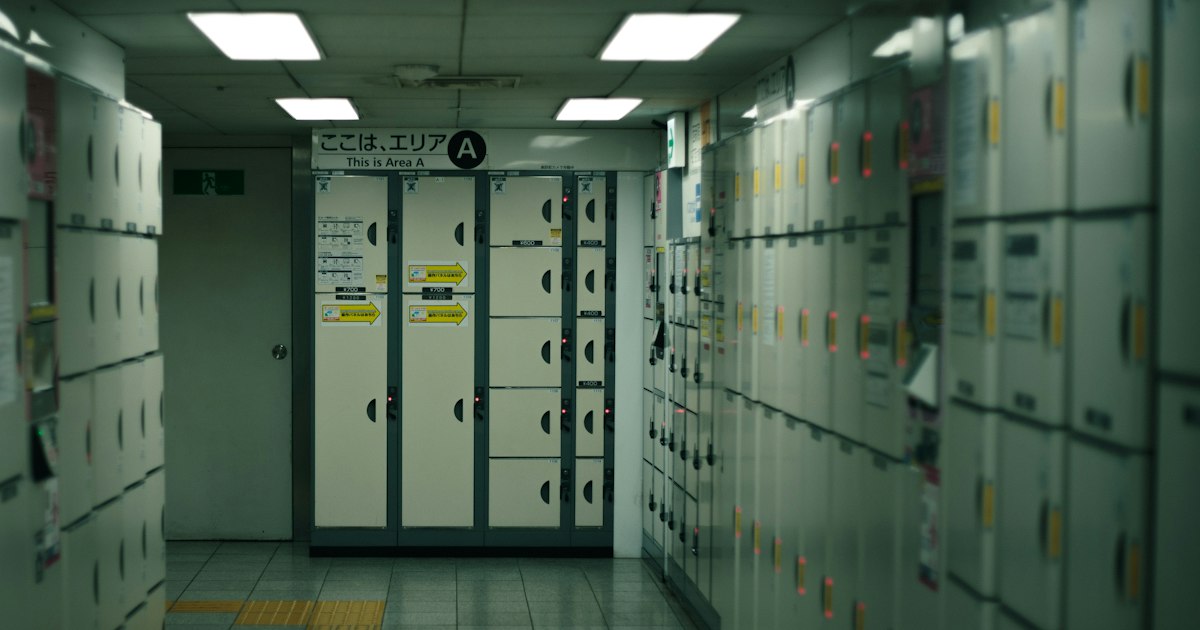
Photo by Thiago Yonamine on Unsplash
Dragging a suitcase through a crowded train station or up a flight of shrine steps is one of the fastest ways to ruin a good day in Japan. Fortunately, the country has built an entire ecosystem around the opposite problem: getting your bags out of your hands so you can actually enjoy the place. Between coin lockers, courier forwarding, and app-based storage networks, there’s almost always a way to walk out of a station carrying nothing but a day pack. Here’s how each option actually works, what it costs, and which one fits your itinerary.
Coin Lockers: The Fastest DIY Option
Coin lockers are the default choice for same-day storage, and nearly every JR, private rail, and subway station in Japan has banks of them, usually near the ticket gates or in a dedicated locker room. Sizes and prices vary slightly by operator, but typical rates at major Tokyo and Osaka stations run:
- Small (fits a daypack or small bag): ¥300–¥500
- Medium (carry-on suitcase): ¥500–¥700
- Large (full-size suitcase): ¥700–¥900
Older lockers take coins only, but most stations have upgraded to IC card (Suica/PASMO/ICOCA) and even credit card payment at the newer touch-panel units. You pay on entry, and the locker usually holds your bag for up to 72 hours before an attendant clears it out — check the posted sign, since this varies by station. The catch: at big hubs like Tokyo, Kyoto, and Osaka Station, lockers near the main concourse fill up by mid-morning, especially during cherry blossom season (late March–early April) and New Year holidays. If the first bank is full, walk toward a secondary exit or a connecting line’s concourse — availability thins out the farther you get from the main entrance, but so does the competition for space.
Luggage Forwarding (Takkyubin): Send It Ahead Instead of Storing It
If you’re not just storing bags for a few hours but moving between cities or hotels, Japan’s courier network (known as takkyubin, run mainly by Yamato Transport and Sagawa Express) is the better tool. Hand your suitcase to your hotel’s front desk or a staffed counter in the morning, and it will typically arrive at your next hotel, a designated airport counter, or even a locker-equipped storage point the following day. Prices for a standard suitcase run roughly ¥2,000–¥3,000 depending on distance and size, which is often cheaper than a taxi and far more comfortable than hauling it onto a packed train.
This is especially useful for day trips bookended by long-distance travel — for example, if you’re heading to see the illuminations at Nabana no Sato near Nagoya before continuing on to Kyoto or Osaka, forwarding your main luggage ahead means you only need a small bag for the day itself. Most hotels can arrange takkyubin at the front desk; just allow one business day for delivery, since same-day forwarding isn’t standard.
App-Based and Shop-Based Storage Networks
Alongside station lockers, a newer layer of storage has grown up around cafes, shops, and tourist facilities that rent out spare space. The largest network, ecbo cloak, lets you reserve storage at partner locations (convenience stores, cafes, hotel lobbies) through its app, paying roughly ¥500–¥700 per bag per day with no need to find an available locker in person. This is a good backup when station lockers are full, and it also works well if you want to drop a bag somewhere closer to your actual destination rather than at the station you arrived through.
Some train operators also run staffed baggage counters at major stations — Tokyo Station’s Gransta area and Kyoto Station both have options for larger or oversized luggage (skis, golf bags, extra-large suitcases) that won’t fit a standard locker. These counters charge a flat daily fee, generally ¥800–¥1,000 per bag, and close in the evening (most by 20:00), so plan your pickup time accordingly.
Matching the Right Service to Your Day Trip
The right choice depends on how long you’re gone and how far you’re going:
- Half-day museum or shrine visit: a standard coin locker at the station you start from is cheapest and simplest. If you’re spending the afternoon at the Tokyo National Museum in Ueno, Ueno Station has ample locker banks right by the park exit.
- Onsen town day trips where you’ll be changing clothes repeatedly: drop your main bag at a locker before you start a bath circuit like the one at Shibu Onsen, and carry only a small toiletry bag and towel between baths.
- Theme-park style day trips with swimwear and towels: at a destination like Hakone Yunessun, many visitors store their regular clothes and bags in on-site lockers (included in admission or a few hundred yen extra) rather than at the train station, since you’ll want dry clothes close by when you’re done.
- Multi-day moves between cities: use takkyubin forwarding rather than hauling bags on the train or paying for multiple days of locker storage.
Common Mistakes to Avoid
A few things trip up first-timers consistently:
- Assuming a locker will be free. During peak travel weeks (New Year, Golden Week in late April/early May, and cherry blossom season), lockers at major stations can be fully booked by 9am. Have a backup plan, such as an ecbo cloak location nearby.
- Forgetting the locker number or key. Digital lockers now print a receipt with a QR code or PIN instead of a physical key — photograph it immediately, since losing it means waiting for station staff to verify your bag with ID.
- Overpacking a “day bag” and needing a locker that doesn’t exist. Oversized sports equipment or multiple large suitcases often won’t fit standard lockers; use a staffed baggage counter instead.
- Missing the clearance deadline. Lockers left beyond the posted limit (commonly 3 days) have their contents removed and held by station lost-and-found, sometimes for a fee to retrieve.
- Not checking opening hours for forwarding counters. Takkyubin desks and staffed baggage rooms usually close by early evening, so don’t plan to drop a bag right before a late flight or train.
Budget, Mid-Range, and Splurge Picks
Budget: A small coin locker (¥300–¥500) is unbeatable for a short museum visit or shopping trip. Mid-range: ecbo cloak or a staffed station counter (¥500–¥1,000/day) when lockers are full or your bag is oversized. Splurge: takkyubin forwarding (¥2,000–¥3,000 per bag) buys you a genuinely hands-free day and saves your back on longer city-to-city hops — well worth it if you’re also dealing with tight flight connections and don’t want to be managing bags at the airport on top of everything else.
None of these services require Japanese fluency — locker panels have English, Chinese, and Korean interfaces, and ecbo cloak’s app works entirely in English. Build one of them into your itinerary and you’ll move through train stations, temple approaches, and shopping streets the way locals do: with nothing to carry but your phone and wallet.