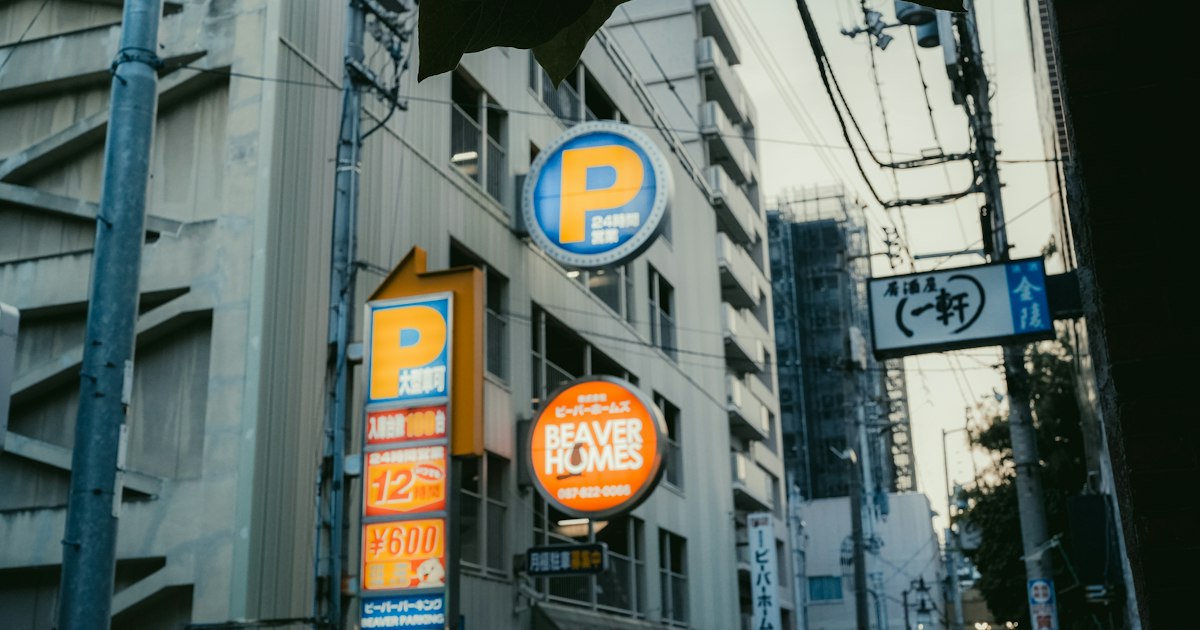
Photo by Johnny Ho on Unsplash
If you’re renting a car in Japan — for a Hokkaido road trip, a dive into the Japanese Alps, or a slow crawl through Kyushu’s onsen towns — parking will trip you up before the driving does. There’s no casual curbside parking here, no feeding a meter outside a restaurant, and no circling the block looking for a free spot. Japan’s parking system is dense, automated, and surprisingly logical once you understand the rules, but it punishes guesswork. Here’s what you actually need to know before you turn the key.
Why You Can’t Just Park on the Street
Street parking is illegal almost everywhere in Japan unless a spot is explicitly marked with a parking meter or sign permitting it, and those are rare outside small towns. This isn’t a loosely enforced rule — it’s backed by a law that most foreign visitors don’t know about: to register a car in Japan, owners must prove they have access to a private parking space (called a shako shomei, or garage certificate). The entire infrastructure assumes nobody is parking on the street, so there’s little tolerance for it.
Enforcement is handled by private parking patrol officers (contracted by local police) who photograph illegally parked cars and slap a bright yellow violation sticker on the windshield — one that’s genuinely difficult to remove. Once that sticker is on, the violation is logged against the car’s plate, and if you’re driving a rental, the fine (typically ¥15,000–¥20,000, variable by prefecture) gets billed to you later via the rental company, usually with an added administrative fee. Worse, officers can and do immobilize cars left unattended in genuinely obstructive spots. The bottom line: find a lot before you park, every time, even for five minutes.
How Coin Parking Lots Work
The default parking option in Japanese cities is the coin parking lot (koin pakingu), and you’ll recognize the two main formats instantly once you’ve seen them:
- Flap-lock lots: You pull into a numbered space, and a metal plate rises out of the ground behind your rear wheels, locking the car in place. To leave, you walk to the payment kiosk, enter your space number, pay the displayed amount, and the plate lowers.
- Gate lots: Function like Western parking garages — take a ticket on entry, pay at a machine before returning to your car, then feed the stamped ticket into the exit gate.
Pricing is almost always tiered: a per-30-or-60-minute daytime rate (commonly ¥200–¥400 per 30 minutes in major cities, less in rural areas) plus a capped daily maximum (saidai ryoukin), often ¥1,000–¥1,500 for the first 24 hours, sometimes less overnight. Always check the rate sign at the entrance before pulling in — rates vary wildly between adjacent lots, and the cheapest-looking sign sometimes only applies to a specific time window. In central Tokyo, Osaka, or Kyoto during peak season, a full day can easily run ¥2,500–¥3,500 if there’s no daily cap, so reading the fine print matters more than the location itself.
Parking Apps Worth Downloading
Several apps let you reserve and sometimes prepay parking before you arrive, which is especially useful around festivals, sumo tournaments, or busy weekends when lots fill fast:
- akippa — Japan’s largest parking-reservation marketplace, listing individually owned driveways and private lots, often cheaper than commercial coin parking. Reservations are made and paid for entirely in-app.
- Times Parking (B-Times app) — Run by Park24, the company behind the ubiquitous “Times” branded lots you’ll see everywhere. The app shows real-time vacancy and current rates at nearby Times lots.
- Google Maps — Increasingly shows nearby paid parking icons with approximate pricing, which is useful for a quick gut check even if you don’t book through it.
Both akippa and the Times app have English-language support, though it’s not always complete — having a Japanese-registered phone number or at least a working credit card on file smooths things considerably. Note that many of these reservation spots are tight residential driveways sized for Japanese kei cars, so double-check the listed dimensions if you’re driving a larger rental SUV or minivan.
Hotel and Ryokan Parking
If you’re staying in a city hotel, don’t assume parking is included — many business hotels in Tokyo, Osaka, and Kyoto either have no lot at all or charge ¥1,500–¥3,000 per night for a small on-site garage, which is often tighter and harder to maneuver into than it looks online. When you book, check the listing for a parking note, and if you’re arriving after hours, this is also the kind of detail worth confirming at check-in — see our guide on checking into a Japanese hotel for what else staff will ask you at the front desk. Rural ryokan and onsen inns are far more generous, typically offering free gravel lots since they assume most guests arrive by car.
Best Season and Timing to Plan Around
Parking demand in Japan spikes hard around three windows: cherry blossom season (late March–early April), Golden Week (April 29–May 5), and New Year (December 29–January 3). During hanami season especially, popular parks and riverside spots sell out their adjacent lots by mid-morning — the same crowds angling for a good blossom-viewing spot, as covered in our hanami picnic etiquette guide, are also competing for parking nearby. If you’re road-tripping during any of these windows, book a reservation-based spot through akippa the night before rather than hoping to find something on arrival.
Winter road trips in snow regions (Hokkaido, Tohoku, Nagano) bring a different problem: some outdoor coin lots partially close or reduce capacity when plowing is needed, and flap-lock mechanisms can jam with ice. If you’re overnighting somewhere cold enough for kerosene heaters to still be in use — our piece on kerosene stoves and where to find fuel covers that old-school heating culture — call ahead or check the lot’s status online rather than assuming it’s open 24/7.
Common Mistakes Visitors Make
- Misreading the rate sign. Japanese coin parking signage often lists multiple time-based rates in dense grids (daytime vs. nighttime, weekday vs. weekend). Take a photo of the sign before you walk away so you can double-check the cap later.
- Parking in a convenience store or restaurant lot without buying anything. These are private lots for customers only, monitored by camera, and non-customers get towed or fined just as readily as illegal street parkers.
- Forgetting the flap-lock delay. After paying, the ground plate takes 10–20 seconds to lower — drivers who gun it immediately after paying can damage the undercarriage.
- Assuming a “full” sign means the whole facility. Large multi-level coin lots sometimes mark individual floors full while others have space; a quick loop inside is worth it before giving up and leaving.
- Not budgeting for sightseeing stops. A scenic coastal drive with five short stops can rack up ¥5,000+ in parking alone if each stop resets a new per-hour clock — factor this into your road trip budget the same way you’d factor in Japan’s consumption tax catching you off guard at checkout.
Get the basics down — read the sign, use an app when lots look scarce, and never assume a curb is fair game — and parking becomes one of the easier parts of a Japan road trip, not the stressful part.