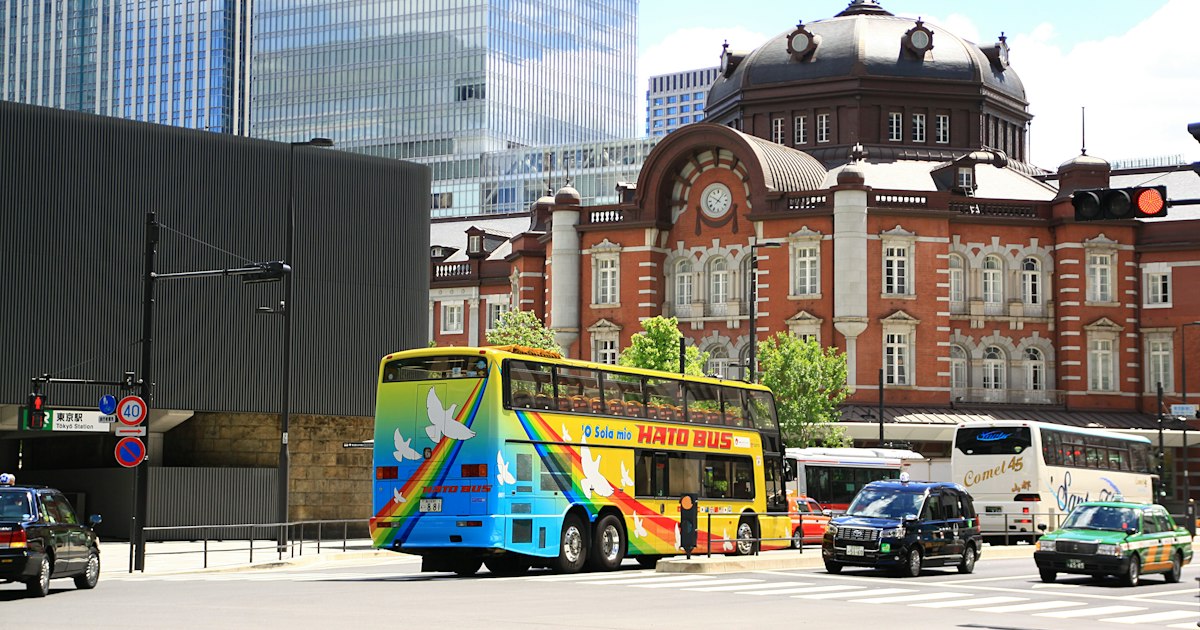
Long before hop-on-hop-off apps and audio-guide headsets became standard, Tokyo already had its own sightseeing bus culture — and it’s still running. Hato Bus has been driving tourists past the Imperial Palace since 1948, and Sky Bus Tokyo’s open-top double-deckers have become one of the most photographed ways to see Tokyo Tower and the Ginza skyline. Neither requires you to speak Japanese, plan a complicated route, or rent a car. Here’s how the two actually differ, what they cost, and how to avoid the mistakes first-timers make.
What’s the Difference Between Hato Bus and Sky Bus Tokyo?
They’re often lumped together, but they serve different purposes. Sky Bus Tokyo (operated by Hinomaru Kotsu) is a fleet of red, roofless double-decker buses that run fixed loop routes of roughly 45 to 100 minutes — think of it as a scenic ride with minimal commitment, good for squeezing skyline views into a half-day. Hato Bus is the older, more traditional operator: fully guided day tours, usually 3 to 9 hours, with a uniformed tour guide narrating the whole way and scheduled stops at gardens, temples, or lunch spots. Sky Bus is closer to a theme-park ride; Hato Bus is closer to an organized excursion.
Riding Sky Bus Tokyo: Open-Top Courses and Prices
Buses depart from in front of the Marunouchi Building (Marubiru), a short walk from Tokyo Station’s Marunouchi South Exit. The most popular route is the Tokyo Panoramic Course, a roughly 45–50 minute loop past the Imperial Palace moat, Hibiya, and Ginza, priced at approximately ¥2,000 for adults and ¥1,000 for children. Longer routes — the Tokyo Tower & Roppongi course and the Asakusa/Tokyo Bay course, each around 90–100 minutes — run roughly ¥3,000–3,600 for adults. Seasonal courses appear around winter illuminations (December) and cherry blossom season (late March–early April), often adding a nighttime departure.
There’s no live multilingual narration on board; instead you get a recorded audio guide through a smartphone app or rented headset, available in Japanese, English, Chinese, and Korean. Walk-up tickets are sold at the booth by the departure point, but book online in advance during peak weekends or cherry blossom week, when early runs sell out.
One mix-up worth avoiding: Sky Bus Tokyo is not the same company as Sky Hop Bus, a separate hop-on-hop-off operator with its own stops and tickets. Double-check which one you’ve booked — they look similar in photos but don’t share tickets or routes.
Riding Hato Bus: Guided Day Tours Across Tokyo and Beyond
Hato Bus’s cream-and-yellow coaches (look for the dove logo — “hato” means pigeon/dove) depart mainly from the Hato Bus Hamamatsucho Terminal, inside the World Trade Center Building complex a few minutes’ walk from Hamamatsucho Station, with some pickups at Tokyo Station’s Yaesu side and major hotels depending on the course. Half-day courses (around 3–4 hours) covering spots like Tokyo Tower and a Sumida River cruise run roughly ¥4,000–6,000. Full-day courses with lunch — Asakusa, the Tsukiji/Toyosu area, Hamarikyu Gardens, a bay cruise — land around ¥9,000–13,000. Day trips outside the city, such as Mt. Fuji or Nikko, typically run ¥12,000–20,000 and up, since they include a longer drive and often a meal.
The guiding is in Japanese on nearly all standard courses; some tours offer an English audio device as a supplement, but don’t expect a live English-speaking guide unless you’ve specifically booked one of the limited foreign-visitor courses, which run on a restricted schedule. If riding solo without Japanese, Sky Bus’s app-based audio guide is the more reliable English experience of the two.
Hato Bus’s countryside day trips cover similar ground to independent excursions you might otherwise piece together yourself — if you’re drawn to river-gorge scenery and boat rides rather than a bus tour, Nagatoro’s gorge line-boats make a good DIY alternative on a similar budget.
Best Time to Ride
Spring (late March–early April) and autumn (November) are peak season for both operators — cherry blossoms along the palace moat and fall color at the gardens Hato Bus visits mean both companies add extra departures and sell out faster, so book at least a few days ahead. Sky Bus’s open-top deck is genuinely uncomfortable at midday in July and August; ride in the early morning or opt for an evening course instead. Rain doesn’t cancel the bus, but it does mean the top deck gets ponchos rather than open sky, and strong wind can shut top-deck access entirely with no separate refund for that portion — check the forecast before locking in a reservation.
Booking Tickets: Where and How
Both companies run English-language booking sites, and Sky Bus also sells same-day walk-up tickets at its departure kiosk when seats are available. Hato Bus tours, especially full-day ones with lunch included, need advance booking since seats and meal counts are fixed — same-day availability is rare for the longer courses. Neither bus has real luggage storage on board, so if you’re tacking a tour onto a travel day, stash your suitcase at the station first rather than hauling it on; see this guide to station luggage storage for where to leave bags near Tokyo or Hamamatsucho Station.
Common Mistakes to Avoid
- Assuming English guiding is standard on Hato Bus. Most courses are Japanese-only narration; check the course description for “English” specifically rather than assuming.
- Showing up late for a full-day tour. Hato Bus day trips run on a fixed group schedule with a set return time — arrive late at a stop and the bus leaves without you, since there’s no way to hold a tour bus for one passenger.
- Riding Sky Bus with a suitcase. There’s no onboard storage; travel light or stash bags beforehand.
- Confusing Sky Bus Tokyo with Sky Hop Bus. Different company, different ticket, different stops — verify before you buy.
- Booking a large group without checking group rates. Both operators offer discounted group bookings above a certain headcount; if you’re traveling with family or a tour group, it’s worth comparing against broader group-travel discounts covered in this guide to group travel savings in Japan.
Budget, Mid-Range, and Splurge Picks
Budget: Sky Bus Tokyo’s Panoramic Course — about ¥2,000, 45 minutes, enough to see the Imperial Palace and Ginza from the open top deck without committing a whole afternoon.
Mid-range: A Hato Bus half-day course (~¥5,000–6,000) pairing Tokyo Tower with a Sumida River cruise and a live guide — a good option if you want narration but not a full day committed.
Splurge: A Hato Bus full-day excursion to Mt. Fuji or Nikko (¥15,000–20,000+) with lunch included — worthwhile if you don’t want to deal with countryside train transfers yourself. If a bay view at night appeals more than a daytime bus loop, a private fireworks-viewing cruise in Tokyo Bay is a seasonal splurge alternative worth comparing.
Whichever you pick, both buses solve the same basic problem — seeing a lot of Tokyo without planning a route yourself — just at very different paces and price points.