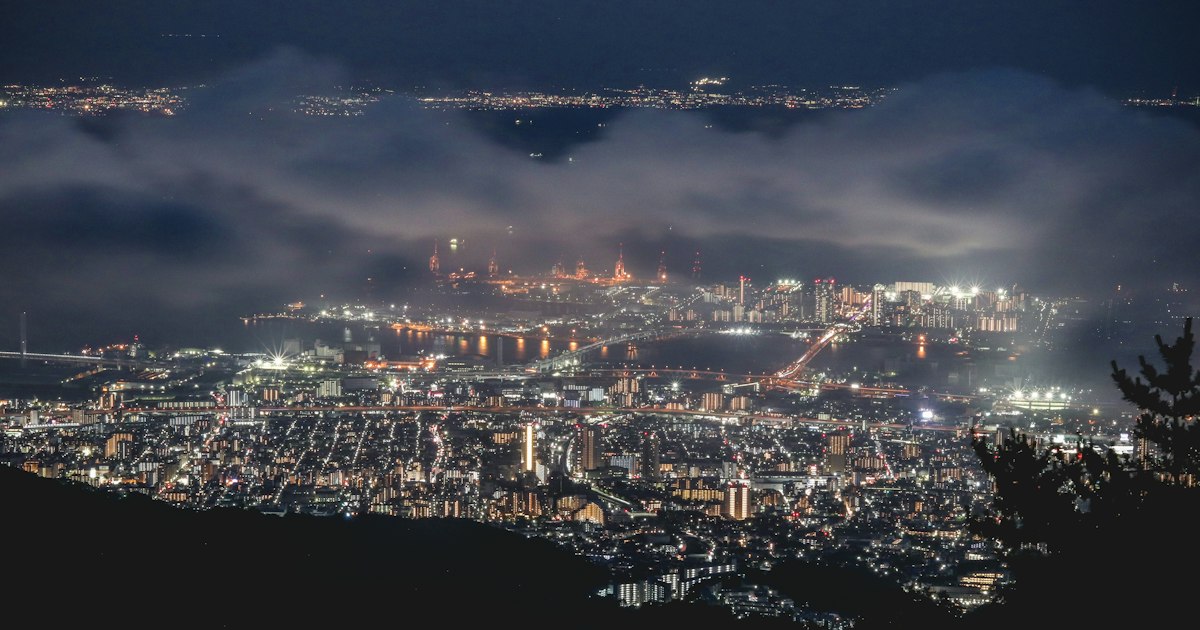
Kobe keeps a secret just above its rooftops: a 931-meter ridge where the entire city, the port, and Osaka Bay fold out into one of Japan’s most celebrated night views. Mount Rokko and its summit complex, Rokko Garden Terrace, are easy to treat as a quick cable car ride and a photo, but with a little planning around timing and weather you can turn it into one of the best half-days of a Kansai trip.
Why Mount Rokko’s Night View Is Worth the Trip
Mount Rokko’s night view is traditionally ranked as one of Japan’s “three great night views” (日本三大夜景), alongside Mount Hakodate in Hokkaido and Mount Inasa in Nagasaki. What makes Rokko’s version distinct is the layout below: Kobe’s dense, lit-up waterfront curves right up against Osaka Bay, with the lights of Osaka visible in the distance on a clear night and Kansai International Airport’s runway lights sometimes picking out the far shoreline. Because the mountain rises so sharply right behind the city, you get a dramatic, almost aerial angle that flatter viewpoints elsewhere can’t match.
Getting to Rokko Cable-Shimo Station
The mountain itself is accessible by road, but almost every visitor goes up via the Rokko Cable, a historic funicular cable car. To reach the base station (Rokko Cable-Shimo):
- From Hankyu Rokko Station or JR Rokko-Michi Station, take a Kobe City Bus (route 16) bound for “Rokko Cable-Shimo.” The ride is roughly 10 minutes.
- If you’re coming from Sannomiya or Shin-Kobe, the simplest route is Hankyu or JR to Rokko, then the bus transfer above.
If you’re double-checking which train line color gets you to Rokko versus other Kobe stations, it’s worth a quick look at our guide to reading Japanese train maps and line colors before you set out, since Kobe’s JR, Hankyu, and Hanshin lines all run roughly parallel and it’s easy to board the wrong one.
Riding the Rokko Cable and Reaching the Garden Terrace
The Rokko Cable climbs from Cable-Shimo Station to Rokko Sancho (mountaintop) Station in about 10 minutes, with cars departing every 15–20 minutes. Adult fares are roughly ¥600 one-way or ¥1,100 round-trip, with child fares about half that — confirm the current timetable and pricing on the operator’s site before you go, since the last car down the mountain (often around 9–10pm depending on season) is the detail that trips people up most.
From Rokko Sancho Station, a shuttle bus connects to the summit attractions, including Rokko Garden Terrace, in just a few minutes. It’s a short, cheap hop rather than a walk you need to budget much time for.
What to Do at Rokko Garden Terrace
Rokko Garden Terrace is a cluster of observation decks, cafés, and small shops built specifically to frame the night view. The standout is the Rokko Shidare Observation Deck, a lattice-wood structure shaped like a weeping willow that wraps around an open-air platform — it’s the most photographed spot on the mountain and worth timing your visit around, since it gets crowded right at sunset. The main “Self Terrace” deck is larger and less packed if you want space to linger.
For food, there’s a casual terrace restaurant with buffet-style dining and a café (UCC Café 1894, in a reused historic building) for coffee with a view. Small shops sell Kobe-themed snacks and souvenirs, so it doubles as a reasonable last stop for gifts if you haven’t shopped yet in the city center.
In winter, the adjacent Rokko Snow Park adds artificial-snow tubing and snow play, and the Rokko Alpine Botanical Garden nearby is a quieter detour in warmer months. Travelers who want to keep going can cross the ridge on the separate Rokko-Arima Ropeway, a roughly 12-minute aerial ride down to Arima Onsen, one of Japan’s oldest hot spring towns — a natural way to turn this into an overnight trip.
Best Time to Go: Season and Timing
Clear, dry air matters more than the season itself. Winter (December–February) tends to deliver the crispest, haze-free views, though it’s genuinely cold and windy at the summit — noticeably colder than street level in Kobe, even in spring or autumn evenings. Humid summer nights and the June rainy season often mean hazier distant views, even without rain. Autumn foliage (mid-November into early December) is a nice bonus layer if you’re going for color as well as lights.
For timing within a day, arrive 45–60 minutes before sunset. That gives you time to get oriented on the deck in daylight, watch the transition as the city lights switch on, and settle into prime position before the after-dinner crowd arrives. Weeknights are calmer than weekends; avoid going up on an overcast or rainy evening entirely, since the view is the whole point and fog or low cloud can erase it completely.
Budget, Mid-Range, and Splurge Options
Budget: Cable car round-trip only (around ¥1,100) plus your own snacks, viewing from the free public deck areas — a full visit can run under ¥2,000 per person.
Mid-range: Add a meal or coffee at the Garden Terrace restaurant or café and pick up a small souvenir; budget ¥3,000–5,000 total.
Splurge: Combine the night view with a ropeway crossing to Arima Onsen and an overnight stay at a hot spring ryokan, or follow the mountain with a Kobe beef dinner back in the city — easily ¥15,000+ but a genuinely memorable pairing.
If you’re planning any Kobe adventure activities on the same trip — Rokko and the surrounding ridge are also a known paragliding launch area — our guide to paragliding and tandem skydiving in Japan covers how visitors can book a flight over this kind of terrain.
Common Mistakes to Avoid
- Going on a cloudy or hazy night. Check the Kobe weather forecast the same afternoon — the view is the entire reason to go up, and there’s no good backup plan if it’s socked in.
- Underestimating the cold. The summit is consistently several degrees colder and windier than the city below, year-round after dark. Pack a real layer, not just a light jacket; if you’re traveling light, Kobe has branches of Alpen and Sports Depo where you can grab an inexpensive fleece or windbreaker before heading up.
- Missing the last cable car down. Operating hours shrink in winter, and getting stranded at the summit after the final descent is an expensive, cold mistake. Confirm the last departure time before you ride up.
- Assuming the Rokko-Arima Ropeway runs every day. It has periodic maintenance closures, so verify its schedule separately if you’re planning to cross to Arima Onsen rather than backtrack the way you came.
Done right, Mount Rokko is one of the easiest big payoffs in the Kansai region — an hour or so from central Kobe for a view that regularly gets ranked among the best in the country. If mountain-view day trips are becoming a theme of your Japan itinerary, it’s worth comparing notes with somewhere like Mount Yotei in Hokkaido for a very different, more rugged version of the same idea.