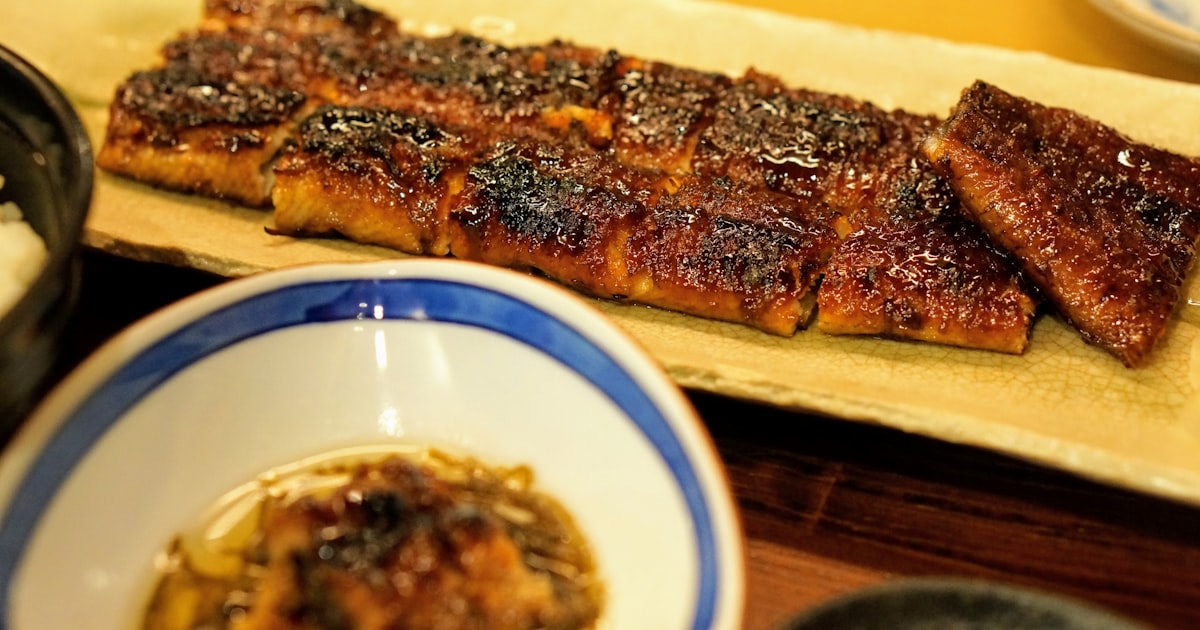
Photo by Takuma Tsubaki on Unsplash
Unagi, or freshwater eel, is one of Japan’s oldest comfort foods — smoky, sweet, and rich enough that a small portion feels like a full meal. It’s also one of the more expensive everyday dishes you’ll encounter, thanks to decades of declining wild eel stocks, so knowing how to order it well and where to spend your money makes a real difference. Here’s what to know before you sit down.
What Is Unagi, and Why Do Japanese People Eat It in Summer?
Unagi refers specifically to freshwater eel (as opposed to anago, saltwater conger eel, which is milder and more common in sushi). It’s split down the back or belly, deboned, skewered, and grilled with a sweet-savory tare sauce made from soy sauce, mirin, and sugar — the same style of glaze used on yakitori, but thicker and glossier.
The tradition of eating unagi in midsummer comes from Doyo no Ushi no Hi, the “Day of the Ox” in the old lunar calendar, which usually falls in late July. The custom is said to date back to the Edo period, when a shop owner asked the scholar Hiraga Gennai for help with slow summer sales; his marketing angle — that eating unagi on this day fights summer fatigue — stuck for over 200 years. In practice, this means unagi shops get very busy and some raise prices slightly around that date, so if you want a quieter, cheaper meal, aim for any other week in summer or autumn, when eel is arguably at its best condition anyway.
Kanto vs Kansai: Two Ways to Grill an Eel
Japan has a genuine east-west split in unagi preparation, and it’s worth knowing before you order. In Tokyo and the Kanto region, the eel is butterflied from the back, steamed to render out fat and soften the flesh, then grilled — producing a texture so tender it barely needs chewing. In Kansai (Osaka, Kyoto) and much of western Japan, the eel is split from the belly and grilled directly with no steaming step, giving a crisper, slightly charred skin and a firmer bite. Neither is “correct”; they’re just different, and trying both if your trip covers both regions is a good way to appreciate the difference. If you’re building a Kyoto food day around this, the stalls and counters of Nishiki Market occasionally have grilled eel skewers worth flagging down alongside the market’s other specialties.
How to Order: Unadon, Unaju, Hitsumabushi, and Shirayaki
Menus can look intimidating, but the core options are simple:
Unadon — eel over rice in a round lacquer or ceramic bowl (donburi). The everyday, slightly more casual version.
Unaju — the same idea served in a square lacquer box (jubako), generally considered a step up in presentation and often price.
Hitsumabushi — a Nagoya specialty where chopped eel over rice is meant to be eaten three (or four) ways: first plain, then with chopped scallions, nori, and wasabi mixed in, then with hot dashi or green tea poured over it like ochazuke, and a final bowl however you liked best. It’s genuinely more fun to eat than a standard unadon and worth seeking out if you pass through Nagoya.
Shirayaki — eel grilled plain with no tare, dipped in salt or wasabi-soy. It shows off the eel’s own flavor and is a good order if you find kabayaki sauce too sweet, or want to pair the eel with sake.
Where to Eat Unagi: By Budget
Budget (¥1,000–¥2,000): Chain restaurants and department store basement (depachika) counters sell compact unadon or unagi bento, and convenience stores sometimes carry unagi bowls as a seasonal item around Doyo no Ushi no Hi. Portions are smaller and the eel is usually imported and pre-processed, but it’s a legitimate way to try the dish without commitment.
Mid-range (¥3,000–¥6,000): Dedicated unagi specialty shops (unagi-ya) in most cities fall here. You’ll get a proper unaju set with liver soup (kimosui) and pickles, freshly grilled to order — expect a wait, since good shops grill in small batches rather than pre-cooking.
Splurge (¥6,000–¥15,000+): Old, established unagi restaurants that source domestic (kokusan) eel and have been perfecting their tare — some recipes are decades or over a century old — for generations. Nodaiwa in Azabu, Tokyo, dates back over 250 years and is one of the most famous names in this category; expect to book ahead and possibly queue even with a reservation.
Regions Worth a Detour for Eel
A few places have built real reputations around unagi. Hamamatsu, on Lake Hamana between Tokyo and Nagoya on the Tokaido Shinkansen line, is one of Japan’s historic eel-farming centers and has unagi restaurants clustered around the station. Nagoya is the place for hitsumabushi — Atsuta Houraiken, founded in 1873 near Atsuta Shrine, is credited with inventing the dish. Yanagawa in Fukuoka Prefecture, a small canal town, is known for seiro mushi, a steamed version of unaju where the rice and eel are steamed together in a bamboo box — a distinct texture from the grilled versions elsewhere. If you’re routing a Kansai-area trip that includes any of these regions, check whether a JR regional rail pass covers your route before buying individual tickets.
Common Mistakes to Avoid
Don’t show up at a well-known unagi restaurant right at opening on a summer weekend without a reservation or a plan to wait — many places grill to order and can sell out of the day’s eel entirely by mid-afternoon, especially around Doyo no Ushi no Hi. Don’t assume unadon and unaju are interchangeably priced; the box version is often ¥500–¥1,500 more for the same eel. And don’t skip the kimosui (eel liver soup) that comes with set meals — it’s included, mild, and a nice contrast to the rich, sweet main dish. If you’re new to ordering rice-bowl meals in Japanese and want a gentler introduction to reading a donburi menu, our guide to Japanese curry rice covers similar bowl terminology and etiquette.
A Note on Sustainability
Japanese eel (Anguilla japonica) is listed as endangered by the IUCN, and glass eel (young eel) catches have declined sharply over recent decades, which is the main reason prices have risen steadily. Most unagi served in Japan today is farmed from wild-caught glass eels rather than fully wild-caught adults, and a portion is imported, often from other parts of Asia. This isn’t a reason to avoid unagi entirely — it remains a legal, regulated food — but it’s worth knowing why a bowl that used to be an everyday lunch is now, in many shops, a special-occasion meal.