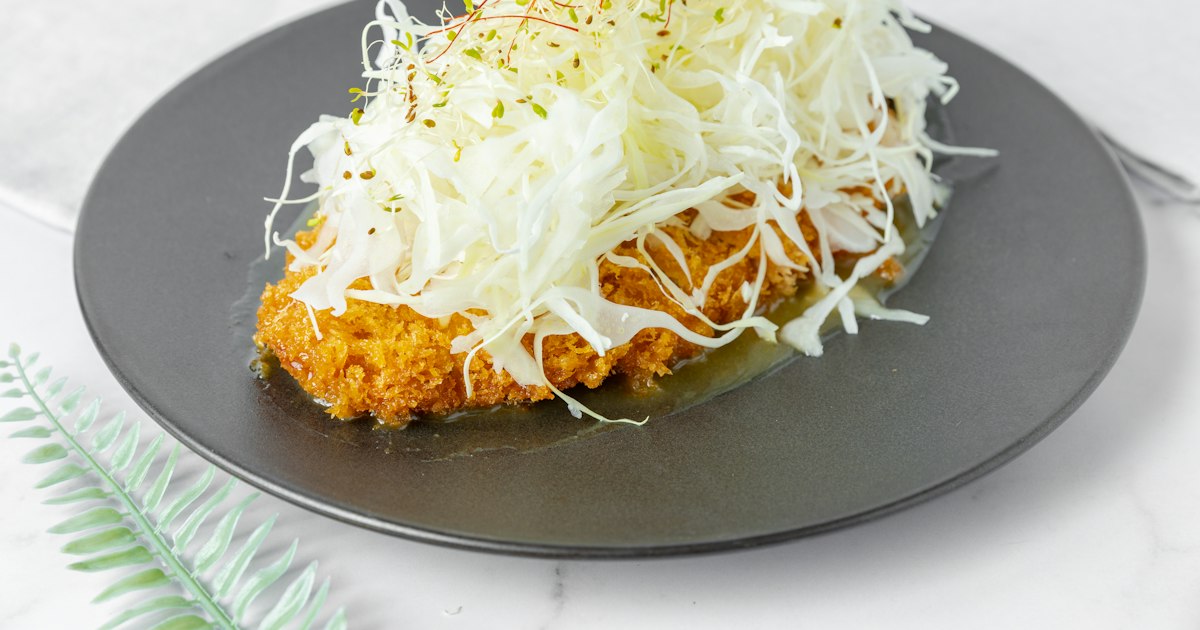
Tonkatsu is one of those dishes that looks simple — a slab of breaded, deep-fried pork — but gets surprisingly deep once you start ordering it. Which cut, how rare, what sauce, and should you really eat the cabbage first? This guide covers what tonkatsu actually is, how to order it without hesitating, and where to eat it on any budget, from a ¥900 convenience-lunch set to an ¥8,000 black-pork splurge.
What Is Tonkatsu, Exactly?
Tonkatsu (豚カツ) is a thick-cut pork cutlet coated in panko breadcrumbs and deep-fried until the crust is crisp and golden but the meat inside stays juicy. It dates back to the late 1800s, part of the wave of Western-style dishes (yōshoku) that Japanese cooks adapted after the Meiji Restoration opened the country to foreign food culture. Unlike a thin Austrian schnitzel, tonkatsu is cut thick — often 1.5 to 2.5 cm — so the first bite matters: a good one has a crackling exterior and a pink-tinged, tender center, not a dry, grey slab.
It’s almost always served as a teishoku (set meal): the cutlet sliced into strips, a mountain of finely shredded raw cabbage, rice, miso soup, and pickles. The cabbage isn’t a garnish — it’s there to cut the richness of the fried pork, and most shops offer free refills.
Rosu vs. Hire: Choosing Your Cut
Every tonkatsu menu asks you to pick a cut, and this is the first decision that trips up first-timers:
- Rosu (ロース) — the loin, with a thin ring of fat along one edge. More flavorful and juicier; the standard choice and usually a little cheaper than hire.
- Hire (ヒレ) — the fillet/tenderloin. Leaner, softer, and milder in flavor. Often the pricier option and a good pick if you want something lighter.
- Kurobuta (黒豚) — “black pork,” a premium breed (most famously from Kagoshima) with sweeter fat and finer texture, usually marked as an upgrade on either cut.
If you can’t decide, many shops sell a rosu-hire moriawase (mixed plate) so you can compare both in one meal.
How to Order Tonkatsu Like a Local
At a sit-down tonkatsu restaurant, the flow is usually: pick your cut and size (many places offer 100g, 150g, 200g portions, priced per gram above the base set), choose rice portion and whether you want miso soup upgraded to pork soup (tonjiru) for a small supplement, then wait — it’s fried fresh, so expect 10–15 minutes even when the restaurant looks empty.
On the table you’ll usually find two sauces: a thick, tangy-sweet tonkatsu sauce (similar to a fruitier Worcestershire) and karashi, a sharp Japanese mustard. Some higher-end shops also give you a small grinding bowl with sesame seeds and ask you to make your own sauce by mixing ground sesame with the tonkatsu sauce — don’t skip this step if it’s offered, it’s part of the experience, not an optional extra.
Many shops also serve tonkatsu curry (katsu curry) and katsudon (cutlet over rice with egg), which are different dishes built from the same fried cutlet — worth knowing so you order the plain version if that’s what you want. If you enjoy comparing how different chains execute one core dish, it’s a similar exercise to sizing up Japan’s gyudon chains — the format is standardized, but each chain has its own signature.
Where to Eat Tonkatsu: Budget to Splurge
Budget (¥900–1,500): Chain restaurants like Saboten and Katsuya serve solid rosu-katsu teishoku sets starting around ¥990–1,290, with free cabbage refills and fast service — reliable if you’re near a train station and want something quick between sightseeing stops. Convenience stores and supermarket deli counters also sell pre-fried katsu for ¥300–500, decent in a pinch but not representative of the real thing.
Mid-range (¥1,800–3,500): Katsukura is a well-regarded mid-tier chain (branches in Kyoto, Tokyo, and elsewhere) where sets run roughly ¥1,800–2,800 and you grind your own sesame sauce. Tonkatsu Maisen’s Aoyama Honten, tucked in a converted old public bathhouse near Omotesando, is one of Tokyo’s most famous tonkatsu addresses — about a 7-minute walk from Omotesando Station (Exit A2), open daily 11:00–21:00 (last order), with hire-katsu sets around ¥2,900–3,900. Expect a short wait at lunch.
Splurge (¥5,000–8,000+): Shops like Butagumi in Nishi-Azabu specialize in regional heirloom pork breeds (Kagoshima kurobuta, Okinawan agu, and others), letting you compare pork varieties the way a steakhouse offers different cattle breeds. This tier is worth it if you’re genuinely curious about pork quality differences, not just for a bigger portion.
Best Time to Go and Avoiding Crowds
Lunch sets (often ¥100–300 cheaper than the dinner menu for the identical cutlet) typically run from opening until around 14:00–15:00, so go right at opening — most tonkatsu shops open around 11:00 — to avoid both the crowd and the price bump. Popular spots like Maisen regularly have queues by 12:00 on weekends; arriving by 11:15 usually means walking straight in. Dinner service generally resumes around 17:00–17:30. There’s no strong seasonal angle to tonkatsu — it’s a year-round comfort dish — though it’s traditionally considered a bit of a good-luck meal before exams or big events, since “katsu” (勝つ) is a homophone for “to win.”
Common Mistakes to Avoid
- Pouring sauce over the whole plate before tasting: try the first piece plain to taste the pork and the panko crust, then sauce the rest.
- Ignoring the cabbage: it’s not filler — eating it between bites genuinely improves the meal and keeps the fried food from feeling heavy. Ask for “okawari” (refill) if the bowl runs out; it’s usually free.
- Ordering the biggest size by default: 200g cutlets are substantial. Unless you’re very hungry, the standard size is plenty, especially paired with rice and soup.
- Assuming all tonkatsu is the same: skipping the rosu/hire choice and just pointing at the menu photo means you might end up with a leaner cut than you wanted. It’s a two-second question worth asking.
- Showing up right at peak lunch (12:00–13:00): at popular shops this means a 20–30 minute wait; shifting by even 30 minutes either side solves it.
Tonkatsu rewards a little attention to detail — the cut, the timing, the sauce ritual — but it’s forgiving enough that even the cheapest chain version is a satisfying meal. Once you know what to ask for, ordering it becomes second nature.