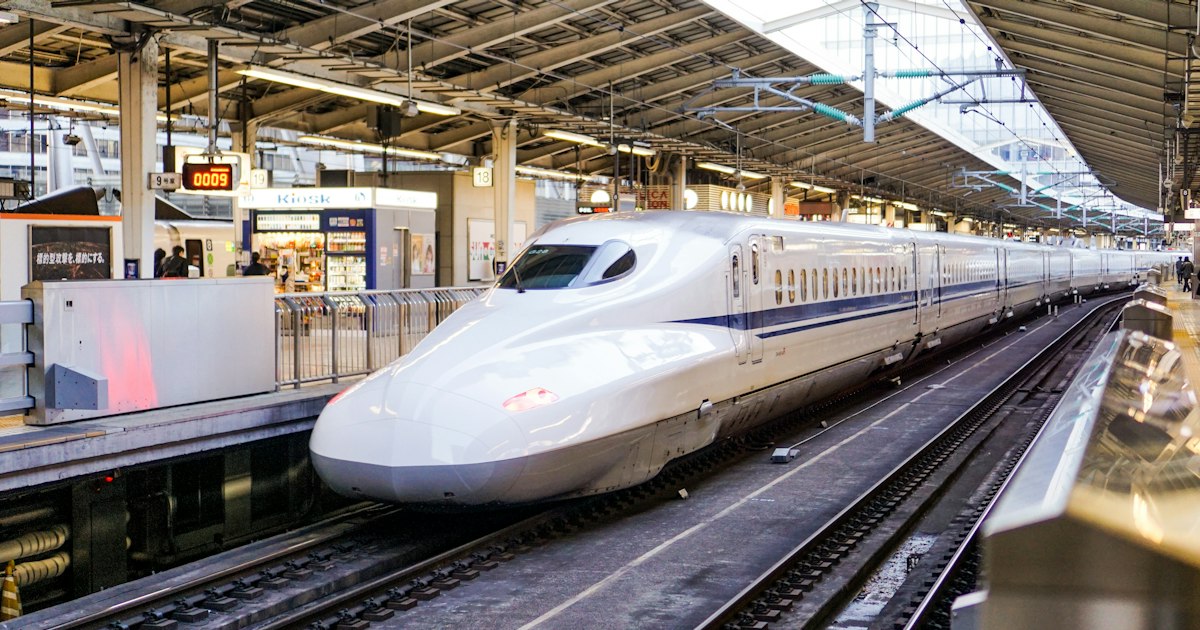
Photo by Fikri Rasyid on Unsplash
You’re standing on the platform watching your Shinkansen pull away without you. In most countries, that’s the end of your ticket. In Japan, it often isn’t. Japan Railways has a set of transfer and change rules that are more forgiving than almost any foreign visitor expects — but they’re also full of specific conditions that determine whether “lenient” means free, cheap, or just “possible.” Here’s what actually happens, and what to do in the ten minutes after you realize you’re going to miss your train.
Why Missing Your Train in Japan Isn’t the Disaster You Think
The key thing to understand is that a Shinkansen ticket is really two tickets bundled together: the base fare ticket (jōshaken), which covers the distance between two stations, and the limited express surcharge (tokkyūken), which pays for the specific train and seat. Only the second part is tightly tied to a specific departure. The base fare portion has its own validity period — for trips over about 100 km, it’s valid for two days or more, with an extra day added for roughly every 200 km of distance. That means even if you miss your bullet train entirely, your base ticket is very often still good tomorrow. You’re not starting from zero; you’re just missing the express portion, which is the cheaper part to replace.
The Official Rule: Free Changes — But Only Before Departure
JR’s actual rule for a reserved-seat ticket is this: you can change the date, train, or seat once, free of charge, as long as you do it before the departure time printed on your ticket. Walk up to a staffed Midori no Madoguchi counter or a multi-function ticket machine, show your ticket, and they’ll rebook you onto a later train the same day (or a different day within the base ticket’s validity) with no fee. This is the rule worth remembering: the moment you sense you’ll miss a train, don’t wait until it’s gone — get to a counter or machine while the clock is still running in your favor. After the printed departure time passes, that specific free-change window officially closes.
If you’ve already decided not to travel at all, a wholly unused reserved ticket can usually be refunded for a flat ¥220 handling fee, again provided it’s done within the validity period and, for the limited express portion, before the original train’s departure.
Already Missed It? What Actually Happens at the Gate
In practice, station staff and conductors are noticeably more flexible than the strict rulebook suggests. If you arrive at the gate and your train has literally just left, telling the staff “the train left without me” (or showing them your ticket and the clock) will usually get you one of two outcomes: they reissue you a seat on the next available train for free or for a small adjustment fee, or they point you toward the non-reserved cars and let the original ticket’s base fare carry you, with only the reserved-seat surcharge needing adjustment. This isn’t a guaranteed legal right — it’s discretionary goodwill — but it’s consistent enough that missing a train in Japan rarely means buying a full-price ticket from scratch. The exception is tickets explicitly marked non-refundable/non-changeable, which brings us to the next point.
Unreserved Seats: Your Automatic Backup Plan
On the Tokaido and Sanyo Shinkansen (Tokyo–Osaka–Hakata), cars 1 through 3 are non-reserved (jiyūseki) on almost every Nozomi, Hikari, and Kodama service. Since October 2023, JR Central also unified the limited express fare so reserved and non-reserved seats cost the same — there’s no longer a price penalty for sitting in the unreserved car. Practically, this means that if you have any valid ticket covering that route and you miss your reserved train, you can usually just walk onto the next train’s unreserved car and ride, sorting out the paperwork later if a conductor asks. This is the single most useful fact in this whole topic: on Japan’s busiest corridor, “missing your train” often just means “catching the next one and sitting in a different car.”
The catch: not every Shinkansen line works this way. Many Tohoku, Hokuriku, and Akita/Yamagata route trains — the Hayabusa being the classic example — are entirely reserved-seating with no unreserved cars at all. On those lines, you genuinely need a new seat assignment, so head straight to a counter rather than assuming you can just hop on.
E-Tickets Make This Even Easier
If you booked through Smart EX, the EX app, or Ekinet rather than a paper ticket, changes are even smoother — you can usually swap your reserved train to a later departure directly in the app, often multiple times, right up until the original train leaves, with no trip to a counter required. This is one more reason to book digitally rather than at a machine if you’re at all unsure about your connection timing; our guide to Smart EX, the EX app, and Ekinet covers how to set these up before you travel. If you’re traveling on a Japan Rail Pass, the leniency is even more pronounced: seat reservations are issued free against the pass, so missing a train simply means walking back to a ticket office and getting a new reservation at no cost — the pass itself is unaffected.
When the Rules Get Stricter: Discount Fares and Peak Season
All of this leniency applies to standard, full-fare tickets. It does not reliably apply to deep-discount advance-purchase fares (like certain EX-Early tiers or package deals such as Puratto Kodama), which often explicitly prohibit changes or charge a real penalty for them — read the fine print at purchase if you booked the cheapest option available, since that’s precisely where the “it’s fine, just catch the next one” assumption breaks down.
Timing matters too. During Golden Week (late April–early May), Obon (mid-August), and New Year (late December–early January), reserved cars sell out days in advance and unreserved cars fill standing-room-only within minutes of departure from a terminal station. “Just hop on the next one” is still technically true in these windows, but it may mean standing for an hour or more. If your trip falls in one of these periods, book your original reservation with extra buffer time rather than relying on the backup plan.
Finally, if a missed connection throws your whole day off and you’re weighing whether to chase a replacement Shinkansen or just fly the remaining leg instead, it’s worth comparing costs — our breakdown of LCC vs. JAL and ANA for domestic flights is useful for exactly that kind of last-minute recalculation on longer routes.
Quick Reference: What to Do the Moment You Realize You’re Late
- Still before departure time: Go straight to a Midori no Madoguchi counter or ticket machine — free change, no questions asked.
- Train just left, Tokaido/Sanyo Shinkansen: Walk to cars 1–3 on the next train and board as non-reserved; sort out any adjustment with the conductor.
- Train just left, fully-reserved line (e.g., Tohoku Shinkansen): Go to the nearest JR counter immediately — you’ll need a new seat assignment.
- Booked via Smart EX/EX app/Ekinet: Try changing it in the app first — it’s often instant.
- Holding a JR Pass: Get a new free reservation; the pass isn’t affected.
- Booked a deep-discount fare: Check the ticket’s terms before assuming any of the above applies.
Japan’s railway system is built around precision, but the people running it understand that humans occasionally run late. Know the rules above and a missed Shinkansen becomes a minor inconvenience rather than a ruined itinerary.