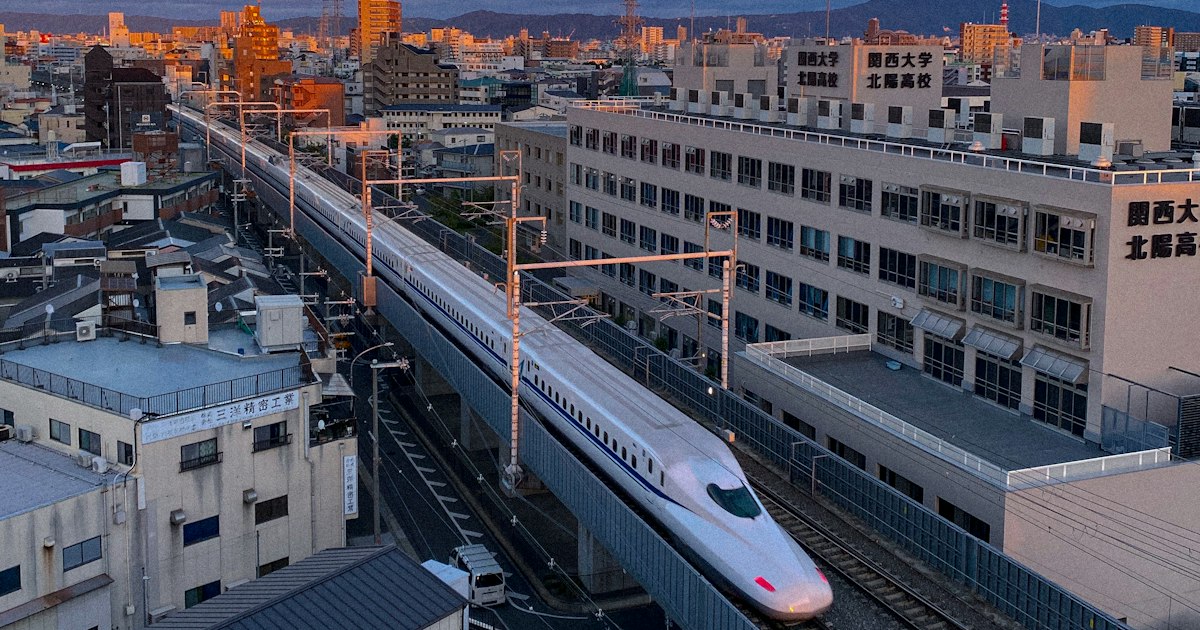
Photo by Jaden William on Unsplash
Most foreign visitors land at Kansai International Airport and never think about Osaka’s monorail at all. But if your itinerary includes a domestic flight through Itami Airport, a stop at the Expo City shopping and entertainment complex, or a side trip to the maple-lined waterfall at Minoh, the Osaka Monorail is the elevated train that ties all three together — and it’s a genuinely scenic, easy way to get between them.
What the Osaka Monorail Actually Is
The Osaka Monorail is a straddle-beam monorail, similar in concept to Tokyo’s Tama Monorail, running on concrete guideways built above the Osaka Chuo Loop and Meishin expressways in northern Osaka. It’s operated by the Osaka Monorail Company and consists of two lines: the Main Line, which runs from Osaka Airport (Itami) Station to Monorail Kadoma-shi Station, and the short Saito Line branch, which splits off at Yamada Station and heads toward Handai-byoin-mae, near Osaka University’s Suita campus. Combined, the network is recognized as the longest monorail system in the world — a fun fact for transit nerds, in the same spirit as the people who detour to ride Nagoya’s Linimo maglev line.
Trains run roughly every 6–12 minutes during the day, thinning out in the evening, with first and last trains generally between about 5:30am and 11:00pm — always worth double-checking on the operator’s timetable before you plan a late return.
From Itami Airport Into Osaka
First, a clarification that trips up a lot of visitors: Itami Airport (officially Osaka International Airport) handles domestic flights only. If you’re flying into Japan from abroad, you almost certainly land at Kansai International Airport (KIX), not Itami. The monorail is useful here mainly if you’re connecting onward from Itami to a domestic destination, or if you’re already in the Kansai region and need to reach the airport or the northern Osaka suburbs. A direct limousine bus links KIX and Itami in roughly 50–65 minutes if you need to move between the two.
Osaka Airport Station is the monorail’s western terminus, a short covered walk from the arrivals areas of both terminals. From there, the single most useful stop for most travelers is Senri-Chuo, about 15 minutes away, where you can transfer to the Osaka Metro Midosuji Line for Umeda, Shinsaibashi, Namba, and Tennoji. Since 2024, Senri-Chuo is also the junction for an extension of the Kita-Osaka Kyuko Railway running north to Minoh-Kayano Station, which has opened up a noticeably more direct rail route toward Minoh than the old transfer pattern (more on that below).
If this is your last ride before a domestic flight out of Itami, it’s also a reasonable moment to deal with any leftover coins rattling around in your bag — see our piece on donating leftover yen at the airport.
Expo City and Expo ’70 Commemoration Park
About 17–20 minutes from Itami, Bampaku-kinen-koen Station puts you right at Expo City, a large shopping and entertainment complex that opened in 2015 on part of the grounds used for Expo ’70. This is worth stating plainly because of a very current source of confusion: Expo City is not the 2025 Osaka-Kansai Expo site. That event was held at Yumeshima, an artificial island reached by a different subway extension entirely, and it has already closed. Expo City, by contrast, is a permanent mall and leisure complex that’s open year-round.
Inside, you’ll find the LaLaport EXPOCITY shopping mall (generally open around 10:00am–9:00pm, with restaurants often open later), NIFREL, an interactive aquarium-meets-museum run by the same operator as Osaka’s Kaiyukan, a Pokémon Center, and the Redhorse Osaka Wheel, a 123-meter Ferris wheel that’s one of the tallest in Japan and makes for good skyline views around sunset. Just across the road, Expo ’70 Commemoration Park itself still has the Tower of the Sun, Taro Okamoto’s striking Expo-era landmark, plus a Japanese garden; the park charges a modest entry fee (in the low hundreds of yen) separate from the mall, and a look inside the tower requires a timed ticket bought in advance.
- Budget: walk the free park grounds, browse LaLaport, skip the paid attractions.
- Mid-range: NIFREL admission (around ¥2,200 for adults) plus lunch at the mall’s food court.
- Splurge: a private gondola on the Osaka Wheel and dinner with a view at LaLaport.
Reaching Minoh and the Waterfall
Minoh, a hillside town known for its 33-meter waterfall and roadside stalls selling momiji tempura (battered, deep-fried maple leaves), isn’t directly on the monorail line, but it’s a workable extension of the same trip. As of the 2024 extension, the quickest route is to ride the monorail to Senri-Chuo, transfer to the Kita-Osaka Kyuko Railway, and ride it to Minoh-Kayano Station. The older, still-valid route is to transfer at Hotarugaike Station (one stop toward Kadoma-shi from the airport) onto the Hankyu Takarazuka Line toward Umeda, then change again at Minoh-guchi onto the short Hankyu Minoh Line, which ends right at the edge of Minoh Park — a few minutes’ walk from the start of the forested trail up to the falls.
From the trailhead, the walk up to the waterfall takes roughly 40–60 minutes each way on a paved, gently sloping path lined with momiji tempura stands, small shrines, and, in autumn, a tunnel of red and orange leaves. Late November is peak season for the colors — if you’re reading this in mid-to-late November, you’re arriving close to the best window of the year. Summer is also pleasant, when the waterfall’s spray cools the trail; midwinter and midsummer midday heat are the least comfortable times to make the hike. Anyone who enjoys pairing a train ride with a nature payoff like this might also like our guide to Mount Rokko and the Rokko Garden Terrace, a similar rail-accessible escape near Kobe.
Fares and Passes
The Osaka Monorail accepts all the major national IC cards — ICOCA, Suica, Pasmo, and the rest — so tapping in and out is the simplest way to pay; fares are calculated by distance. As rough guidance, expect around ¥330–¥400 from Osaka Airport to Senri-Chuo or Bampaku-kinen-koen, and more like ¥600 for the full ride to Kadoma-shi. If you plan to hop on and off a lot in one day, the monorail sells a one-day unlimited pass for its own network, priced around ¥1,000 for adults — worth it if you’re doing Itami, Expo City, and a return trip in the same visit. Note that this pass doesn’t cover the Osaka Metro or Hankyu/Kita-Osaka Kyuko legs toward central Osaka or Minoh, so an IC card is still the easiest way to handle those separately. Fares and pass prices do get revised occasionally, so it’s worth a quick check on the operator’s site before you travel.
Common Mistakes to Avoid
- Mixing up Itami and Kansai International. If your flight itinerary says KIX, you’re not near this monorail at all unless you’re connecting onward domestically.
- Confusing Expo City with the 2025 World Expo site. They’re unrelated locations on different train lines; Expo City is the permanent mall, not the former Yumeshima expo grounds.
- Underestimating the walk to Minoh Falls. It’s not a quick photo stop from the station — budget at least 1.5–2 hours round trip once you factor in the trail.
- Leaving Minoh too late. The Hankyu Minoh Line and connecting services thin out at night, and missing a transfer can leave you waiting a while on a quiet platform.
- Assuming one ticket covers everything. The monorail’s own day pass doesn’t extend to the subway, Hankyu, or Kita-Osaka Kyuko lines you’ll likely transfer onto.
Used as a connector rather than a destination in itself, the Osaka Monorail quietly does a lot of work: airport access, a shortcut to a solid shopping and entertainment stop, and — with the 2024 rail extension — a faster path than before toward one of the Kansai region’s best autumn walks.