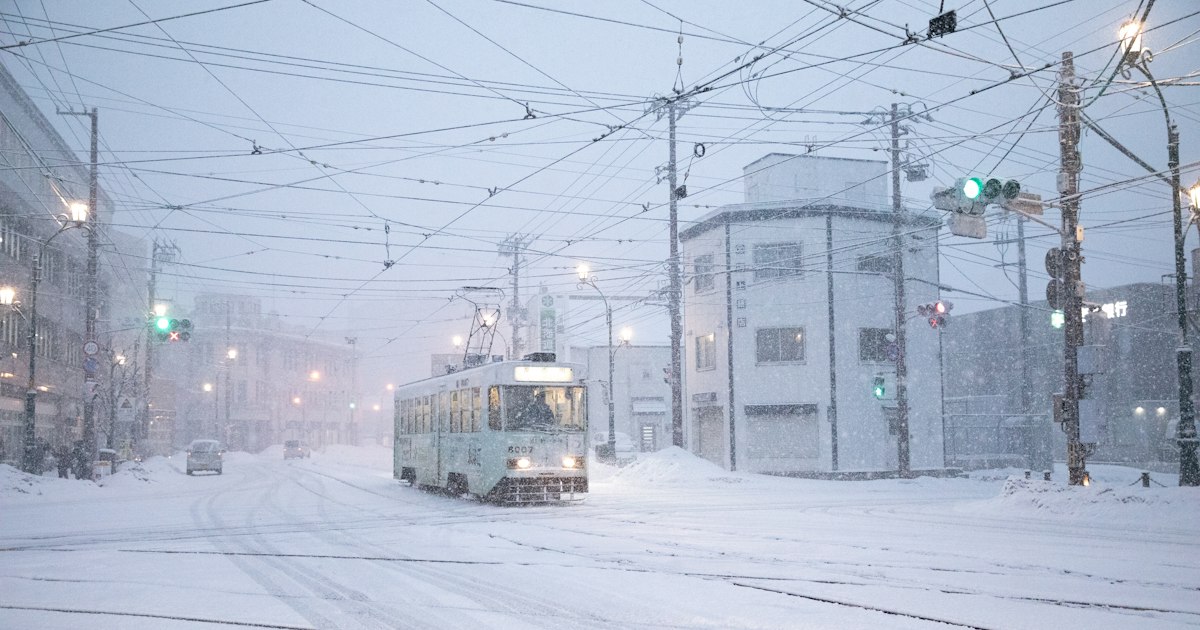
On a short stretch of single track in rural Aomori, a train still runs with a coal-burning potbelly stove bolted to the floor of each carriage. The Tsugaru Railway’s “Stove Train” (ストーブ列車, Stove-ressha) is one of the last regularly scheduled trains in Japan heated this way, and for a few winter months it turns a 20-minute commuter line into one of Tohoku’s most atmospheric rides. Here’s what it actually costs, when to go, and how to get there from Aomori or Hirosaki without wasting a half-day on transfers.
What the Stove Train Actually Is
The Tsugaru Railway is a small private line running 20.7 km between Tsugaru-Goshogawara and Tsugaru-Nakasato stations, through rice-growing flatland that turns into deep snow country every winter. The Stove Train uses older passenger cars fitted with cast-iron coal stoves (daruma stobu) down the center aisle instead of modern electric heating. Staff feed the stoves by hand throughout the run, and the smell of coal smoke and warm metal is as much a part of the experience as the scenery.
The signature ritual is the grilled dried squid: an onboard vendor sells whole surume (dried squid) that you hand to the conductor to toast on top of the stove, then eat with a cup of hot sake or tea bought from the same cart. It’s a simple, slightly touristy routine, but it’s also exactly why people make the trip — there’s nowhere else in Japan where this is a normal part of riding a train to the next town.
How to Get There
The gateway station is Tsugaru-Goshogawara, right next to JR Goshogawara Station in Goshogawara City. From central Aomori, take the JR Ou Line toward Hirosaki and change onto the JR Gono Line bound for Goshogawara; the whole trip runs roughly an hour. From Hirosaki, it’s simpler — a direct Gono Line train to Goshogawara takes about 35–40 minutes. If you’re coming off the Tohoku Shinkansen at Shin-Aomori, connect at Aomori Station for the same Ou Line/Gono Line route.
Once at JR Goshogawara Station, it’s a two-minute walk to the separate Tsugaru-Goshogawara Station building, where you buy your ticket and board. There’s no need to book the whole journey from Tokyo or Sendai in advance — just build in the regional transfer time, since Gono Line services aren’t frequent (often one per hour or less off-peak).
If you’re flying into Aomori Airport on a domestic carrier rather than taking the Shinkansen, check your airline’s carry-on policy before you land — regional flights into Aomori are often operated by budget or regional carriers, and the rules on what gets gate-checked differ from JR etiquette. The breakdown in Oversized Carry-On Enforcement on Japan’s Domestic LCCs is worth a look if you’re packing winter gear in a roller bag.
Tickets and Prices
Riding the Stove Train costs more than a normal Tsugaru Railway fare. You pay the standard distance-based ticket for your journey (a few hundred yen for most of the line, topping out under ¥700 for the full run to Tsugaru-Nakasato), plus a separate Stove Train surcharge ticket of around ¥500 for adults and roughly half that for children, bought at the station window or from staff onboard. The grilled squid and drinks are extra, typically ¥500–1,000 depending on size and what you order. Bring cash — this is a small regional operator, and card payment at the station or onboard is not something to count on.
For a day out, budget roughly ¥2,000–¥3,000 per adult once you include the round-trip fare, surcharge, and a squid-and-sake snack. That’s a modest splurge by Japan rail standards, and the closest thing to a “mid-range” option here — there’s no first-class car or private charter version of this particular train, unlike the chartered onsen-view limited express cars some JR lines offer further south.
Best Time to Ride
The Stove Train runs seasonally, typically from around December 1 through the end of March, with several round trips a day (commonly three) timed around the regular Tsugaru Railway schedule rather than as a dedicated tourist run. January and February are the most reliable months for heavy snow cover on the fields outside the window, which is most of the visual appeal — a December ride can still be relatively bare. Weekday mornings are quieter; weekends and the New Year period bring more domestic tourists and photographers, so cars can fill up.
Schedules shift slightly year to year, so confirm exact departure times on the Tsugaru Railway’s own site or by phone shortly before your trip rather than relying on last season’s timetable.
Common Mistakes to Avoid
- Treating it like a quick photo op. The round trip to Tsugaru-Nakasato and back takes well over an hour including the stop, and the one-way ride alone is about 40 minutes. Rushing back for a tight connection in Aomori or Hirosaki is the most common regret.
- Not bringing cash in small denominations. The onboard vendor and station ticket window deal mostly in coins and small notes for squid, drinks, and surcharge tickets.
- Underestimating the cold outside the train. The stove keeps the car warm, but platforms at Tsugaru-Goshogawara and Tsugaru-Nakasato are open and exposed to lake-effect wind off the Tsugaru Strait. Waterproof boots matter more than extra sweaters.
- Trying to set up a tripod on the platform or inside the car without asking. Space is tight and the train is a working commuter line, not a photo set. If you want serious shots of the stove or the station architecture, it’s worth reading the rules on tripods and camera permits in Japanese stations before you go, since small private railways can have their own informal policies that differ from JR’s.
Making It Part of a Bigger Tohoku Trip
Goshogawara isn’t a destination most visitors build a whole itinerary around, so it works best as a day trip from Aomori or Hirosaki, both of which have enough lodging and food to anchor a two- or three-night stay in the region. If you’re already chasing small regional railways in Japan, the Tsugaru Railway sits in interesting company — it’s a different scale and climate entirely from somewhere like Nishitetsu’s private lines in Fukuoka, but both show how much local character survives on Japan’s non-JR railways once you get off the Shinkansen corridor.
After a cold morning on the stove train, several onsen towns in the wider Tsugaru and Shimokita area are an easy add-on for warming back up properly; if a visible tattoo has made onsen-hunting stressful elsewhere in Japan, it’s worth checking which onsen towns let tattooed travelers soak without a cover-up sticker before you commit to a particular ryokan near Goshogawara or Hirosaki.