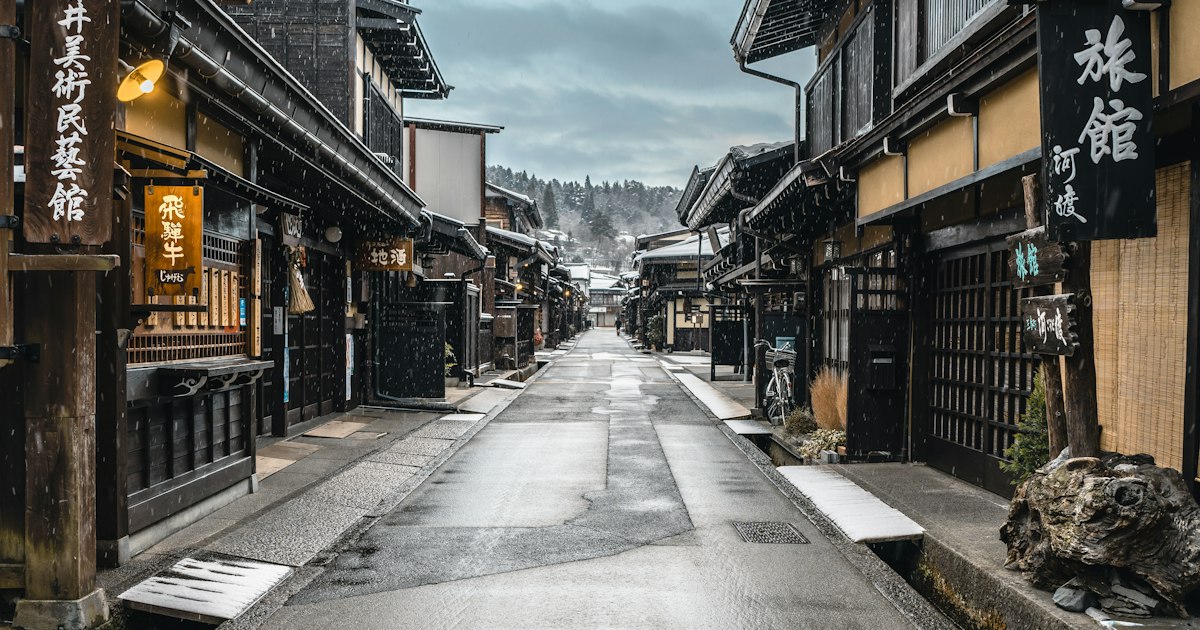
Photo by Rogério Toledo on Unsplash
In the old town of Hida Takayama, tucked between mountain ranges in northern Gifu Prefecture, you’ll spot a small red figure hanging in shop windows, tied to backpacks, and stacked on market tables by the dozen. It has no eyes, no nose, no mouth — just a rounded red body, stubby limbs, and a knotted head. This is the sarubobo, one of Japan’s most charming and least understood good-luck charms. Here’s what it actually means, and where to buy one that’s worth bringing home.
What Is a Sarubobo, and Why No Face?
Sarubobo (さるぼぼ) literally means “baby monkey” in the local Hida dialect. The dolls were traditionally handmade by grandmothers from scraps of old kimono cloth, stuffed with cotton, and given to grandchildren and new mothers as protective charms — for safe childbirth, a good marriage, and general household luck. Red was the original and most common color, chosen because red was believed to ward off illness and misfortune, and because it was historically an expensive, valuable dye.
The absence of a face is deliberate, not unfinished. Without specific features, the doll doesn’t have a fixed expression, so it’s said to take on the mood of its owner and reflect back whatever feeling it’s given — a kind of blank-slate companion rather than a fixed character. Some older explanations also tie it to the idea that a faceless charm can’t “see” misfortune coming toward its owner, so it can absorb bad luck more readily. If you’ve read about omamori, the paper-and-cloth amulets sold at shrines and temples, sarubobo work on a similar principle — a portable object carrying a specific wish — but they’re a folk craft item rather than a blessed religious object, so you won’t find them for sale inside shrine grounds the way you would omamori.
What the Colors Mean
Modern sarubobo makers have expanded well beyond the original red, and each color is now marketed with its own wish, similar to how omamori are color-coded by purpose. The most common pairings you’ll see on shop signage in Takayama:
- Red — the traditional color, for good match-making, marriage, and general good fortune
- Pink — love and romance
- Yellow — money and financial luck
- Blue — success in work or study
- Green — health
- Purple — longevity
- Black — protection from traffic accidents, sometimes sold as a car charm
Don’t take the color chart too seriously as ancient doctrine — it’s a fairly recent tourism-era addition layered onto an older folk object, similar to how omamori shrines expanded from one or two general charms into dozens of specific ones for exams, safe driving, and matchmaking. Buy the color that appeals to you or matches the occasion (pink for a friend’s wedding, yellow for a coworker starting a new job) and don’t worry about getting it “wrong.”
Where to Buy Sarubobo in Takayama
You can find mass-produced sarubobo keychains all over Japan, including in Tokyo souvenir shops, but for the real Hida-made article, buy in Takayama itself.
- Miyagawa Morning Market (Miyagawa Asaichi) — a row of open-air stalls along the Miyagawa River in the old town, open roughly 7:00am–12:00pm from April to October and 8:00am–12:00pm from November to March. Several stalls sell handmade sarubobo alongside pickles, produce, and local crafts. This is a good spot for one-of-a-kind, slightly rougher handmade pieces rather than uniform factory versions.
- Jinya-mae Morning Market — a smaller market directly in front of Takayama Jinya (the old government house), with similar hours and a similar mix of craft stalls.
- Sanmachi Suji old town district — the preserved Edo-period merchant streets a short walk from the station, lined with craft shops, sake breweries, and souvenir stores that stock sarubobo in every size, from tiny phone charms to large plush versions. Shops here generally run 9:00am–5:00pm.
- Shops along Kokubunji-dori, the street connecting JR Takayama Station to the old town, including dedicated sarubobo specialty stores where you can see the full color range and size range side by side.
Because sarubobo were originally handmade at home, quality and stitching vary shop to shop — it’s worth comparing a couple of stalls or stores before buying if you want a tighter weave and cleaner seams rather than the cheapest keychain version.
How Much to Budget
- Budget (roughly ¥500–800): small keychain or strap-sized sarubobo, a few centimeters tall — the easy, pack-light souvenir
- Mid-range (roughly ¥1,000–1,500): standard hanging doll, around 10–15cm, the size most commonly seen displayed in homes and cars
- Splurge (roughly ¥3,000–6,000+): large plush versions, sets in multiple colors, or sarubobo incorporated into other goods like pouches, phone cases, or Hida-Shunkei style lacquerware accents
Prices are generally fixed and non-negotiable at both the morning markets and shops. Cash is still useful at the market stalls, though most old-town shops now take cards.
Best Time to Visit
Takayama is worth visiting for its own sake, not just for sarubobo shopping. Spring (early-mid April) and autumn (early-mid October) bring the Takayama Festival, with enormous, elaborately carved floats paraded through the old town — one of Japan’s most famous festivals and a spectacular time to combine sightseeing with souvenir shopping, though accommodation books up and prices rise well in advance. If you want the morning markets without festival crowds, aim for a weekday in late spring or autumn when the weather is mild and the old town is still walkable without long queues. Winter brings heavy snow and a quieter, more atmospheric old town, but some outdoor stalls scale back.
Getting to Takayama
Takayama sits on the JR Takayama Line. The most common route is the limited express Hida from Nagoya, taking around 2 hours 20 minutes; there’s also a direct line from Toyama (around 1.5 hours), useful if you’re coming from the Hokuriku side after visiting Kanazawa. Highway buses connect Takayama to Tokyo (Shinjuku, around 5.5 hours), Kyoto and Osaka, and Matsumoto (around 2 hours 40 minutes), which is handy if you’re combining Takayama with the Japan Alps or Kamikochi. If you’re using a rail pass that covers reserved seating on limited express trains, it’s worth checking whether an upgraded seat class makes sense for the Nagoya–Takayama leg — see our guide to Green Car and Gran Class seating for how those upgrades work and whether they’re worth it on a given route.
Common Mistakes to Avoid
- Buying from a generic Tokyo souvenir shop and assuming it’s the same thing. You’ll find sarubobo-branded goods nationwide, but the ones actually made in Hida tend to have better stitching and are the more meaningful version to bring home from this specific trip.
- Arriving at the morning markets after noon. Both markets wind down by midday, and stalls pack up promptly — plan sarubobo shopping for the morning, not as an afternoon add-on.
- Overpaying for a “matched set” you don’t need. Multi-color gift boxes are marketed hard to tourists; a single doll in the color that matches your wish is just as authentic and much cheaper.
- Forgetting it’s a folk charm, not a blessed religious item. Unlike omamori, sarubobo aren’t consecrated at a shrine, so there’s no ritual return period or disposal custom to worry about — it’s fine to keep one indefinitely or give it as a casual gift.
If you’re building out a broader Japan souvenir list beyond Takayama, it’s worth browsing regional craft guides like Hakone’s yosegi zaiku mosaic boxes for another distinctive, place-specific buy that travels well and holds up better as a keepsake than generic gift-shop items.