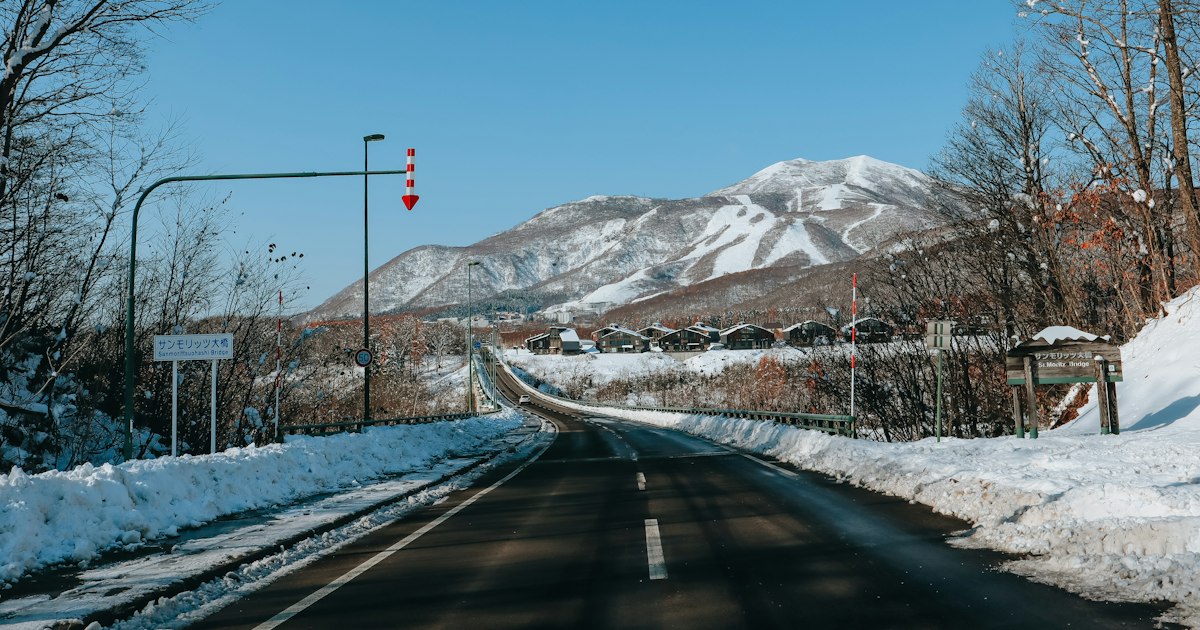
Photo by Asmut Dante on Unsplash
Driving through a snow-banked pass in Hokkaido or threading between the ski towns of Tohoku is one of the best ways to see rural Japan in winter — but it’s a different driving environment than most visitors have faced before. Roads that look clear can be sheeted in invisible ice, rental car counters run on their own winter logic, and a single wrong assumption about tires can leave you stranded. Here’s what actually matters before you turn the key.
Why Hokkaido and Tohoku Winter Driving Is Different
Snowfall here isn’t an occasional dusting — Hokkaido’s interior and Tohoku’s mountain prefectures (Aomori, Akita, Yamagata) regularly see meters of accumulated snow between December and March. Main roads are plowed aggressively and kept open far more often than visitors expect, but side roads, mountain passes, and anything near the coast can close with little notice during a “bakuzatsu” (bomb cyclone) snowstorm or a whiteout ground blizzard (called doh-huri, 地吹雪, locally). Temperatures swing from a sunny -2°C midday to -15°C overnight, which matters more for driving than the snow itself — it’s the freeze-thaw cycle that creates the real hazard.
Studded Tires Are Banned — What Rental Cars Actually Use
This is the single most misunderstood point for foreign drivers: metal-studded tires have been effectively illegal on Japan’s paved roads since 1991, under a law passed to stop the dust pollution they caused in cities. So no rental car in Hokkaido or Tohoku will have actual spiked tires, and you don’t need to search for them. What you’ll get instead are studless winter tires (スタッドレスタイヤ, sutaddoresu) — soft rubber compounds with deep, flexible tread and micro-slits (sipes) that grip ice and compacted snow without studs. They’re genuinely effective, but they are not snow chains and have real limits on glare ice or steep, ungritted grades.
Rental agencies in Hokkaido and snowy Tohoku prefectures fit studless tires as standard on every car from roughly early November through mid-April, usually with no extra fee — but always confirm this at booking if you’re renting outside that window, or if you’re picking up in a milder Tohoku city like Sendai and driving north into snow country, since cars based in non-snow regions may not be swapped over.
Black Ice: The Danger You Won’t See Coming
Locals call it kagamibari (鏡張り) — “mirror glaze” — and it’s the thing that catches visitors out, not falling snow. Black ice forms when melted snow refreezes into a thin, clear layer that looks exactly like wet asphalt. It’s most common in predictable spots: bridges and overpasses (which cool faster than ground-level road), tunnel entrances and exits, shaded curves that never get direct sun, and anywhere near rivers or the coast. The highest-risk hours are early morning and after sunset, and — counterintuitively — the shoulder seasons of late November and March are often more dangerous than deep January, because temperatures hover right around freezing and roads look dry and bare while still carrying a thin ice film.
The only real defenses are behavioral: slow down well before bridges and tunnels, never brake or accelerate hard while turning, double your following distance, and assume any shaded patch after a sunny day is icy even if the rest of the road is wet and grippy.
Renting a Car: Licenses, Costs, and What to Check at the Counter
You’ll need either a Japanese-recognized International Driving Permit (the 1949 Geneva Convention version) or a licence from one of the handful of countries with a bilateral agreement — rules vary enough by nationality that it’s worth checking the specifics before you fly. Our guide to International Driving Permits for Japan breaks down which countries’ licenses actually work and which require a Japanese translation instead.
At the counter, specifically ask for: studless tires confirmed (don’t just assume), a car with a battery-heated windshield washer line (freezes solid otherwise), an ice scraper and snow brush, and — if you’re heading into the mountains of Tohoku or Hokkaido’s interior — a set of tire chains as backup even though you likely won’t use them. Major nationwide chains like Toyota Rent a Car, Nippon Rent-A-Car, and Times Car all operate counters at New Chitose Airport (CTS) and the regional Tohoku airports (Aomori, Akita, Sendai), and winter is peak season, so book at least a few weeks ahead for ski-season weekends.
Common Mistakes Visitors Make
- Driving at summer speeds. Studless tires reduce stopping distance compared to bald summer tires, but they don’t eliminate physics — plan for roughly double your normal braking distance on packed snow and more on ice.
- Letting the fuel tank run low. Keep it at least half full; if you get stuck or stopped in a whiteout, the engine is your only heat source, and rural gas stations can be far apart and occasionally cash-only or closed overnight.
- Ignoring road closure reports. Mountain passes (Hokkaido’s Mt. Usu area, Tohoku’s Hakkoda range) close for hours or days during heavy snow. Check Japan Road Traffic Information Center reports or ask your rental counter before committing to a route.
- Skipping the warm-up. Let the engine and cabin run for a couple of minutes before setting off — it clears window fog and lets the tires reach working temperature.
- Using cruise control on snow or ice. It fights you if the car starts to slide; drive with manual throttle control in any winter condition.
Budget, Mid-Range, and Splurge Rental Options
Budget travelers can get a kei-class compact from a local Hokkaido agency for roughly ¥5,000–8,000 per day in winter — fine for short hops between towns but underpowered for long mountain drives. Mid-range renters typically land ¥8,000–12,000 per day with a major chain for a standard sedan or compact SUV with navigation included, a sensible default for most itineraries. If you want extra peace of mind — more ground clearance, 4WD, and cabin space for luggage and ski gear — a mid-size SUV like a Subaru Forester runs closer to ¥15,000–25,000 per day and is worth it for multi-day trips deep into snow country. If your plans only involve short urban errands in Sapporo or Sendai rather than highway driving, it’s also worth comparing against car-sharing apps like Times Car and Careco, which skip the counter entirely for hourly rentals.
Practical Precautions Before You Set Off
Carry a phone charger, a blanket, and some snacks in the car at all times — not for drama, but because getting stuck waiting for a plow or tow truck in rural Tohoku can take a couple of hours. Japan’s JAF (Japan Automobile Federation) roadside service is reliable and can assist non-members for a fee if your rental doesn’t already include coverage — ask about this at pickup. Keep some cash on hand for rural toll booths, parking, and smaller gas stations that don’t always take foreign cards; our guide to currency exchange in Japan covers where to get yen before you leave the city. Finally, build slack into your itinerary — a direct flight or train connection timed tightly around a winter drive is the easiest way to turn a snow delay into a missed flight.