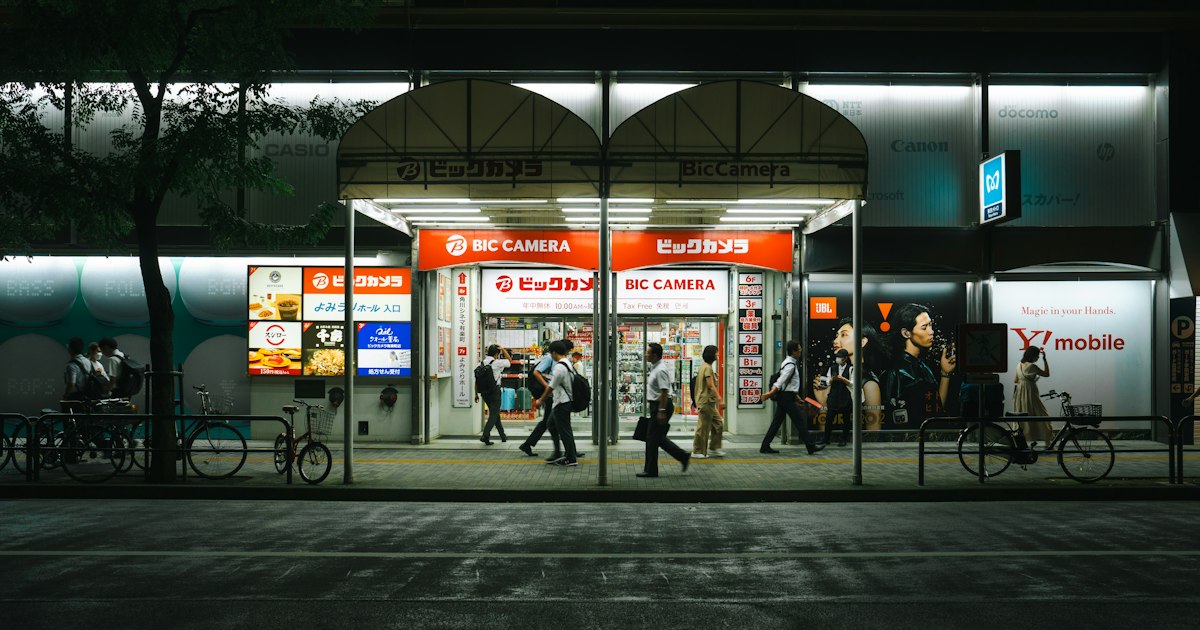
Photo by taro ohtani on Unsplash
If you’re buying a camera, rice cooker, or the latest gaming handheld in Japan, you’ll almost certainly end up choosing between Bic Camera and Yodobashi Camera. Both are nationwide electronics megastores with duty-free counters, English-speaking staff, and towers of merchandise that can overwhelm even confident shoppers. The two chains look similar from the outside, but their points systems and store layouts work differently enough that picking the wrong one — or using it the wrong way — can cost you real money. Here’s what actually matters.
Bic Camera vs Yodobashi Camera: What’s the Difference?
Both chains sell the same core categories: cameras, laptops, phones, home appliances, watches, toys, and increasingly cosmetics and souvenirs on their tax-free floors. The practical differences come down to store footprint and location:
- Yodobashi Camera tends to build a small number of enormous flagship stores — Yodobashi Akiba next to Akihabara Station is the chain’s largest, spanning multiple buildings with electronics, a golf range, and a rooftop baseball field for demos.
- Bic Camera runs more, slightly smaller branches spread across major stations, including a flagship in Yurakucho (walking distance from Ginza and Tokyo Station), a huge Shinjuku location split across east and west exits, and branches in Ikebukuro, Namba, and Umeda.
In practice, both carry near-identical stock from the same Japanese brands (Panasonic, Sony, Zojirushi, Tiger, Nintendo), so for a single-item purchase, proximity to your hotel or train route usually matters more than brand loyalty.
How Tax-Free Shopping Works at Both Chains
Both Bic Camera and Yodobashi have dedicated tax-free counters (look for “Tax-Free” signage, usually on an upper floor). The rules are set by Japanese customs, not the store, so they’re identical at both chains:
- You must be a foreign tourist (short-term visa status) and show your passport at checkout or the tax-free counter.
- Minimum spend is ¥5,000 (before tax) in a single day at a single store to qualify for the 10% consumption tax exemption.
- Electronics, appliances, and general goods no longer need to be sealed in special bags — only consumable items like food, drinks, and cosmetics still get sealed and must leave Japan unopened within 30 days.
- Your passport gets an electronic record attached at purchase; customs may check this on departure, so keep tax-free receipts accessible until you’ve left the country.
Both stores accept major foreign credit cards, Alipay, WeChat Pay, and increasingly cash-free payment for tax-free purchases, so there’s no real advantage either way on the mechanics of tax exemption itself.
Points Cards: Bic Point vs Yodobashi Gold Point
This is where things diverge and where most visitors lose value without realizing it. Both chains run loyalty programs — Bic Point and Yodobashi Gold Point — that return somewhere around 8–10% of your purchase as store credit usable on a future visit to the same chain.
The catch: when you use the tax-free exemption, the points rate on that purchase is typically cut roughly in half (often down to around 5%, though the exact figure varies by product category and is posted at the register). The store effectively can’t give you both the full tax break and the full points rate on the same transaction.
For most tourists this doesn’t matter much, since points only redeem at that same chain’s Japanese stores and expire within a year or two — not very useful if you’re flying home in a week. But it matters if:
- You’re making multiple purchases on the same trip and could redeem points at a second visit before you leave.
- You’re a frequent visitor to Japan who might come back within the points’ validity window.
- You’re buying a big-ticket item (a camera body, a laptop) where even a 3–5 percentage point difference is thousands of yen.
In that case, do the math: sometimes skipping the tax exemption and taking the full points rate is actually worse than taking tax-free and the reduced points, since the 10% tax saving is immediate and guaranteed while points require a return visit. For a one-time tourist purchase, always take the tax exemption.
Both point cards can be issued on the spot to tourists with just a passport — no Japanese address or phone number required — but there’s little reason to sign up unless you’re buying enough to make the points meaningful before you leave.
Flagship Stores and How to Get There
Yodobashi Akiba sits directly connected to Akihabara Station (JR Yamanote/Chuo-Sobu lines, Hibiya and Tsukuba Express lines nearby), making it an easy add-on if you’re already exploring Akihabara’s electronics and anime shops. It’s open roughly 9:30 AM–10:00 PM daily and is large enough to need a floor map — electronics are on lower floors, with restaurants and a sports/outdoor section upstairs.
Bic Camera Yurakucho is a 1–2 minute walk from Yurakucho Station (JR Yamanote/Keihin-Tohoku lines) or Ginza Station, and sits right at the edge of the Ginza shopping district, so it pairs naturally with a day of upscale window shopping. Hours are typically 10:00 AM–9:00 PM. Bic Camera’s Shinjuku East branch (the “Bicqlo” building, which shares space with a Uniqlo) is another strong option if you’re based around Shinjuku.
Both chains also have large branches in Osaka (Yodobashi Umeda near Osaka Station; Bic Camera Namba near Namba Station), so travelers doing a Tokyo–Osaka itinerary don’t need to front-load all their electronics shopping in one city.
Common Mistakes to Avoid
- Not comparing prices between floors. Both stores sometimes have the same item at slightly different prices between a “new release” display and the regular shelf — scan the barcode with a price-comparison app if you’re unsure.
- Forgetting your passport. No passport, no tax exemption — staff cannot apply it retroactively once you’ve left the counter.
- Assuming voltage and plugs match home. Japan runs on 100V, and some appliances (rice cookers, hair tools) are built for Japanese electrical standards only — ask staff for an “overseas use” (kaigai taiô) model if you plan to use it outside Japan.
- Buying the first thing you see. Both chains will often price-match a competitor’s listed price if you ask politely at the register, especially on cameras and laptops — it’s worth a try before you commit.
Which Should You Choose?
For most visitors, the honest answer is: whichever is closer to where you’re already going. If you’re spending a day in Akihabara, Yodobashi Akiba’s scale and the surrounding electronics district make it the obvious stop. If you’re based near Ginza, Tokyo Station, or Shinjuku, Bic Camera’s flagship branches are just as well-stocked and save you a detour. Big spenders on a single large purchase should take the tax exemption every time and treat points as a minor bonus rather than a deciding factor. And if electronics shopping isn’t scratching your itch for only-in-Japan retail, it’s worth pairing your trip with something quirkier — Village Vanguard’s chaotic variety-store shelves or Koenji’s vintage clothing racks make a good contrast to a sterile electronics floor.