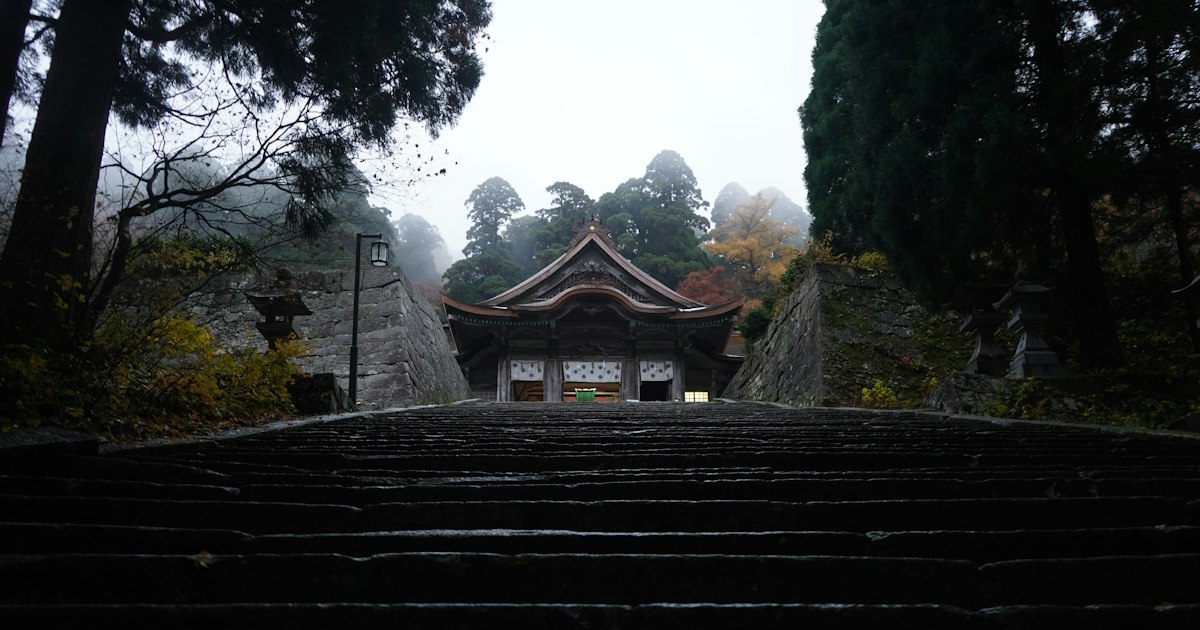
Photo by Yosuke Ota on Unsplash
While Mount Fuji draws crowds thick enough to need a lottery system, Mount Daisen in Tottori Prefecture offers something increasingly rare in Japan: a genuinely quiet sacred mountain you can hike in a single day without reservations, timed-entry tickets, or another hiker in sight for long stretches of trail. Locals in western Japan call it “Hoki Fuji” for its symmetrical cone shape when viewed from the coast, but up close it’s a very different mountain — forested, mossy, dotted with centuries-old temple buildings rather than souvenir stands. Here’s how to actually plan the trip from Yonago, the nearest city with real train access.
A Mountain Worshipped, Not Just Climbed
Daisen has been a site of mountain worship since at least the Nara period, and the religious infrastructure around its base is as much the destination as the summit itself. Daisenji Temple (大山寺), a Tendai-sect complex founded in 718, sits at roughly 520m elevation and is free to walk through, though the small Amida Hall museum charges a modest entry fee (around ¥300). A few minutes further up the stone path is Ogamiyama Shrine’s Okunomiya (大神山神社奥宮), reached via the longest natural stone approach path in Japan — about 700 meters of uneven, centuries-worn rock that’s worth slowing down for even if you’re eager to start climbing. Shugendo ascetic practice has roots here too, which is part of why the mountain still feels more like a pilgrimage route than a tourist trail.
Getting to Mount Daisen from Yonago
Yonago is the practical gateway. JR Yonago Station is served by limited express trains (Super Oki, Super Matsukaze) connecting to Okayama, Tottori, and Izumo, and by Yonago Kitaro Airport with flights to/from Haneda in about 1 hour 20 minutes. If you’re routing through the Shinkansen network first — say, Tokyo to Okayama before transferring to a limited express — it’s worth knowing which Shinkansen seats actually have power outlets, since the Okayama leg alone can run 3+ hours.
From Yonago Station’s bus terminal, Nihon Kotsu buses run to the Daisenji stop, the main trailhead area, in about 50 minutes for a fare of roughly ¥710–760 one way. Service is more frequent on weekends and during the April–November hiking season (sometimes 6–8 runs a day); in winter it thins out considerably, so check the timetable the day before rather than assuming an hourly service. Driving is the other realistic option — about 30–35 minutes from Yonago via local roads — with paid parking lots near Daisenji charging around ¥500 for the day. There’s no train directly to the mountain, so budget the bus or car time into your day regardless.
The Hike: Daisenji to Misen Summit
The standard route is the Natsuyama (summer) Trail, starting near the Daisen Nature Center just past Daisenji Temple at around 520m elevation. It climbs through beech forest marked by the traditional “gome” (合目) station numbers used on Japanese mountains, 1 through 8, with the gradient noticeably steepening in the upper third. Near the top, wooden boardwalks protect the fragile alpine grassland from erosion — don’t step off them even where the view tempts you to.
Here’s the detail many guidebooks gloss over: the true summit, Kengamine (1,729m), has been closed to hikers for years due to a dangerously eroded, knife-edge ridge. Everyone hikes to Misen (弥山), the secondary peak at 1,709m, which is the official end point and still delivers a sweeping view over the Sea of Japan on a clear day. Round trip from Daisenji to Misen and back typically takes 5–6 hours including rest stops — budget closer to 3 hours up and 2 hours down if you’re reasonably fit. There’s no mountain hut selling food on this route, so bring your own lunch and at least 1.5 liters of water; the only facilities are at the trailhead.
Best Time to Go (and When Not To)
The marked hiking season runs roughly late April through early November. Late May to June brings fresh green foliage and fewer bugs than midsummer; July and August are climbable but hot and humid even at altitude, with afternoon thunderstorms a real risk. Autumn colors peak in the beech forest from mid-October into early November — if you’re reading this in November, you’re near the tail end of a good window, but check recent trail reports since the upper sections can see early frost or light snow by mid-month.
Outside the hiking season, Daisen switches identities entirely: its western slopes host ski resorts (Daisen Makiba, Daisen Olympia), making it one of the few ski areas in the Chugoku region. If your trip is winter-focused instead of hiking-focused, the logistics are different enough that shipping skis ahead via takkyubin counters is worth reading before you go. Don’t attempt the Natsuyama Trail itself in winter without serious alpine experience and gear — it’s not maintained or patrolled for snow conditions.
Where to Eat, Stay, and Spend Your Yen
For a budget day trip, pack a convenience-store lunch in Yonago before you head out — there’s nothing to buy on the trail itself. Near Daisenji, a handful of small soba and udon shops serve hikers in the ¥900–1,300 range; they keep irregular hours outside peak season, so treat any posted closing time as approximate.
If you’d rather turn this into an overnight trip, Kaike Onsen on Yonago’s coast is the obvious mid-range to splurge pick — hot spring ryokan with sea views, generally ¥12,000–25,000 per person with dinner included. Because weather can change your hiking plans on short notice, it’s worth understanding what you actually lose cancelling or changing a ryokan booking before you commit to a date. Budget travelers can instead base themselves at a business hotel near Yonago Station for roughly ¥6,000–9,000 a night and bus out to Daisen for the day.
Mistakes First-Time Visitors Make
- Assuming you can summit Kengamine. You can’t — it’s closed. Plan for Misen as the actual destination and you won’t be disappointed on the trail.
- Underestimating the bus schedule. Missing the last bus back from Daisenji in shoulder season can mean a very long wait or an expensive taxi; confirm the return time before you start climbing, not after.
- Skipping the temple complex to “save time for the hike.” Daisenji and Ogamiyama Shrine take under an hour combined and are arguably more historically significant than the summit view — don’t rush past them.
- Wearing sightseeing shoes. The upper trail has loose volcanic rock and wet boardwalks; this is a real hike, not a paved temple approach, and sneakers without grip are a common cause of turned ankles here.
- Not checking fog conditions. Daisen’s summit area is frequently clouded in even when Yonago is clear. If visibility is your goal, check a local weather camera or forecast the morning of, not the night before.
Mount Daisen rewards people willing to do a little more logistics work than a typical Kansai day trip requires — but that’s exactly why it stays peaceful. For most visitors, a single well-timed day from Yonago is enough to see the temple, make the summit, and be back in time for a hot spring soak before dinner.