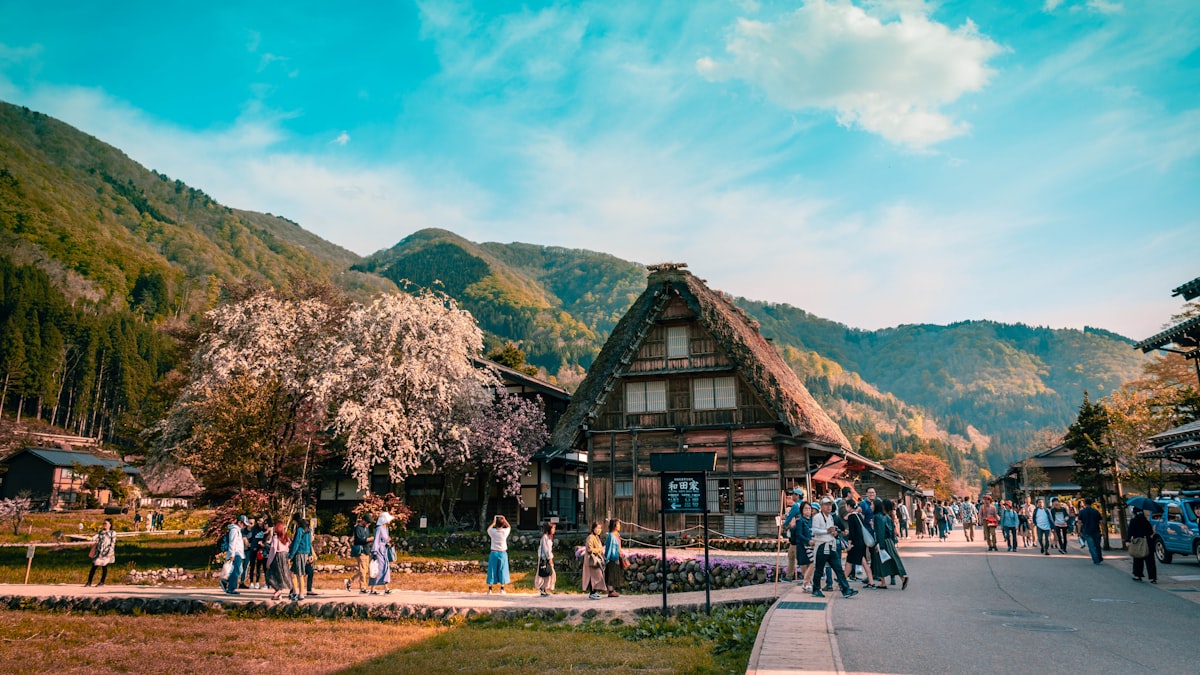
For a taste of old, rural Japan, head into the mountains to Takayama and Shirakawa-go — a historic town and a fairytale village of thatched farmhouses. Here’s how to visit.
Takayama
- Sanmachi old town — beautifully preserved Edo-era streets of sake breweries and craft shops.
- Morning markets along the river — local produce, pickles, and crafts.
- Hida beef — the region’s prized wagyu; try it grilled or as sushi.
- Festivals — the spring and autumn Takayama Matsuri are among Japan’s finest.
Shirakawa-go
- Gassho-zukuri farmhouses — UNESCO-listed houses with steep thatched roofs built to shed heavy snow.
- Shiroyama viewpoint — the postcard panorama over the village.
- Winter light-ups — the snow-covered village glows on select evenings (reservations required).
- Nearby Gokayama is a quieter alternative with similar houses.
Getting there
- Takayama is reached by the scenic limited express from Nagoya (covered by the JR Pass).
- Buses connect Takayama, Shirakawa-go, and Kanazawa — book ahead in peak seasons.
- It fits neatly between Tokyo/Kyoto trips — see our 14-day itinerary.
When to go
Gorgeous year-round: fresh green in summer, autumn leaves in fall, and snow-globe scenery in winter. Summers are cooler than the cities — a nice escape.
Tips
- Stay overnight in a Takayama ryokan or a Shirakawa-go farmhouse minshuku for the full experience.
- It’s rural — carry cash and an eSIM.
- Pair with Kyoto and Kanazawa for a great “old Japan” loop.
What things cost
- Shirakawa-go’s Shiroyama viewpoint is free to reach on foot, or a shuttle bus runs about JPY 200 one-way if you’d rather skip the uphill walk after a day of sightseeing.
- The winter light-up evenings require advance reservation and often a paid parking/shuttle package (roughly JPY 2,000-3,000), since the village strictly limits visitor numbers on those nights to preserve the atmosphere.
- A Hida beef dinner in Takayama runs JPY 3,000-8,000 depending on cut and preparation, with grilled skewers from street stalls offering a cheaper JPY 500-800 taste for those not ready for a full meal.
Common mistakes to avoid
- Treating Shirakawa-go as a quick photo stop — most tour buses give only an hour or two, but the village rewards a longer, unhurried walk through its farmhouse lanes away from the main viewpoint crowd.
- Visiting Takayama’s morning markets in the afternoon — they wind down by early afternoon, so a late start means missing most of the fresh produce and craft stalls.
- Booking a same-day return bus from Shirakawa-go without checking the schedule — rural bus frequency is much lower than city transport, and missing a bus can mean a long wait for the next one.
Staying overnight in a Shirakawa-go farmhouse
A handful of the gassho-zukuri houses operate as minshuku guesthouses, letting you sleep inside one of the actual UNESCO-listed structures — a genuinely rare experience booked well in advance, since only a limited number of rooms exist across the whole village.
Combining with Kanazawa or Kyoto
Direct buses connect Takayama and Shirakawa-go to Kanazawa, making a natural “old Japan” triangle route that avoids doubling back through Tokyo or Nagoya — a popular structure for 10-14 day itineraries that want depth in rural, historic Japan alongside the bigger cities.