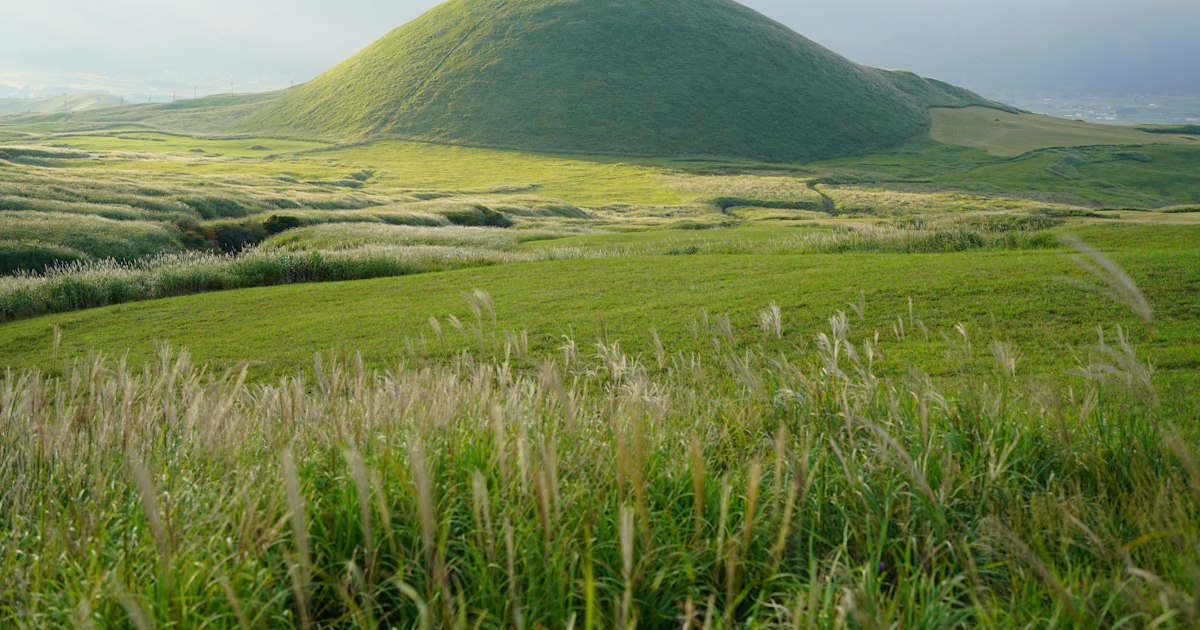
Photo by Jong Hyuk Lee on Unsplash
Mount Aso is one of the few places in Japan where you can drive, bus, or walk into the middle of an active volcano’s caldera and still find grazing horses, a working visitor center, and a pond ringed by grass. It sits in the middle of Kyushu, roughly between Kumamoto and Oita, inside one of the largest calderas on Earth — about 25 km across — and the Kusasenri grasslands occupy a flat stretch of that caldera floor, right below the smoking Nakadake crater itself. It’s an easy day trip if you’re already in Kumamoto, and a worthwhile reason to rent a car and spend a night in the area if you’re not.
Why Mount Aso Is Worth the Detour
Most visitors to Kyushu stick to Fukuoka, Nagasaki, and Kumamoto Castle, which means Aso stays relatively uncrowded compared to Mt. Fuji or the Hakone volcanic area near Tokyo. What makes it distinctive is scale: you’re not looking at a single peak but standing inside a caldera large enough to contain towns, farmland, train lines, and a national highway. Nakadake is one of the most active volcanoes in Japan and still periodically closed to visitors, which is part of the appeal — this is a live geological feature, not a dormant postcard. Kusasenri, the grassy plain at its base, is the easiest and safest way to experience that landscape even on days when the crater itself is off-limits.
Getting There
The gateway city is Kumamoto. From Kumamoto Station, the JR Hohi Line runs to Aso Station in roughly 1 hour 10–40 minutes depending on the train (around 1,500–2,000 yen one-way); service is limited to roughly one train every 1–2 hours, so check the timetable before you go. From Aso Station, Sanko Bus runs a seasonal “Aso Volcano Line” shuttle up to Kusasenri and the crater area (roughly 30–40 minutes, around 600–700 yen one-way) — but this bus doesn’t run every day in winter, so confirm the current schedule locally or at the station.
A direct highway bus also runs from Kumamoto Station and Kumamoto Airport to Aso, which is often simpler than the train-plus-local-bus combination. If you’re coming from Fukuoka, there’s no fast direct public transport option — most visitors either transfer through Kumamoto or drive.
Honestly, a rental car is the most practical way to see Aso properly, since the grasslands, crater area, and surrounding viewpoints are spread across the caldera with infrequent public transport between them. It’s about a 1.5–2 hour drive from Kumamoto city, largely on the scenic “Milk Road” through dairy pastureland. Driving also lets you stop at Daikanbo, a viewpoint on the caldera’s northern rim with a sweeping panorama back across the whole crater floor — arguably a better single photo than anything at Kusasenri itself.
Kusasenri Grasslands: What to See and Do
Kusasenri is a broad, grass-covered basin with a shallow pond (Kusasenri-ga-hama) at its center, framed by Mount Eboshi on one side. There’s a paved walking loop around the pond that takes about 20–40 minutes depending on how often you stop for photos, and it’s flat and easy — suitable for most fitness levels and for kids. Horses are grazed here by local operators, and short guided horse rides are sometimes available for a few thousand yen, mostly in warmer months.
Next to the grassland is the Aso Volcano Museum, which is worth the stop even if the crater is closed that day — it has live-feed cameras pointed into Nakadake plus exhibits on the region’s volcanic history. Admission is roughly 1,200 yen for adults, and it’s open daily, typically 9:00–17:00 (last entry around 16:30). A free public visitor center nearby also has basic information and restrooms.
A short drive or detour from Kusasenri brings you to Komezuka, a small, strikingly symmetrical cinder cone that looks almost artificial — a good 10-minute photo stop if you have a car.
The Nakadake Crater: When You Can (and Can’t) Get Close
This is the part of the trip you cannot fully plan in advance. Nakadake’s active crater is monitored by the Japan Meteorological Agency, and access to the crater rim is restricted whenever the volcanic alert level rises — sometimes for days, sometimes for months at a stretch. When access is open, a shuttle bus runs from a staging area up to the crater rim parking area (the old ropeway was destroyed in the 2016 Kumamoto earthquake and never rebuilt), with a round-trip fare in the ballpark of 1,000–1,200 yen. Even when the crater is accessible, rangers can close it on short notice if gas levels spike, so build flexibility into your schedule rather than treating the crater viewing as guaranteed.
If you’re set on seeing the crater specifically, check the current access status the morning of your visit — local tourist information centers and the Aso Volcano Museum staff keep up-to-date status information, more reliably than most English-language sites. Kusasenri, by contrast, is almost always open regardless of the crater’s status, which is why it’s the more dependable half of this day trip.
Best Time to Visit
Spring (April–May) brings fresh green growth to the grasslands and comfortable hiking weather. Late autumn (late October–November) turns the grass silver-gold and is arguably the most photogenic season, with the Kyushu volcanic plains at their most dramatic. Summer is green and lush but can be hazy, and visibility into the caldera is sometimes poor on humid afternoons — aim for a morning visit. Winter brings a real chance of snow dusting the grasslands and crater rim, which is beautiful but also when road and bus closures are most likely, including possible snow chains requirements if you’re self-driving. Many travelers planning a Kyushu itinerary build Aso in around the same window as other regional stops — if you’re mapping dates around Japanese holidays, it’s worth checking which dates to avoid or plan around in 2026, since Golden Week and other holiday periods can make the limited local buses and rental cars harder to book.
Common Mistakes to Avoid
- Assuming the crater will be open. Many visitors build their whole day around seeing Nakadake up close and are disappointed when it’s closed for gas activity. Treat Kusasenri as the main event and the crater as a bonus.
- Underestimating the bus schedule gaps. The Aso Volcano Line bus doesn’t run constantly, and missing the last one back to Aso Station can strand you. Check return times before you set out, especially outside peak season.
- Not bringing warm layers. Even in summer, the caldera floor and crater rim sit at elevation and can be significantly colder and windier than Kumamoto city.
- Skipping Daikanbo. If you have a car, this viewpoint gives you the “whole caldera” perspective that you can’t get from inside it at Kusasenri — don’t treat it as optional.
Where to Eat and Stay Nearby
For budget options, the Aso Station area has simple soba and curry shops in the 700–1,000 yen range, plus convenience stores for picnic supplies to eat by the Kusasenri pond. Mid-range travelers should try the local specialty, Akaushi (Aso red beef) — restaurants around Aso town serve grilled or hot-pot versions typically running 2,500–4,000 yen per person. The region is dairy country, too, so fresh milk, soft-serve, and cheese from roadside farm stands along the Milk Road are worth the stop. If you’re managing dietary restrictions while trying regional dishes, it’s worth carrying a translated food allergy card, since rural restaurants around Aso are less likely to have English-speaking staff than places in Kumamoto city.
For a splurge, consider staying a night at one of the onsen ryokan in the Aso or nearby Kurokawa Onsen area rather than doing this purely as a Kumamoto day trip — soaking in a hot spring after a day on volcanic ground is about as thematically appropriate as travel gets. If you’re building out a broader Kyushu itinerary with Aso as one stop among several, the island also rewards detours to lesser-visited spots like the Goto Islands off Nagasaki, which pair well with a Kumamoto–Nagasaki loop.