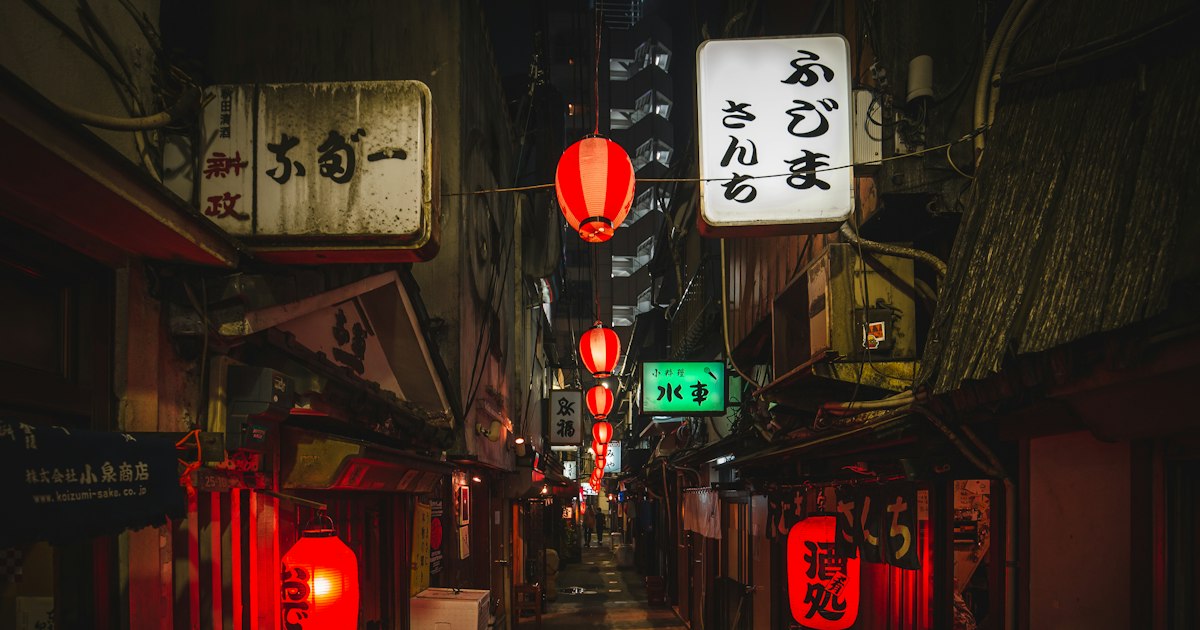
Photo by Denys Nevozhai on Unsplash
Walk five minutes from the polished department stores of Ginza and you’ll hit a wall of charcoal smoke, hanging red lanterns, and the rattle of trains passing directly overhead. This is Yurakucho’s gado-shita — literally “under the girder” — a string of yakitori counters, standing bars, and tiny izakaya built into the brick and steel arches that support the elevated railway between Yurakucho and Shimbashi stations. It’s one of the last unpolished pockets left this close to Ginza, and it’s still where plenty of Tokyo office workers go to unwind after work. Here’s how to actually use it as a visitor, not just photograph it.
What Gado-Shita Actually Is
The tracks overhead carry the JR Yamanote Line, the Keihin-Tohoku Line, and Shinkansen traffic in and out of Tokyo Station, and the brick arches beneath them have been rented out as cheap commercial space since the postwar years. Rather than tear it down for redevelopment, the area between Yurakucho and Shimbashi kept its string of yakitori stalls, oden counters, and standing bars, so the atmosphere is older and grittier than almost anywhere else within walking distance of Ginza’s luxury boutiques. If you’ve ridden the loop line and watched the scenery blur past this stretch, you’ve actually looked down on the roofs of these izakaya — it’s worth reading our Yamanote Line guide to see how Yurakucho fits into the rest of the loop if you’re combining this with other stops that day.
A notable feature unique to this stretch is a cluster of stalls that specialize in food and drink shipped directly from a single prefecture — a shop pouring only Kagoshima shochu alongside Kagoshima-raised pork, another built around Hokkaido seafood. You won’t find that regional focus in Shinjuku’s better-known Omoide Yokocho, which makes Yurakucho worth the detour even if you’ve already done the “alley yakitori” experience elsewhere.
Getting There
Yurakucho Station (JR Yamanote/Keihin-Tohoku lines, and the Tokyo Metro Yurakucho and Hibiya lines) is the obvious landmark — take the Hibiya exit or Ginza exit and you’re already standing at the northern edge of the gado-shita strip. The stalls run roughly south along the tracks toward Shimbashi Station, so if you end up near Shimbashi instead, just walk north under the rail line and you’ll run into the same area. The whole stretch covers maybe 10–15 minutes of walking if you go end to end. Because these places are tucked into numbered arches rather than conventional street-facing buildings, exact addresses can be close to useless for navigation — if you’re trying to meet someone at a specific spot, our guide to how Japanese addresses work explains why, and it’s usually faster to just use a landmark or a map pin shared by the restaurant instead.
How It Works: Seating, Ordering, Prices
Most spots are tiny — a counter with 8-15 stools, or standing-only (tachinomi) bars with barely enough room to turn around. Expect to share close quarters with strangers; that’s part of the appeal. Menus are frequently Japanese-only and often just a handwritten board, but most places have a plastic or laminated photo menu you can point at, and skewers are usually displayed in a glass case at the counter so you can just gesture at what looks good.
Rough pricing to budget by:
- Yakitori skewers: ¥150–¥400 each, depending on the cut (regular chicken parts are cheaper; tsukune, chicken liver, and pork belly run higher)
- Draft beer (nama biru): ¥500–¥700 for a standard glass
- Highball or shochu-based drinks: ¥400–¥600
- A seat charge (otoshi/table charge) of a few hundred yen is common at sit-down counters, less so at standing bars
- A full dinner with 5-6 skewers and 2-3 drinks per person typically lands around ¥3,000–¥4,500
Cash is still king at the oldest, smallest stalls, though more places now take IC cards (Suica/Pasmo) or credit cards — don’t assume either way, and carry some cash as backup.
What to Eat and Drink
Yakitori is the backbone — order a mix of momo (thigh), negima (thigh and leek), tsukune (chicken meatball), and if you’re feeling adventurous, kawa (crispy grilled skin) or reba (liver). Many counters also do motsuyaki (grilled offal), oden in the colder months, and simple sides like edamame or hiyayakko (cold tofu). If you don’t want beer, a highball is the default order here — it’s the drink most associated with this style of postwar Tokyo bar. For something non-alcoholic, plain oolong tea is the standard fallback at most counters rather than mugicha, though it doesn’t hurt to ask. If you’re drinking late and want something to settle your stomach before heading home, keep an eye out for ochazuke on the menu — a number of izakaya in Tokyo serve it specifically as a last dish to end a night of drinking, and our ochazuke guide explains how to order it if you’ve never seen it on a menu before.
Best Time to Go
The area is at its liveliest on weekday evenings from about 6pm to 9pm, when salarymen pour in straight from the office — that’s also when it’s hardest to get a seat without waiting. If you want the atmosphere and smoke without the crush, show up right at opening (many stalls start around 5pm, with a handful also open for lunch from 11:30am) or go on a weeknight rather than Friday. Winter is genuinely a good season for this: the cold makes the charcoal smoke, steam from oden pots, and huddled-together seating feel more atmospheric, and hot sake or oden are at their best. Summer evenings are still fine, just hotter and more humid standing that close to open grills.
Budget, Mid-Range, and Splurge
On a tight budget, stick to a standing bar (tachinomi) and order a few skewers with one drink — you can eat and drink for around ¥1,500–¥2,000 and move on. For a standard night out, settle into a counter seat at one of the yakitori specialists and expect ¥3,500–¥5,000 per person with a proper spread of skewers and a few rounds of drinks. For a splurge, some of the sit-down izakaya further from the main foot traffic serve higher-grade brand-name chicken (jidori) or premium seafood from their regional-specialty stalls, where a meal can run ¥6,000–¥8,000 per person with good sake or shochu pairings — still modest by Ginza standards, but noticeably more refined than the stand-up stalls.
Common Mistakes to Avoid
- Showing up at 7pm on a Friday expecting a seat immediately — this is peak time for a reason; go earlier or pick a quieter weeknight.
- Assuming every stall takes cards — bring cash as a backup, especially for the smallest standing bars.
- Treating the otoshi (seat charge) as optional — it’s a standard part of the bill at sit-down counters, not an add-on you can decline.
- Wearing clothes you care about — charcoal smoke clings, and seating is tight enough that spills happen.
- Expecting English menus everywhere — a few larger places cater to tourists, but most of the charm here comes from the fact that they haven’t changed their format for decades. Pointing at the display case works fine.
Gado-shita isn’t a polished attraction — it’s a working-class drinking strip that happens to sit a few minutes from some of the most expensive real estate in Tokyo, and that contrast is exactly why it’s worth an evening of your trip.