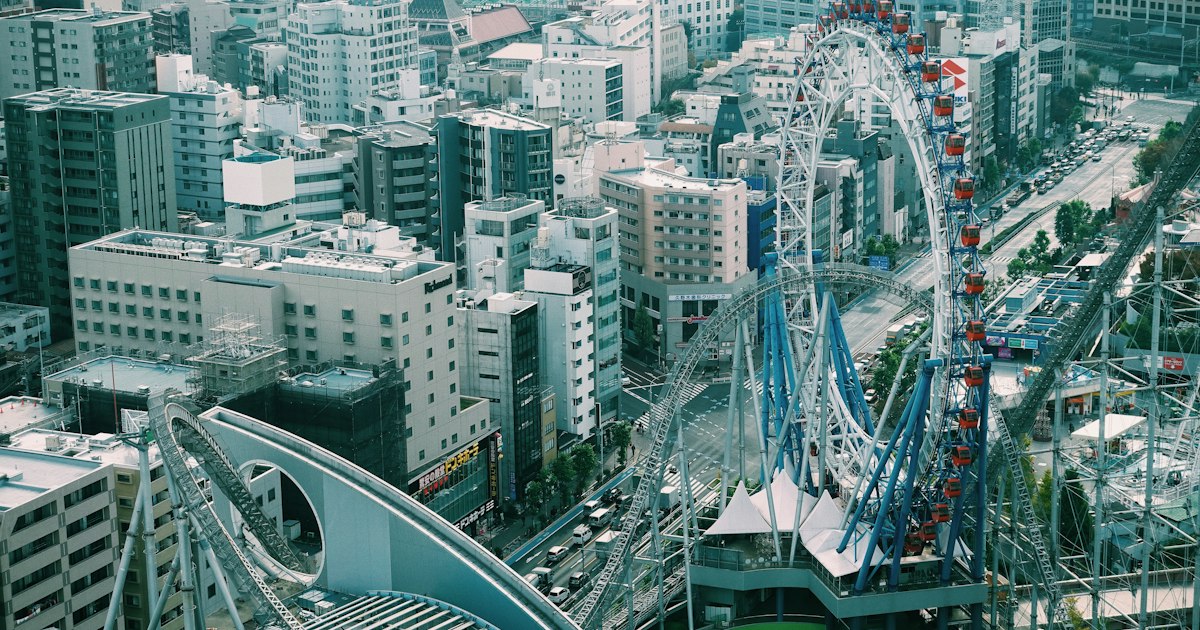
Photo by Nakaharu Line on Unsplash
Most amusement parks make you buy your way through a gate before you’ve ridden anything. Tokyo Dome City does the opposite: you can wander in for free, watch a roller coaster thread itself through the spokes of a wheel with no center axle, grab dinner, and only pay for the rides you actually want to go on. Tucked into Bunkyo Ward next to the stadium where the Yomiuri Giants play, it’s one of the few amusement parks in the world you can reach by subway in fifteen minutes from a major city center — no day trip required.
What Tokyo Dome City Actually Is
Tokyo Dome City is a entertainment complex built around Tokyo Dome, the roofed baseball stadium that gives the area its name. The amusement park section — officially Tokyo Dome City Attractions — sits on the site of the old Korakuen Yuenchi, which was redeveloped and rebranded in 2003. Unlike Tokyo Disneyland or Fuji-Q Highland, there’s no perimeter fence and no general admission ticket. The park is an open urban space threaded between shops, restaurants, a spa, and the stadium itself, so you can walk straight in, look around, and decide which rides are worth your money before committing to anything.
The complex’s signature structure is the Big O, a Ferris wheel with no central hub — the whole ring is supported from the outside, which was a genuine engineering first when it opened. Thunder Dolphin, the park’s main roller coaster, is built to loop directly through the open center of that wheel, which is the photo everyone comes home with.
The Rides: From Family-Friendly to Genuinely Scary
Thunder Dolphin is the headline attraction — a steel coaster with a steep first drop and a layout that weaves between and through the surrounding buildings and the Big O’s frame. It’s intense enough that height and health restrictions apply, so it’s not for younger kids or anyone with back or heart issues. Alongside it, the park runs a mix of calmer attractions: the Big O wheel itself (a good option if coasters aren’t your thing but you still want the view over Bunkyo Ward), a smaller family coaster, spinning and swinging rides, and attractions aimed squarely at younger children. It’s a compact lineup compared to a full-day theme park like Universal Studios Japan, which makes it realistic to see and ride everything in a half-day visit.
How the Pricing Works
Because there’s no entry fee, you pay per ride using either individual tickets or a reloadable value, and there’s typically also an unlimited-ride pass for the day if you plan to ride more than four or five times. Individual ride tickets generally fall in the roughly ¥500–¥1,000 range, with Thunder Dolphin at the higher end; an all-day unlimited pass has historically run in the neighborhood of ¥4,000–¥4,500 for adults, with cheaper rates for children. These numbers shift with seasonal promotions and occasional price revisions, so treat them as a planning estimate and check the official Tokyo Dome City Attractions site for the current ticket chart before you go — it’s the one part of this trip worth double-checking the week of your visit.
Budget approach: pick two or three rides you actually want and pay individually rather than buying the all-day pass. Mid-range: the unlimited pass pays for itself once you’ve ridden four or five times, which is realistic if you’re there with kids who want to repeat favorites. Splurge: combine your visit with Spa LaQua (see below) for a full day that mixes adrenaline and recovery.
Getting There
This is the park’s biggest practical advantage over Japan’s other big theme parks: it sits inside the city, not an hour outside it. Three stations put you within a few minutes’ walk of the entrance — Suidobashi Station on the JR Chuo-Sobu Line or the Toei Mita Line, Korakuen Station on the Tokyo Metro Marunouchi or Namboku Lines, and Kasuga Station on the Toei Mita or Oedo Lines. If you’re coming from central Tokyo, there’s a good chance you won’t need to transfer more than once. For getting between your hotel and the station, or hopping to a nearby neighborhood afterward, Tokyo’s shared e-scooters are a genuinely useful option for visitors — see LUUP: How Tourists Can Legally Ride Japan’s Shared E-Scooters for how to register and ride legally.
Best Time to Visit
Tokyo Dome City Attractions typically opens around 10:00 AM and closes somewhere between 6:00 PM and 9:00 PM depending on the day and season, with extended hours in summer and shorter ones in winter — always check the calendar on the official site before you plan your day, since hours can change week to week. Weekday mornings are noticeably quieter than weekends, and the park gets busy fast on days when there’s a baseball game or concert at Tokyo Dome itself, since the stadium crowd spills straight into the attractions area. If you want short lines on Thunder Dolphin, aim for a weekday right at opening. Spring and autumn are the most comfortable seasons weather-wise for an outdoor park with no real shade; summer visits are doable but hot, and a surprising number of the rides are outdoors with full sun exposure.
Beyond the Rides
Tokyo Dome City is bigger than just the amusement park. Spa LaQua is a proper hot-spring-style spa and sauna facility within the complex, and it’s a legitimately good way to spend an evening after a day of rides — most visitors treat it as a separate half-day rather than tacking it onto the same visit. The complex also has a shopping mall with casual dining, and if you’re hungry before or after the rides, the Suidobashi side of the station area has no shortage of ramen shops; tsukemen, Tokyo’s dipping-noodle variation, is especially popular in this part of the city if you want something more substantial than a quick snack — see Tsukemen: Japan’s Dipping Ramen and Where to Try It for how to order it properly. If you end up picking up snacks or small gifts in the shopping arcade, it’s worth knowing what you’re allowed to bring home duty-free before you buy in bulk — see Japan’s Duty-Free Allowance Coming Home.
Right next door is Koishikawa Korakuen, a genuine Edo-period strolling garden (not to be confused with the amusement park’s old Korakuen Yuenchi name) — it’s a quiet counterpoint if you want to pair thrill rides with something more traditional on the same day.
Common Mistakes to Avoid
- Assuming it’s a full-fence theme park. There’s no single ticket gate — budget your money ride by ride or you’ll either overspend on an all-day pass you don’t need, or underspend and waste time buying tickets one at a time at the booth.
- Visiting on a game day without checking the schedule. If the Giants are playing, expect heavier crowds throughout the complex, not just near the stadium.
- Skipping the height/health check for Thunder Dolphin. Restrictions are posted at the ride and enforced — don’t assume you’ll be let on.
- Not checking the day’s closing time. Hours vary enough by season and weekday that showing up late afternoon can mean missing rides you planned around.
- Forgetting cash or IC card options. Ticket and pass purchasing has shifted toward electronic payment and reloadable cards in recent years; it’s worth having your transit IC card charged up before you arrive.
Tokyo Dome City won’t out-thrill a full-day park like Fuji-Q Highland, and it won’t out-charm Disneyland’s theming. What it does uniquely well is let you squeeze a genuine amusement park, a roller coaster through a Ferris wheel, and a spa into an afternoon without leaving the city — which makes it one of the easiest “extra half-day” additions to a Tokyo itinerary that’s already packed with temples, shopping, and food.