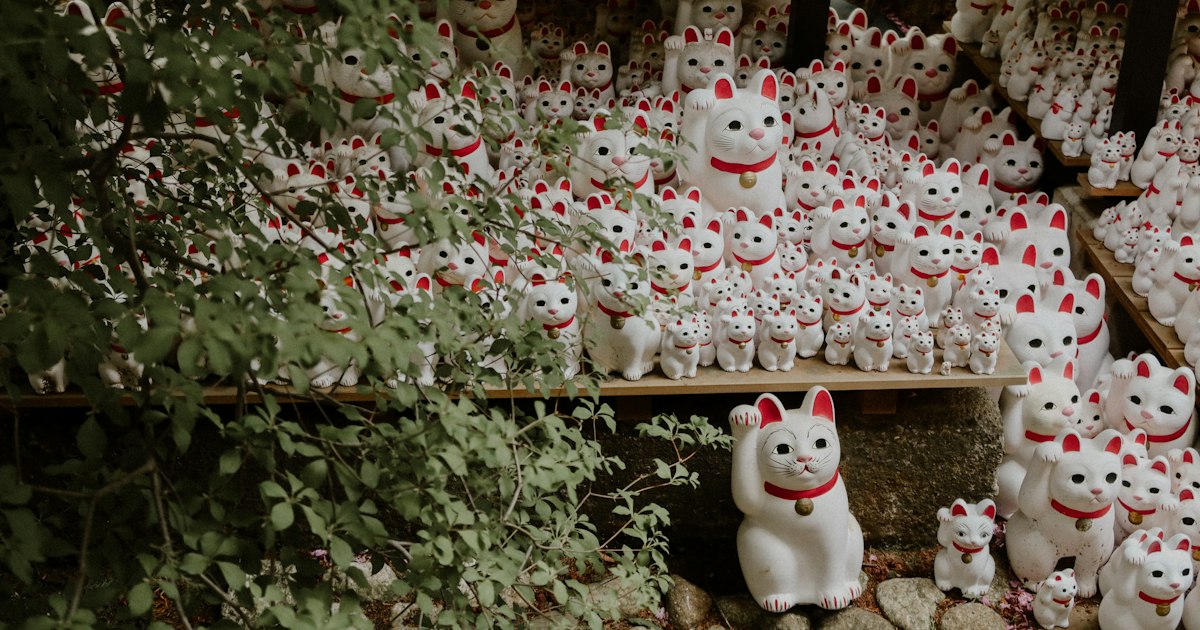
Photo by Elise Heikamp on Unsplash
Tucked into a quiet residential pocket of Setagaya, Gotokuji Temple doesn’t look like much from the street — just another Soto Zen temple with a cemetery and a pagoda. Then you round a corner and find thousands of small white ceramic cats staring back at you, paws raised in a permanent beckoning wave. This is where the maneki-neko, Japan’s famous “lucky cat” figurine, is said to have originated, and it’s one of the few places in Tokyo where a genuinely odd, photogenic sight costs nothing to see and sits almost entirely off the main tourist track.
The Legend Behind Tokyo’s Luckiest Cats
The story goes that in the 17th century, a feudal lord named Ii Naotaka was riding past Gotokuji during a thunderstorm when he saw a temple cat raising its paw as if beckoning him inside. He followed it in, took shelter, and narrowly avoided being struck by lightning (or, in some versions, simply received a cup of tea and a dharma talk that moved him). Grateful, he became a patron of the temple, and the Ii family’s fortunes — and the temple’s — grew. When the cat eventually died, the monks enshrined it, and the beckoning-cat motif became the temple’s symbol.
Worth knowing before you go: Imado Shrine in Asakusa also claims to be the maneki-neko’s birthplace, and you’ll find this argument repeated on both sides with total confidence. There’s no definitive answer, so don’t be thrown off if you see competing claims — Gotokuji is the one most historians and most of the cat-statue tourism actually centers on.
What You’ll Actually See at Gotokuji
The cat field sits beside the temple’s three-story pagoda (built in 2006, with small carved cats worked into its details), and it’s exactly as described: tiered wooden shelves packed with maneki-neko figurines of every size, from palm-sized to nearly a foot tall, all facing roughly the same direction, all with one paw raised. Visitors buy a cat from the temple’s small shop, write a wish on it (or just hold it in mind), and either take it home or leave it on the shelves as an offering — which is why the collection keeps growing year over year rather than shrinking.
The rest of the grounds are genuinely peaceful: a working cemetery, mature trees, and the graves of the Ii family, including Ii Naosuke, the Edo-period statesman assassinated in 1860 in the famous Sakuradamon Incident. It’s a real historical site, not a theme park, and the contrast between the solemn cemetery and the cheerful wall of cats is part of what makes the place memorable.
Getting There
Gotokuji is in Setagaya Ward, and there are two reasonable approaches:
- Odakyu Line to Gotokuji Station — about 15 minutes from Shinjuku on a local train, then a 5–10 minute walk to the temple.
- Tokyu Setagaya Line to Miyanosaka Station — this quaint, two-car local tram line connects from Sangenjaya (itself reachable via the Denentoshi Line from Shibuya), and Miyanosaka is only about a 5-minute walk from the temple gate, making it the closer option if you’re coming from that side of the city.
Entry to the temple grounds is free, and there’s no gate or ticket booth — it functions like most neighborhood temples in Japan, open to the public roughly from early morning to early evening (a commonly cited window is around 6:00am–6:00pm, though this isn’t rigidly enforced the way a museum’s hours would be). There’s no admission fee, no English signage push, and no crowds funneling you through — bring cash for the cat shop since it’s a small operation.
Best Time to Visit
Weekday mornings are the sweet spot if you want photos of the cat shelves without other visitors in frame — this has become a popular stop for both tourists and Japanese visitors doing a “lucky spot” tour of Tokyo, and weekend afternoons can get surprisingly busy for such a small site. Spring brings cherry blossoms to the grounds, which pair nicely with the pagoda in photos, but the cats themselves are a year-round draw with no real seasonal advantage either way. Avoid treating this as a long stop — most visitors spend 20–40 minutes here, which makes it easy to combine with other low-key Tokyo neighborhoods for a half-day loop, similar in pace to a visit to Monzen-Nakacho on the other side of the city.
Buying Your Own Maneki-neko (and Common Mistakes)
The temple shop sells plain white ceramic cats in a few sizes, generally running from around ¥300 for the smallest to a few thousand yen for larger figures — simple, unglazed, and deliberately uniform rather than the colorful painted versions sold as souvenirs elsewhere in Japan. A goshuin (temple stamp) booklet entry, if you collect them, typically costs around ¥300.
- Budget: A small cat (¥300–500) plus free entry is the whole trip.
- Mid-range: A medium figurine (¥1,000–3,000) to display at home, often bought alongside a goshuin stamp.
- Splurge: Larger statues or a full set in different sizes, running ¥5,000 and up.
The most common mistake is expecting a shopping street or souvenir market — there isn’t one. This is a quiet, working temple with a cemetery, so keep voices down near the graves and don’t treat the whole site as a photo backdrop. The second common mistake is confusing Gotokuji with Imado Shrine and being surprised the “famous lucky cat street” of Asakusa isn’t here; Gotokuji is residential and understated by design. If you want colorful, painted maneki-neko as gifts rather than the plain temple-style ones, those are easier to find at shops near Asakusa or in general souvenir stores, and if you’re shopping for Japanese cat goods after you’re home, secondhand and specialty maneki-neko figures also turn up regularly on sites covered in guides like buying on Mercari Japan from abroad.
Making the Most of the Visit
Because the cat shelves are visually striking but the surrounding temple is hushed, this is a good spot to slow down rather than rush through for a single shot. If you’re someone who likes a physical keepsake beyond the figurine itself, this is also a natural place to use an instant camera — the dense rows of identical cats make for one of the more satisfying instant-print compositions in Tokyo, and if you need film or a camera before you go, it’s worth checking a guide to Instax Cheki culture and where to buy film. There’s no café or rest area on-site, so plan your coffee stop in Gotokuji or Sangenjaya before or after.
Gotokuji rewards visitors who treat it as what it is: a real, still-functioning Buddhist temple that happens to have an extraordinary, slightly surreal detail tucked into one corner. Go early, go quietly, and budget half an hour — it’s one of Tokyo’s best free sights precisely because almost no one oversells it.