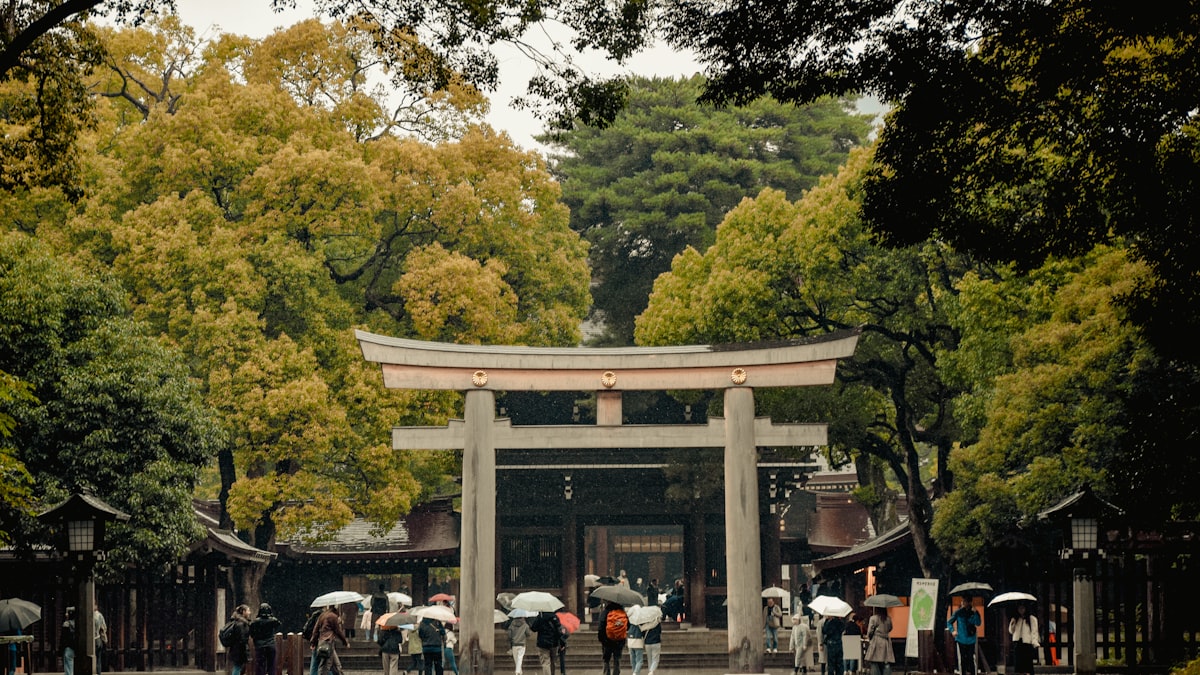
You’ll visit a lot of shrines and temples in Japan — but what’s the difference? Knowing helps you appreciate them and behave respectfully. Here’s a simple guide.
The basic difference
- Shrines (jinja) are Shinto — Japan’s indigenous religion of kami (spirits/gods). Look for a torii gate at the entrance.
- Temples (o-tera) are Buddhist. Look for a large gate with guardian statues, an incense burner, and often a pagoda.
Many sites blend both, and most Japanese people take part in each — Shinto for life events and New Year, Buddhism for funerals.
How to visit a shrine
- Bow slightly at the torii; walk to the side, not the center (reserved for the kami).
- Purify at the water basin (temizuya): rinse left hand, right hand, then mouth.
- At the hall: toss a coin, bow twice, clap twice, pray, bow once.
How to visit a temple
- Bow at the gate.
- Optionally waft incense smoke over yourself for good health.
- At the hall: toss a coin, bow, pray quietly (no clapping), bow.
Good to know
- Omamori (charms) and goshuin (stamp-book seals) make meaningful souvenirs.
- Photography is often fine outside but restricted inside halls — check signs.
- Dress and behave modestly. More in our etiquette guide.
See famous examples in Kyoto, Asakusa, and Nikko.
Costs & practical details
- Most shrines are free to enter; the majority of Buddhist temples charge a modest JPY 300-600 entry fee for the main garden or hall, though the grounds themselves are often free to walk.
- A goshuin stamp costs JPY 300-500 at either type of site and is collected in a dedicated book (goshuincho, JPY 1,500-3,000) rather than a passport or notebook — buy the book at your first stop.
- Omamori charms run JPY 500-1,500 depending on their purpose (health, travel safety, love, exam success) and are meant to be renewed yearly rather than kept forever, traditionally returned to any shrine or temple for a ritual burning.
Common mistakes to avoid
- Clapping at a Buddhist temple — the clap-twice ritual belongs to Shinto shrines only; at a temple, pray silently with palms together after your coin offering, no clapping.
- Walking straight up the center of a shrine’s approach path — the center is traditionally reserved for the resident kami, not visitors, so walk slightly to one side as a small but appreciated courtesy.
- Skipping the purification basin because the process seems unclear — rinse your left hand, then right hand, then cup a little water in your left hand to rinse your mouth (don’t drink from the ladle directly), then rinse the ladle handle itself before setting it down.
Sites that combine both in one visit
Several famous complexes blend Shinto and Buddhist elements on the same grounds, a good way to see both traditions side by side in a single stop — Nikko’s Toshogu area mixes shrines and temples across one hillside complex, and many Kyoto neighborhoods have a shrine and temple within a few minutes’ walk of each other, making it easy to compare the etiquette in practice rather than just in theory.