Photo by Susann Schuster on Unsplash
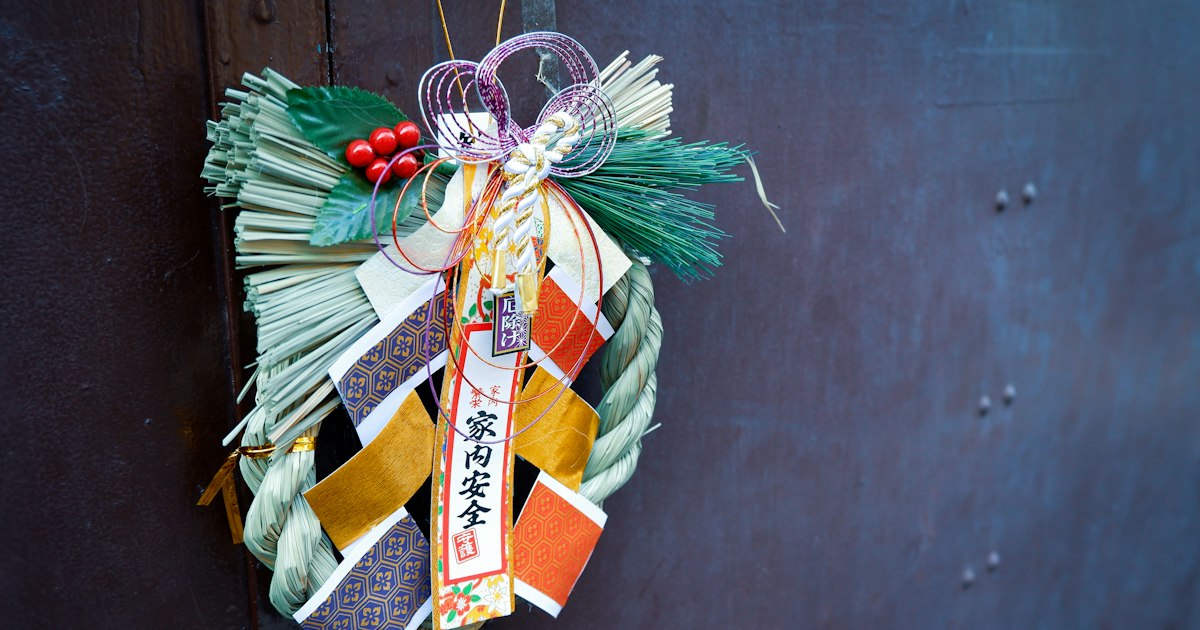
If you’re in Japan in the final two weeks of December, you’ll notice straw wreaths suddenly appearing on front doors, shop entrances, and even car bumpers — rings of twisted rice straw dressed up with paper zigzags, ferns, and a small orange. These are shimekazari (しめ飾り), one of the most visible and most overlooked pieces of Japanese New Year culture. They’re also an easy, genuinely meaningful souvenir if you know where to look and what to buy.
What Exactly Is a Shimekazari?
A shimekazari is a woven straw decoration hung at entrances to welcome toshigami, the New Year deity, into the home and to mark the space as purified against misfortune for the coming year. It’s a smaller, domesticated cousin of the thick shimenawa rope you see strung across shrine gates and sacred trees year-round.
Most versions share the same core elements, each with its own meaning:
- Twisted straw rope — the base, symbolizing purification
- Daidai (bitter orange) — a pun on “generations” (代々), wishing prosperity across generations
- Urajiro fern — its white underside represents a pure heart and marital harmony
- Shide — the folded white zigzag paper strips also seen at shrines, marking sacred space
- Ebi (lobster/shrimp) or pine — for a bent-back, long-living old age
Regional versions vary a lot. In and around Ise and Toba (Mie Prefecture), many homes keep a thicker shimenawa-style decoration with a wooden tag up year-round rather than a seasonal wreath — a local custom tied to a folk legend about the god Susanoo-no-Mikoto.
When to Put One Up — and When to Take It Down
Timing matters more than most tourists realize, and getting it wrong is the single most common mistake even some Japanese households make.
- Hang it: anywhere from December 13 (the traditional start of New Year preparations) through December 28. Most households today wait until after Christmas, around December 26–28, so it doesn’t visually compete with Christmas decorations.
- Avoid December 29: the number 9 can be read as “ku,” evoking suffering (苦), so putting it up that day is considered bad luck.
- Avoid December 31: putting it up on New Year’s Eve itself is seen as a rushed, last-minute “one-night-only” decoration (一夜飾り) and considered disrespectful to the deity.
- Take it down: at the end of “matsu no uchi,” the pine-decoration period. That’s January 7 in the Kanto region (Tokyo, Yokohama) and January 15 in much of the Kansai region (Osaka, Kyoto) and elsewhere — so if you’re traveling between regions in early January, don’t be surprised to see wreaths still up in one city and gone in another.
Proper disposal is its own ritual: the wreath is traditionally brought to a dondo-yaki or sagicho bonfire at a local shrine in mid-January, where New Year decorations are burned together to send the deity off. Tossing it straight in household trash is common in practice now, but if you want the full experience, ask a shrine near your lodging whether they hold one — these bonfires are free, open to visitors, and worth attending even if you’re not the one who hung the decoration.
Where to Buy One in Japan
Shimekazari go on sale from roughly the first week of December and sell out or disappear from shelves by December 28–30, so this is a narrow shopping window — don’t expect to find one in late January.
- 100-yen shops (Daiso, Seria): simple mini wreaths, around 7–12cm, usually ¥100–¥500. Good for a cheap, packable souvenir, though decorations are plastic/artificial rather than real straw and citrus.
- Supermarkets (Life, Ito-Yokado, Aeon, Seiyu): a dedicated New Year corner appears near the entrance in early December, with standard door wreaths around ¥500–¥1,500. Hours are typically 9am or 10am to 9pm or later.
- Home centers (Cainz, Kohnan, DCM): the widest selection by far, from plain to quite decorative, roughly ¥800–¥3,000. Open 9am–8pm or 9pm daily.
- Flower shops and garden centers: fresher, nicer arrangements with real pine and citrus, generally ¥2,000–¥5,000.
- Department store New Year corners (Isetan Shinjuku, Takashimaya, Mitsukoshi — usually on a home-goods floor, open 10am–8pm): curated, design-forward wreaths, often ¥3,000–¥10,000+, including versions in muted colors meant for modern interiors rather than traditional red-and-gold.
If you’re stocking up on cash for market or stall purchases, note that many smaller flower shops and craft stalls are cash-only — check our guide to convenience store ATM withdrawal limits before you go, since per-transaction caps can catch travelers off guard right when they need cash for a seasonal market.
Budget, Mid-Range, and Splurge Picks
- Budget (¥100–¥500): Daiso or Seria mini wreaths. Fine as a lightweight gift or tree ornament back home.
- Mid-range (¥1,500–¥3,500): home center or supermarket standard wreaths with real straw and dried (not fresh) citrus-style ornaments — the version most Japanese households actually buy.
- Splurge (¥5,000–¥15,000+): department store or specialty craft versions using thicker hand-twisted straw, real pine, and sometimes a genuine small daidai orange. These are the ones worth buying if you plan to display it at home rather than travel with it, since fresh fruit won’t survive a long flight.
Buying One as a Souvenir: What Tourists Should Know
A few practical snags trip up visitors who want to bring one home:
- Real plant material can be an import problem. Countries including the US, Australia, Canada, and much of the EU restrict or inspect dried straw, fern, and fruit brought in luggage for agricultural biosecurity reasons. If you’re flying home, choose a wreath with artificial (plastic or paper) citrus and greenery rather than real dried plants, and declare it at customs if asked.
- Pack it flat or in a box. The straw base is more fragile than it looks; a crushed wreath doesn’t spring back. Many shops will give you a flat paper sleeve on request — ask for one.
- Buy early in your trip, not on your last day. Shimekazari sell out fast in the final week of December, and panic-buying on December 30 at the airport isn’t an option — these aren’t sold at airport gift shops.
December in most of Japan is genuinely cold for wreath-shopping trips to outdoor markets and home-center parking-lot displays, so layer up — our breakdown of Uniqlo HeatTech layering is a good primer if you’re packing light. And if minimalist Japanese craft and natural materials are what draw you to shimekazari in the first place, it’s worth browsing Karimoku’s wooden furniture too — a different price bracket entirely, but the same design sensibility.
Common Mistakes to Avoid
- Hanging it on December 29 or 31 — both are considered unlucky timing, as explained above.
- Leaving it up past matsu no uchi (January 7 or 15 depending on region) — it should come down promptly, not linger into February.
- Assuming all shimekazari look the same — regional and modern-design versions vary enormously, so if you want the classic red-and-straw look, say so at a home center rather than grabbing the first one you see.
- Waiting until your last week in Japan to shop — stock thins out fast and isn’t restocked after Christmas.
Shimekazari are cheap, light, and genuinely tied to a living tradition rather than a tourist-shop invention — which makes them one of the better small souvenirs to pick up if your trip happens to overlap with late December.