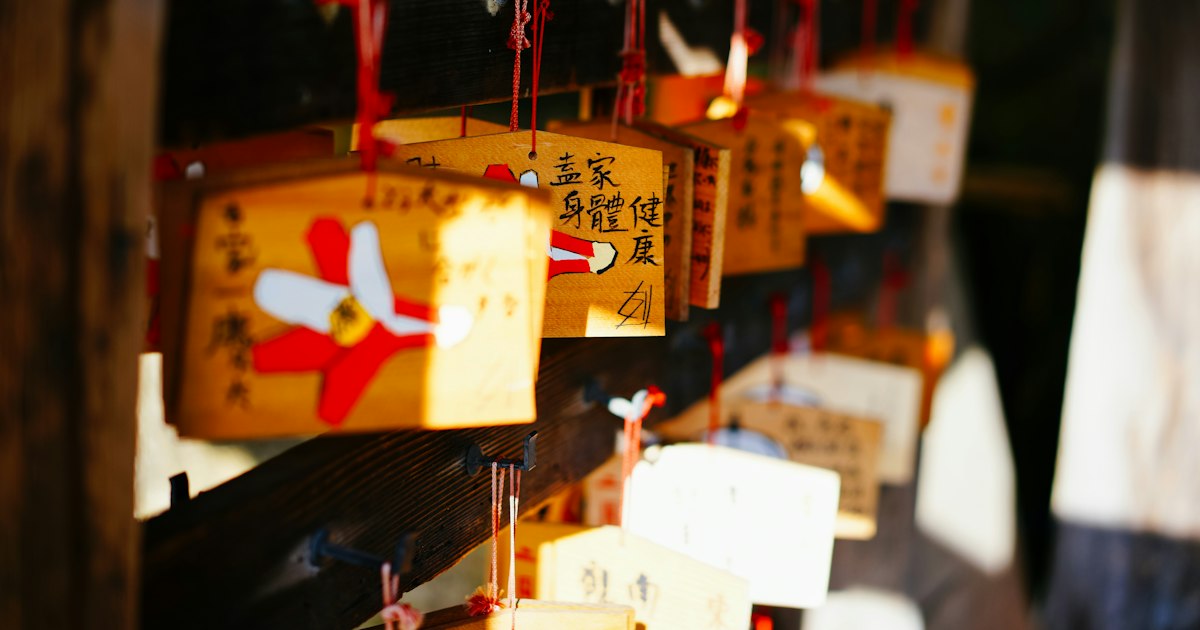
At almost every Shinto shrine in Japan, you’ll spot small wooden plaques hanging in rows near a rack, covered in handwriting — some in Japanese, increasingly more in English, Korean, and Chinese. These are ema, and writing one is one of the few shrine traditions that visitors are actively encouraged to take part in, not just watch from a distance. Unlike omamori (amulets) or goshuin (shrine stamps), which you simply buy, an ema asks you to sit down, think about what you actually want, and put it in writing. Here’s how to do it properly.
What Is an Ema, and Where Does It Come From?
Ema (絵馬) literally means “picture horse.” Centuries ago, worshippers donated real horses to shrines as offerings to the kami (deities), since horses were believed to be how gods traveled. Over time, live horses were replaced by wooden plaques painted with a horse’s image, and eventually the horse motif gave way to whatever image suited the shrine — a fox at an Inari shrine, a plum blossom at a scholarship shrine, a zodiac animal for the current year, or a shrine’s own mascot character.
The front of the plaque carries the printed or painted image; the back is left blank for you to write your wish. Once written, the ema is hung on a wooden rack called an ema-kake, left there for the kami to read, and eventually ritually burned by the shrine in a purification ceremony (usually at year-end or during a seasonal festival) rather than thrown out as trash.
Where to Buy One and What It Costs
Ema are sold at the shrine’s shamusho (office) or at a small stall near the main hall, usually alongside omamori and omikuji (fortune slips). Expect to pay 500–1,000 yen for a standard ema; larger or more elaborately painted ones, especially at famous shrines, can run 1,500–2,000 yen. Payment is almost always cash, and self-service honor boxes are common at smaller shrines with no attendant — it’s worth having coins and small bills on hand, since there’s rarely a card reader. If you’re stocking up on yen before a shrine-heavy day, 7-Bank ATMs at 7-Eleven are the easiest withdrawal option, and a no-fee card from this list of no-foreign-transaction-fee credit cards helps elsewhere on the trip.
Shrine grounds themselves are typically open 24 hours, but the office or stall selling ema usually keeps hours of roughly 9:00 a.m. to 5:00 p.m., sometimes shorter in winter. If you arrive early morning or late evening, you may find the ema stand unattended — some shrines leave a self-service box with a price list, but many simply close up for the day.
How to Write Your Wish, Step by Step
- Use the pen provided. Shrines usually leave a felt-tip marker or brush pen tied to the writing table by a string. Black ink is standard; don’t use your own pen unless none is available.
- Write on the blank back, not the painted front. This trips up almost every first-timer — the picture side is decorative, the wish goes on the reverse.
- Keep it short. The writing space is small, roughly postcard-sized or smaller. One clear sentence is better than a paragraph. “May our baby be born healthy,” “Pass the entrance exam,” or “Good health for my family this year” are typical in form and length.
- Add your name and sometimes your age or address. Traditionally, Japanese visitors write their name (or initials, if they prefer privacy) so the kami knows who is asking. You don’t have to include your full address — initials and a first name are fine for a visitor.
- Write in your own language if that’s easier. Shrines that see a lot of international visitors, such as Tokyo’s Meiji Jingu, have entire racks filled with wishes in English and other languages. The sincerity matters more than the language.
Hanging It and Basic Etiquette
Once written, carry the ema to the ema-kake rack, usually located near the main worship hall, and hang it using the hole already drilled in the top. There’s no bowing ritual specific to ema, but it’s polite to follow general shrine manners: bow slightly before approaching, don’t photograph other people’s wishes close enough to read them, and keep your voice down near the worship hall. If you want to also pay respects at the main shrine, the standard sequence is a small coin offering, two bows, two claps, a silent wish, and one final bow — separate from the ema itself.
A common question: can you take the ema home instead of hanging it? Some shrines allow this and sell ema specifically designed as souvenirs (often decorative, with a stand rather than a hanging hole). But a standard wish-ema is meant to stay at the shrine, so if you want one to keep, buy a second one explicitly marked as a souvenir or ask the shrine staff whether taking it is acceptable.
Best Shrines and Timing for Ema
A few shrines are particularly known for their ema traditions:
- Dazaifu Tenmangu (near Fukuoka) — dedicated to Tenjin, the god of scholarship, its ema racks are packed with exam-success wishes, especially from January through March during Japan’s university entrance exam season. If you’re flying through Fukuoka Airport, it’s an easy half-day trip from downtown.
- Kitano Tenmangu (Kyoto) — another Tenjin shrine, similarly popular with students before exams.
- Fushimi Inari Taisha (Kyoto) — sells fox-faced ema where you draw the fox’s expression yourself before writing your wish, a fun variation for visitors.
- Meiji Jingu (Tokyo) — its large ema displays near the main shrine show just how international the custom has become.
- Kirishima Jingu (Kyushu) — set in the dramatic volcanic landscape covered in our guide to Kirishima’s shrine country, worth combining with an onsen stop.
Any time of year works for writing an ema, but New Year (January 1–3) and exam season (January–February) are when racks fill up fastest and the atmosphere is liveliest — also when shrines are most crowded. If you want a quieter, more reflective experience, a weekday morning outside these peak windows is far easier. The New Year period pairs naturally with Japan’s other written-wish custom; if ema interest you, the nengajo New Year postcard tradition is a related custom worth reading about.
Common Mistakes to Avoid
- Writing on the picture side. Flip the plaque over before you start.
- Treating it like a wishing well coin. Ema are meant to carry a specific, sincere wish — vague doodles or jokes are generally discouraged, especially at shrines where locals are writing genuine prayers nearby.
- Forgetting cash. Card payment is rare at shrine shops; carry small bills and coins.
- Assuming every shrine sells them. Smaller neighborhood shrines may not have ema at all, while major shrines and temples associated with specific wishes (exams, safe childbirth, business success) almost always do.
- Taking someone else’s hung ema as a souvenir. It should go without saying, but the racks are not free samples — once hung, an ema belongs to the shrine until it’s ritually burned.
Budget travelers can get the full experience for under 1,000 yen at almost any shrine; if you want something more elaborate as a keepsake, look for the larger, hand-painted ema sold at major shrines for 1,500–2,000 yen, often marked as display or souvenir versions you’re allowed to take home. Either way, it’s one of the cheapest, most personal souvenirs of a Japan trip — not an object you buy, but a wish you leave behind.