Photo by Harman Tatla on Unsplash
You step onto an escalator at Shinjuku Station, plant yourself on the left like you did all week in Tokyo, and someone clips your shoulder hurrying past on the right. Three days later you’re in Osaka doing the exact same thing, and this time you’re the one blocking the lane. Japan has one escalator rule almost everyone follows without being told — stand on one side, leave the other open for walkers — but which side changes depending on which city you’re in, and almost no first-time visitor is warned about the switch.
The Basic Rule: One Side Stands, One Side Walks
Across nearly all of Japan — Tokyo, Yokohama, Nagoya, Kyoto, Fukuoka, Sapporo — the convention is stand left, walk right. If you’re not in a hurry, step onto the escalator and move all the way to the left side of the step, keeping the right lane clear for people who want to climb or descend on foot. This isn’t written on a sign at most stations; it’s just absorbed by watching everyone else, which is exactly how visitors get it wrong on day one.
Osaka, and most of the surrounding Kansai region including Kobe, flips it: stand right, walk left. Cross from Kyoto into Osaka on the Keihan or Hankyu line and the pattern you just learned reverses within an hour. It trips up Japanese domestic travelers too, not just foreigners — Osakans visiting Tokyo complain about it as much as tourists do.
Why Osaka Is the Outlier
The commonly told origin traces back to the late 1960s at Hankyu Railway’s Umeda Station in Osaka, ahead of Expo ’70. Station staff wanted a way to move the huge crowds expected for the World’s Fair more efficiently and looked at London, where Underground riders already stood on the right and walked on the left. Hankyu rolled out signage asking passengers to do the same, and because Osaka’s commuter rail network is dense and the habit spread station to station, it stuck region-wide while the rest of the country — influenced more by Tokyo’s own rail operators — settled into the opposite pattern. There’s no law behind either side; it’s purely social convention that calcified over decades, which is why it’s so consistent within each region and so confusing the moment you cross a regional line.
Where You’ll Actually Run Into This
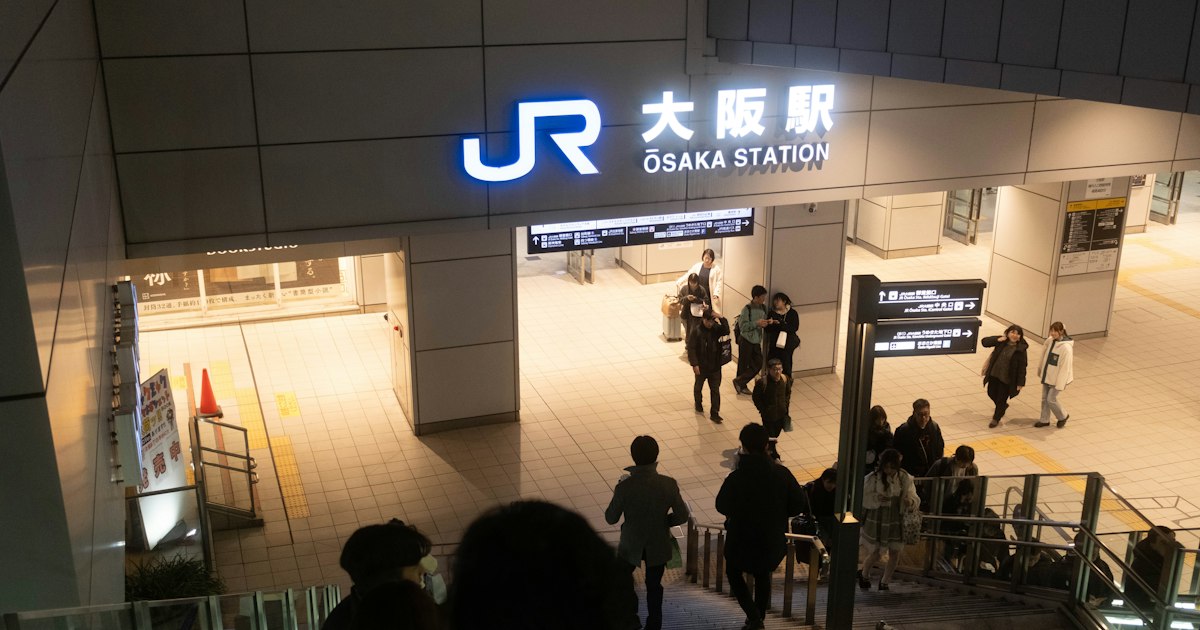
You don’t need to go looking for it — it’s unavoidable at any station with real passenger volume. Osaka’s Umeda Station complex (Hankyu Umeda, Hanshin Umeda, and JR Osaka Station all cluster here) is the classic place to see stand-right in action, especially during the 7:30–9:00am and 5:30–7:30pm rush. In Tokyo, Shinjuku, Shibuya, and Tokyo Station are the busiest proving grounds for stand-left. Airports follow the regional pattern too — Kansai International and Itami lean right, Narita and Haneda lean left — so the switch starts the moment you land, not just once you’re downtown.
If your itinerary has you bouncing between regions — say, a few nights in Kyoto, a day trip to Osaka, then back up to Tokyo on the Shinkansen — expect to consciously reset which side you stand on every time you change cities. It becomes easier with repetition, but the first transfer of each trip usually catches people off guard.
The Bigger Shift: Standing Still Instead of Walking at All
Here’s the twist that matters more than left-versus-right: Japan has been actively discouraging walking on escalators altogether, regardless of which side. Saitama Prefecture passed an ordinance, effective October 2021, requiring escalator users to hold the handrail and stand still rather than walk — the first such rule in Japan, driven by data showing a large share of escalator injuries happen to people walking or running on the steps. There’s no fine for breaking it, but station staff and signage actively remind riders. Nagoya and several railway operators elsewhere have run similar “please stand still” campaigns, and JR East and Tokyo Metro have posted stand-still signage at major stations for years. The old lane-split habit hasn’t disappeared — people still default to one side — but you’ll increasingly see both lanes filled with stationary riders, especially behind elderly passengers, people with large suitcases, or parents with strollers who simply can’t safely share a step with someone squeezing past.
Practically, this means you’re never wrong to just stand still and hold the rail on either side if an escalator is crowded or if you have luggage. You risk mild friction for walking up the “wrong” side in Osaka versus Tokyo; you risk nothing for just standing still anywhere.
Common Mistakes Visitors Make
- Standing with a suitcase blocking both lanes. A wheeled bag angled sideways takes up the full width of a step. Turn it parallel to your body and keep it on your standing side.
- Freezing mid-transition between regions. If you genuinely can’t remember which side applies, glance at the people already on the escalator ahead of you and mirror them rather than guessing.
- Walking up during rush hour out of habit. Even where walking is technically tolerated, doing it at full commuter-rush density is how people get bumped or bump others. Save the walking lane for when the escalator is lightly used.
- Standing on stairs-style escalators at department stores and expecting the same split. Shopping malls and department stores sometimes have lighter, more relaxed usage where the lane convention is looser — follow the crowd rather than assuming a hard rule.
- Treating it as a big deal. No one will scold a visitor over this. Locals notice, maybe step around you, and move on. It’s a courtesy norm, not an enforced law.
Beyond the Escalator: The Same Courtesy Logic on Platforms and Trains
The stand-aside, keep-moving mindset behind escalator etiquette shows up everywhere else in Japan’s transit system — queuing in marked lines on the platform before doors open, letting passengers off before boarding, keeping bags off the seat beside you. If you’re traveling during one of Japan’s peak congestion windows, like the mid-August Obon travel week, every one of these small conventions gets stress-tested by sheer crowd volume, and escalators at Shinkansen transfer stations become genuine bottlenecks. The same applies in dense neighborhood hubs — a station like Takadanobaba, with its constant churn of students and commuters, runs on exactly this kind of unspoken lane discipline during class-change hours.
The Quick Version to Remember
Stand left almost everywhere in Japan; stand right in Osaka, Kobe, and most of Kansai. When in doubt, mirror whoever is ahead of you on the escalator rather than committing to a side from memory. And if you’re carrying luggage, holding a child’s hand, or the escalator is packed, just stand still and hold the rail — that’s never the wrong move, in any city.