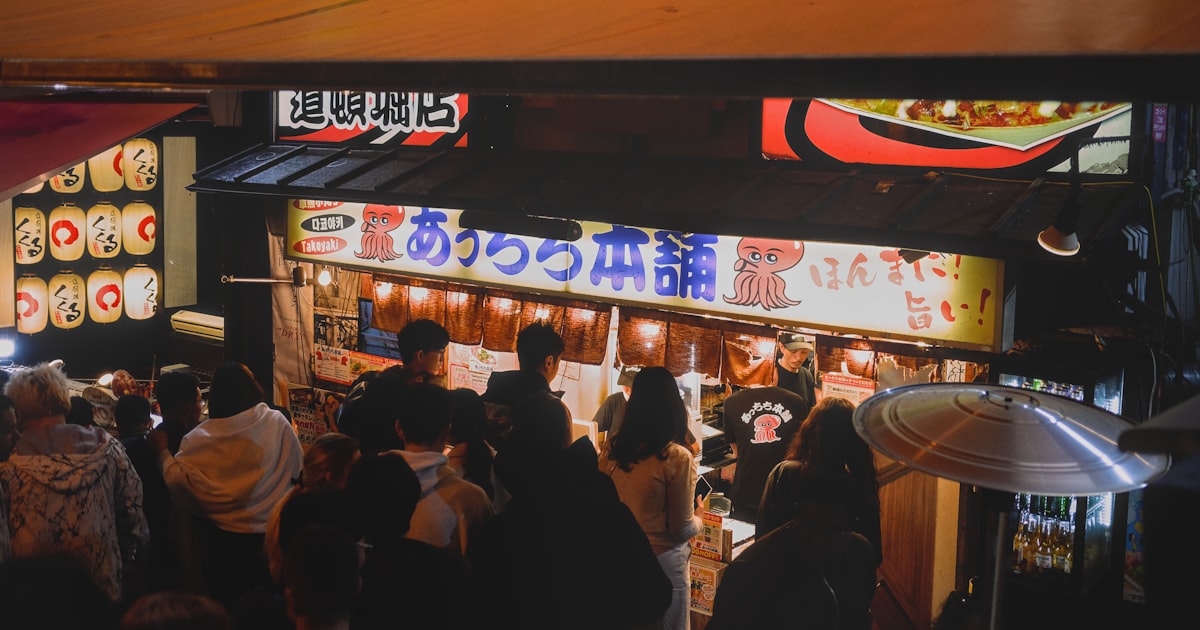
Crisp on the outside, molten and slightly gooey inside, and dotted with a whole piece of octopus — takoyaki is Osaka’s signature street food, and no trip to the city is complete without eating it hot off the griddle. It looks simple: a golf-ball-sized batter sphere brushed with sauce and mayo. But there’s real technique behind a good one, real history behind the dish, and a few rookie mistakes that trip up almost every first-time visitor. Here’s how to find the best takoyaki in Osaka and eat it the way locals do.
What Exactly Is Takoyaki?
Takoyaki (たこ焼き, literally “grilled octopus”) is a ball-shaped snack made from a wheat-flour batter poured into a specialized half-sphere griddle, then filled with a chunk of boiled octopus, tempura scraps (tenkasu), pickled ginger, and green onion. The cook flips each ball with a metal pick as it cooks, building a thin, crisp shell around a soft, custardy center. Finished balls are brushed with a Worcestershire-style takoyaki sauce, striped with Japanese mayonnaise, and dusted with dried bonito flakes (katsuobushi) and green seaweed powder (aonori). A standard order is 6 or 8 pieces in a paper tray or boat, meant to be shared or eaten solo as a snack rather than a full meal.
A Bit of History: Born in Osaka in the 1930s
Takoyaki was invented in Osaka in 1935 by a street vendor named Tomekichi Endo, who adapted an earlier snack called “radio-yaki” by swapping in octopus — a nod to Osaka’s strong seafood culture and its Akashi-yaki dish (a similar egg-rich octopus ball from nearby Akashi, eaten dipped in dashi broth rather than sauce). The dish caught on fast in Osaka’s working-class neighborhoods and spread nationwide after World War II. Osaka still treats takoyaki as a point of civic pride — many households even own a home takoyaki griddle for parties, and you’ll find takoyaki-flavored snacks, keychains, and plushies all over the city’s souvenir shops.
Where to Eat the Best Takoyaki in Osaka
Dotonbori is the obvious starting point and genuinely delivers. Along the canal and its side streets you’ll find several long-running specialists:
- Aizuya (会津屋) – widely credited as running in the direct lineage of the original 1935 recipe, serving a simpler, sauce-free style so you taste the octopus and dashi-based batter. A few locations near Dotonbori and Namba.
- Takoyaki Doraku Wanaka – a Dotonbori institution with the giant lit-up crab sign nearby; balls come with a noticeably crisp shell and generous octopus chunks. Around 600–700 JPY for 8 pieces.
- Juhachiban (十八番) – a small, always-busy stand tucked in the backstreets off the main canal, popular with locals for its molten, almost soupy center.
For a different scene, head to Shinsekai, the retro neighborhood under Tsutenkaku Tower, where Wanaka (Sakuraya Honten) is the original outpost of the Dotonbori chain above and considered by many Osakans to be the better version — less touristy, slightly cheaper, and open late. If you’d rather sample several styles side by side in one stop, the Osaka Takoyaki Museum at Universal CityWalk Osaka (right outside Universal Studios Japan, on the JR Yumesaki Line) gathers stalls from several famous Osaka takoyaki brands under one roof, which is a convenient way to compare shops without crossing town — handy if you’re already heading to USJ for the day.
How Much It Costs and What to Expect
Takoyaki is one of the cheapest hot meals you’ll find in Japan. Expect roughly 500–800 JPY for 8 pieces at a street stall, and 600–1,000 JPY at a sit-down izakaya version with extra toppings like cheese, spicy mayo, or negi-shio (green onion and salt, no sauce). Most stalls are cash-friendly and increasingly take IC cards (Suica/ICOCA) or PayPay; don’t assume every tiny stand takes credit cards. There’s no real “splurge” tier for takoyaki itself — even upscale versions rarely exceed 1,200 JPY — but some restaurants serve it as part of a larger okonomiyaki-and-teppan set menu for 2,000–3,000 JPY if you want a fuller meal built around it.
How to Order and Eat It Like a Local
Most stalls are order-at-the-window, pay-first operations — point at the menu photo or say the number of pieces you want (“hachi-ko,” 8 pieces, or “roku-ko,” 6 pieces). The single biggest rookie mistake is biting straight into a fresh ball: the center holds heat far longer than the crust suggests, and burnt-mouth takoyaki injuries are common enough among tourists that it’s practically a running joke in Osaka. Let it sit for a minute, or eat it in two bites so the steam escapes. Use the wooden pick or toothpick provided rather than your fingers — the outside can still be surprisingly hot even after the center has cooled. If you don’t like mayo, ask for “mayo nashi” (no mayo) before they finish topping it, since scraping it off afterward ruins the texture. And don’t fill up before trying it — portions are small on purpose, so it’s meant to be one stop of several on a street food crawl, similar in spirit to grazing through Nishiki Market in Kyoto.
Best Time to Go
Takoyaki is a year-round food with no real seasonal peak, but timing your visit still matters for the experience. Dotonbori stalls are least crowded on weekday afternoons (2–5pm); evenings and weekends bring long lines, especially at the famous names. Most stands open around 10 or 11am and stay open until 10 or 11pm, with some late-night spots in Shinsekai running past midnight. If you want to watch the griddle work up close without being jostled by crowds, arrive right at opening.
Getting There
Dotonbori and Shinsekai are both easily reached on foot or by subway from Namba or Shinsaibashi stations, and are typically covered by regional rail passes if you’re coming in from elsewhere in Kansai — check the JR Regional Rail Passes for Kansai if you’re planning a wider loop through the region. If you’re arriving from Tokyo on a budget, an overnight bus is a common way to save on the trip down. And if you fall hard enough for takoyaki that you want to make it at home, takoyaki griddle pans (both electric and stovetop) are sold at kitchen supply shops around Osaka and at Tokyo’s Kappabashi Kitchen Town, which stocks the professional-grade cast iron versions used by actual stalls.