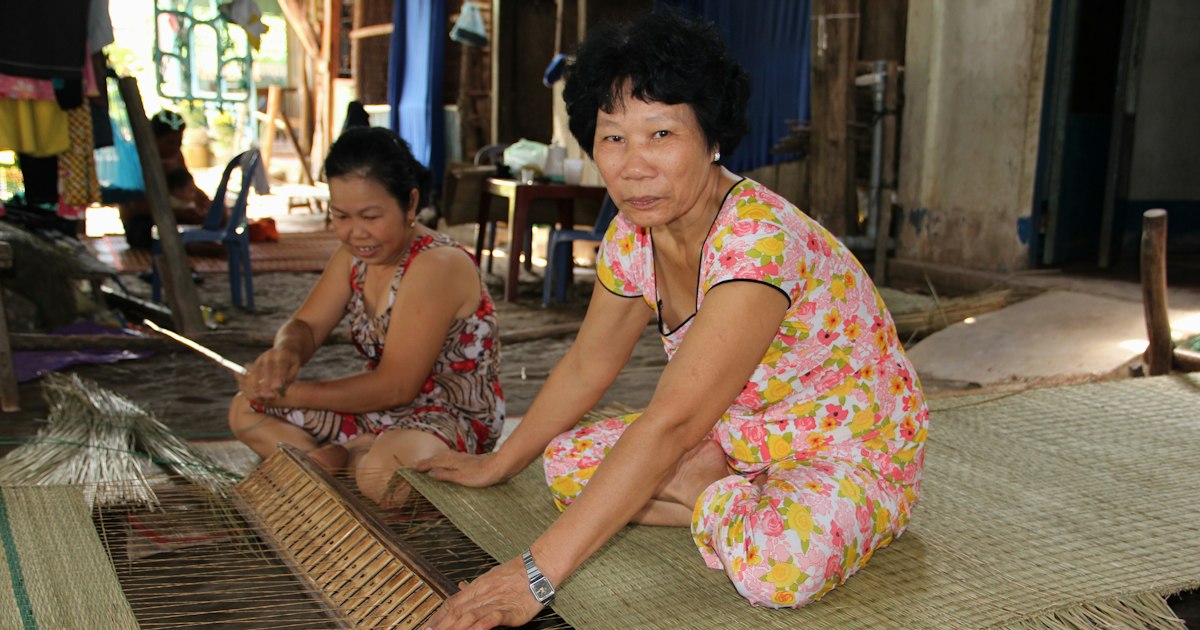
Photo by Freysteinn G. Jonsson on Unsplash
Most visitors meet tatami as a surface underfoot — in a ryokan room, a temple hall, or an Airbnb listing warning you to take your shoes off. Few realize that each mat is still, in many workshops, built by hand from rice-straw or rush-grass cores, stitched with a long needle, and bound at the edges with cloth tape that’s sewn on by eye. Watching a craftsman do this — usually in a shop no bigger than a two-car garage, radio on, mat on a wooden frame called a tatami-dai — is one of the more underrated craft experiences in Japan, and it’s far easier to arrange than most people assume.
What’s Actually Happening in a Tatami Workshop
A tatami mat has three parts, and a workshop visit makes all three visible. The doko is the core — traditionally compressed rice straw, now often a lighter wood-fiber or polystyrene board in modern mats. The omote is the woven rush-grass surface, made from igusa reed; roughly 90% of Japan’s domestically grown igusa comes from the Yatsushiro area of Kumamoto Prefecture, and workshops elsewhere buy their rolls from there. The heri is the decorative cloth border sewn along the long edges, and it’s the one part a craftsman will often let you choose — plain navy and charcoal for a traditional room, or patterned brocade if the mat is going into a modern space.
In an actual working shop, you’ll usually see a craftsman trimming a mat to fit a room’s exact dimensions (no two rooms are identical, so mats are built to order, not sold off a shelf), hand-stitching the heri with a curved needle, or re-covering an old doko with fresh omote — a job called omote-gae that most Japanese households still do every few years rather than buying new mats.
Where to Watch Craftsmen Work
Independent tatami shops (tatami-ten) exist in almost every neighborhood in Japan, identifiable by the stacks of rolled rush matting visible through the front window or door. Most are family businesses and genuinely welcome a polite, brief look if you ask — a simple “Chotto mite mo ii desu ka?” (Is it okay if I take a quick look?) goes a long way, especially if you’re not asking during a rush order.
For a guaranteed, English-friendlier option, two museum-workshops are reliable:
- Edo Shitamachi Traditional Crafts Museum (Asakusa, Tokyo) — rotates demonstrations by different Edo-era craft masters, tatami-making included on some days. Free entry, open roughly 10:00–18:00, closed Mondays; check the day’s schedule at the door since the craftsperson on duty changes.
- Kyoto Museum of Traditional Crafts (Fureaikan), in the basement of Miyako Messe near Heian Jingu — displays tatami alongside Kyoto’s other 70-plus registered traditional crafts, with live demonstrations on selected days. Free, open 9:00–17:00 (last entry 16:30), closed over New Year.
If you happen to be near Kita-Kamakura, it’s worth pairing a craft detour with the temple circuit at Engaku-ji, Kencho-ji and Tokei-ji — the tatami-floored meditation halls there are some of the best-maintained traditional mats you’ll see outside a workshop, and give useful context for what “good” tatami is supposed to look and smell like fresh.
Booking an Actual Hands-On Class
A handful of workshops in Tokyo, Kyoto, and Kumamoto run short paid experiences for visitors rather than just letting you watch. Typical formats:
- Mini tatami coaster or trivet weaving — ¥2,000–¥3,500, 30–45 minutes, no reservation needed in some shops, walk-in friendly.
- Tatami edge-binding (heri) practice on a sample panel — ¥4,000–¥6,000, roughly 60–90 minutes, usually requires advance booking by phone or through a local tourism association since only one or two craftsmen run these.
- Full igusa-weaving demonstration with a loom — mostly in Kumamoto’s Yatsushiro area, sometimes bundled with a farm visit during the igusa harvest; prices vary by operator, generally ¥3,000–¥8,000.
These classes aren’t centrally listed the way, say, cooking classes are, so local tourism office websites and ryokan concierge desks are your best bet for current availability. If you like the format of a short, souvenir-producing craft class, it’s worth comparing against wagashi-making classes in Kyoto and Tokyo, which run on a similar scale and booking pattern and are easier to find in English.
Best Season and Timing
Tatami workshops run year-round, but a few timing notes matter. Igusa is harvested in Kumamoto in June, so late spring visits there sometimes coincide with fresh-cut rush being dried and sorted — a good month to see the raw material rather than just the finished weave. In ordinary neighborhood tatami-ten, late winter and early spring (January–March) is the busiest season for omote-gae re-covering work, since many households replace tatami before New Year or before spring moves; craftsmen are more rushed and less available to chat then. Early afternoon on a weekday, outside that peak window, is the easiest time to get a relaxed conversation and a look at the workshop.
Common Mistakes
- Treating a tatami-ten like a tourist attraction. These are working businesses fulfilling real orders, not demonstration stages. Ask before photographing, and don’t linger if a craftsman is mid-measurement on a paying customer’s mat.
- Assuming all tatami is rice straw. Most mats made and sold today — including what you’ll see in budget apartments — use a compressed wood-fiber or foam core, not straw. If you want to see or buy traditional straw-core tatami, ask specifically; it costs more and is heavier.
- Expecting English signage or websites. Independent workshops rarely have either. A translation app and a printed address (not just a pin) make the visit much smoother.
- Buying a full-size tatami mat as a souvenir. Mats are custom-cut to room dimensions and are bulky to ship; what you actually want for a souvenir is a tatami coaster, a small zabuton cushion edged in the same heri tape, or a sachet of dried igusa (sold for its scent and said to help with humidity) — all genuinely portable.
Budget, Mid-Range, and Splurge Options
At the budget end, a free look into a neighborhood tatami-ten or a visit to the Edo Shitamachi museum costs nothing beyond transport. Mid-range, a ¥2,000–¥3,500 mini-weaving class gets you a finished coaster and real hands-on time with a craftsman. For a splurge, the Yatsushiro-area loom demonstrations bundled with a farm tour (¥3,000–¥8,000, sometimes including a light meal) are the closest you’ll get to seeing the entire igusa-to-mat chain in one day. None of this requires fluent Japanese — a polite greeting, cash in small bills (most small workshops don’t take cards), and a willingness to watch quietly will get you further than any amount of planning.
If you’re building out a broader “traditional craft” day — pairing a tatami stop with a kimono shop or a textile restoration visit, for instance — the same low-key, appointment-friendly approach works at places like the kimono restorers covered in arai-hari kimono cleaning and restoration, where craftsmen are similarly happy to talk shop if you ask at a quiet moment.