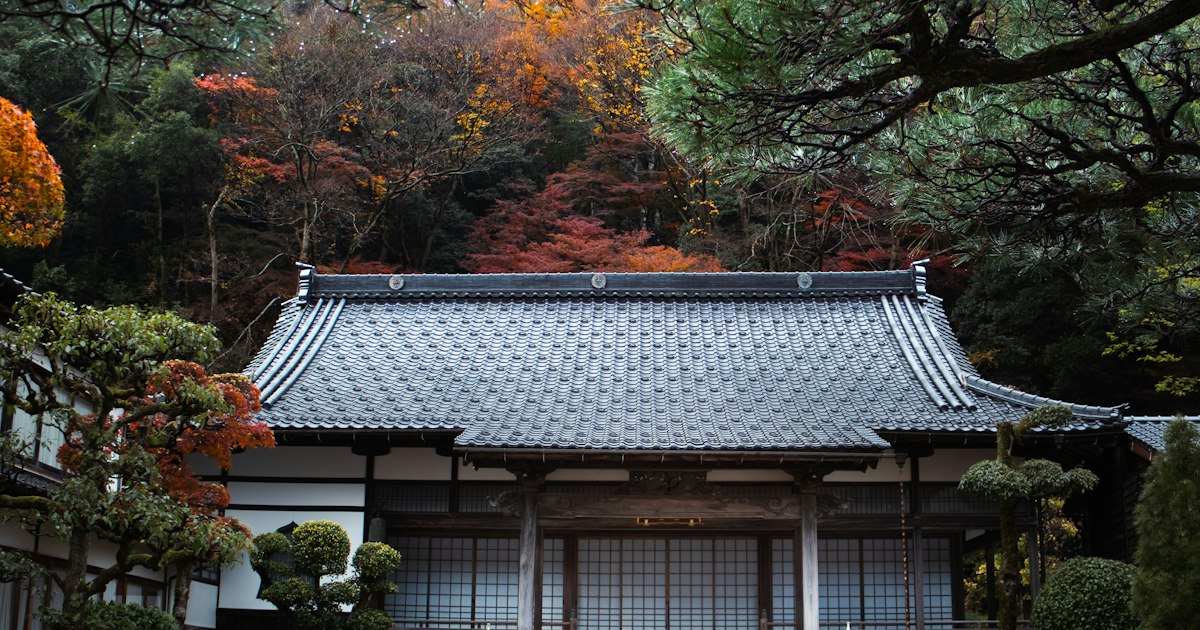
Photo by Kate Kasiutich on Unsplash
Most first-time visitors to Kamakura funnel straight toward the Great Buddha, and by late morning the approach road to Kotoku-in looks more like a theme park queue than a pilgrimage route. One station up the Yokosuka Line, Kita-Kamakura offers the opposite experience: three of Japan’s most historically important Zen temples, moss-covered stone paths, and—on a weekday morning—long stretches where you won’t see another tourist. This trio, Engaku-ji, Kencho-ji and Tokei-ji, gives you a genuinely quiet, self-paced half-day of temple-hopping that most Daibutsu-bound visitors never bother to try.
Why Kita-Kamakura Instead of the Daibutsu Crowds
Kita-Kamakura station sits one stop before Kamakura on the JR Yokosuka Line, and it was built specifically because of the temples clustered around it. Engaku-ji and Tokei-ji are practically at the station exit; Kencho-ji is a comfortable 15–20 minute walk away, toward central Kamakura. All three belong to the Rinzai school of Zen Buddhism and two of them—Engaku-ji and Kencho-ji—rank first and second among the “Kamakura Gozan,” the five great Zen temples the Kamakura shogunate formally ranked in the 14th century. Unlike the Daibutsu, which is essentially one photo stop, these are large temple complexes meant to be walked through slowly, which is exactly why they don’t draw the same tour-bus traffic.
Engaku-ji: Kamakura’s Grandest Zen Temple
Founded in 1282 by regent Hojo Tokimune to pray for soldiers lost repelling the Mongol invasions, Engaku-ji is the largest and most architecturally complete of the three. From the station, you’re at its San-mon gate within about a minute’s walk. Inside, the grounds climb gently through a series of halls, bells, and subtemples shaded by huge cedar and camphor trees. Look for the Shariden (a National Treasure reliquary hall, usually viewable only from outside its fence except during rare special openings) and the Ogane, a massive 1301 bronze bell that’s also a National Treasure. Butsunichi-an, a small subtemple partway up the grounds, serves matcha with a sweet for a few hundred yen if you want to sit and absorb the quiet.
Admission is ¥500 for adults, ¥200 for elementary and junior-high students. The temple is open 8:00–16:30 from December through February and 8:00–17:00 from March through November. Bring cash—like nearly every temple in Kamakura, there’s no card payment at the gate.
Kencho-ji: Japan’s Oldest Zen Training Monastery
Kencho-ji predates Engaku-ji by nearly thirty years. Founded in 1253, it’s recognized as the first dedicated Zen training monastery built in Japan, and it tops the Kamakura Gozan ranking. The approach alone is worth the walk: a row of towering juniper (biakushin) trees said to have been grown from seeds the founding Chinese monk, Rankei Doryu, brought with him almost 800 years ago. Beyond the main hall, the Hojo garden—a pond garden attributed to the famous landscape designer Muso Soseki—is one of the better-preserved Zen gardens in the city.
If you have energy left, a path behind the temple climbs past Hanso-bo, a shrine guarded by tengu statues, to a viewpoint over Kamakura and, on a clear day, the sea. This is also the start of the Ten-en hiking trail, a longer ridge walk connecting several temples—worth knowing about if you ever want to turn this into a half-day hike rather than a temple circuit.
Admission is ¥500, and the temple is open 8:30–16:30 year-round. It’s roughly a 15–20 minute walk from Kita-Kamakura station, or about the same distance from Kamakura station on the other side, so it works as a natural midpoint if you’re walking the whole route end to end.
Tokei-ji: The Quiet “Divorce Temple”
Tokei-ji is the smallest and least visited of the three, and that’s precisely its appeal. Originally a nunnery, it carries the nickname “Enkiri-dera” (divorce temple) because for centuries it served as a sanctioned refuge where women could obtain a divorce simply by taking shelter there for a set period—a rare legal escape route in feudal Japan. Today it’s a modest, flower-focused temple: plum blossoms in February, hydrangea through June, and bush clover and cosmos in autumn. The scholar D.T. Suzuki, who did more than almost anyone to introduce Zen Buddhism to the West, is buried in the cemetery here, a detail that draws a trickle of quiet visitors but no crowds.
Admission is ¥200. Hours run 8:30–16:30 from October through March and 8:30–17:00 from April through September. It sits just a few minutes’ walk from Kita-Kamakura station on the way toward Engaku-ji, making it easy to fold into either end of your route.
Getting There and Planning Your Route
Kita-Kamakura station is on the JR Yokosuka Line. From Tokyo Station it’s a direct ride of around 55–60 minutes; from Yokohama it’s roughly 30 minutes; and from Kamakura station itself it’s just one stop, about 3 minutes and ¥150. There’s no train between Kita-Kamakura and Kamakura stations, so the Kencho-ji leg is a walk (or a short bus ride on the Keikyu bus bound for Kamakura station, which stops near all three temples).
A logical order: start at Engaku-ji right by the station, swing by Tokei-ji on your way out, then walk the 15–20 minutes to Kencho-ji before continuing into central Kamakura if you still have time. Budget around three to four hours for all three temples at an unhurried pace, more if you add the Hanso-bo hike at Kencho-ji.
Best Time to Visit and Common Mistakes
Go on a weekday and arrive at opening time—gates open between 8:00 and 8:30, and that first hour is almost always the quietest, even on the busiest autumn weekends. Late November into early December brings excellent foliage, particularly at Engaku-ji, while early June is prime hydrangea season at Tokei-ji. February and early March bring plum blossoms.
The most common mistake is trying to cram all three temples plus the Daibutsu and Hase-dera into a single day—that’s a full day of temple-hopping, not a quick add-on. The second is assuming a ticket machine or card reader will be waiting at the gate; bring enough ¥1,000 and ¥500 notes in cash. If you’re planning to continue onto the Hanso-bo trail behind Kencho-ji, wear real shoes rather than sandals—the path is unpaved and can be muddy after rain.
Where to Eat Nearby
Budget travelers can grab onigiri or sandwiches from the convenience stores right by Kita-Kamakura station before heading in, since none of the temples have real restaurants inside. For something more memorable at mid-range prices, Hachinoki, near Kencho-ji, serves shojin ryori—the vegetarian cuisine developed for Zen monks—with lunch sets generally starting around ¥3,000. It’s a fitting way to extend the temple theme into your meal rather than just refueling. If you’re visiting with friends or family and splitting the bill, it’s worth knowing how that typically works in Japan; our guide to warikan bill-splitting at Japanese restaurants and izakaya covers the etiquette.
If the quiet, contemplative mood of these temples has you curious about Japanese tea culture more broadly, it’s worth pairing this trip with a proper wagashi-making class in Kyoto or Tokyo on another day of your trip. And if you’d like photos in kimono among the temple grounds, note that several Kamakura rental shops cater to a wide range of body types—our guide to plus-size kimono and yukata rental in Japan is a useful starting point before you book.