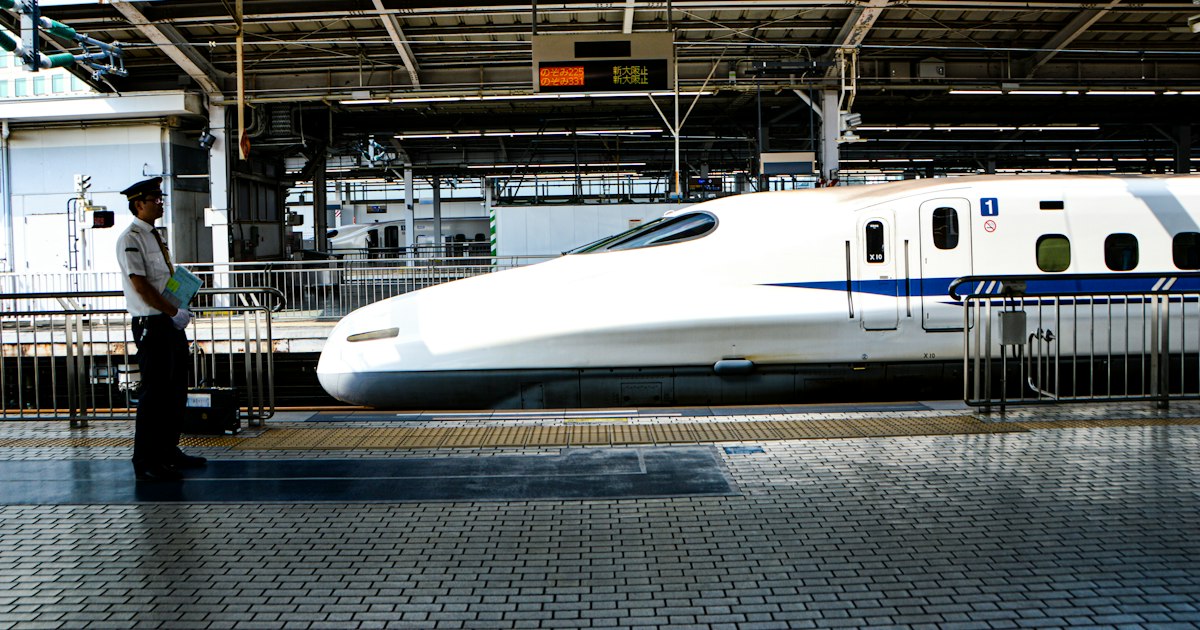
Photo by henry perks on Unsplash
If you’re touring Japan with an instrument, the Shinkansen is almost always your fastest and most comfortable option — but it isn’t a free-for-all with luggage. Japan Railways has a specific rule for anything bulky, and a cello, full-size guitar or double bass can easily trip it. Get it wrong and you’ll either be charged on the spot, told to repack, or in the worst case, asked to leave your case behind. Here’s exactly how the rule works, how to book around it for free, and what to do if your instrument is simply too big to carry on.
The 160cm Rule: Measure Your Case Before You Book
Since May 2020, JR Central, JR West and JR Kyushu have run a size-based system on the Tokaido Shinkansen (Tokyo–Osaka), the Sanyo Shinkansen (Osaka–Hakata) and the Kyushu Shinkansen. The trigger isn’t weight — it’s the sum of your case’s three dimensions: length + width + depth.
- Under 160cm total: treat it like normal carry-on. Overhead rack, the gap between seat and wall, or your lap for anything small.
- 160cm to 250cm total: this is “oversized baggage” (特大荷物). You must reserve a seat with dedicated oversized-baggage space — and you must sit in that seat.
- Over 250cm total: not permitted as carry-on at all, with very few exceptions.
Where your gear lands matters a lot here. A standard 4/4 hard-shell cello case is roughly 125 x 50 x 30cm — a sum around 205cm, comfortably in the “must reserve” band. Most full-size acoustic guitar cases (dreadnought-style, around 104 x 43 x 15cm) sit right at the 160cm line, so some will require a reservation and some won’t depending on the exact case. Electric guitar and violin/viola cases are almost always under 160cm and need nothing extra. Measure your actual case with a tape measure before you travel — don’t guess.
Reserving the Oversized-Baggage Seat
The good news: this reservation is completely free, it’s just mandatory. When you book your Shinkansen ticket for the Tokaido, Sanyo or Kyushu lines, ask specifically for a “seat with oversized baggage space” (特大荷物スペースつき座席). This can be done at a staffed Midori-no-Madoguchi counter, at a ticket machine, through a travel agency, or via the Smart EX / EX-IC apps if you have a compatible payment card. If you’re traveling on a Japan Rail Pass, tell the exchange-office or ticket-counter staff when you pick your reserved seat — they can add the oversized space to a pass-covered seat at no extra charge.
These seats are limited — usually just a row at the back of a handful of specific cars per train, with the exact car shown on your ticket or booking screen. During Golden Week, Obon, the New Year holidays or cherry blossom season, they sell out fast, so reserve as far ahead as you can. Outside peak season, a day or two ahead is usually fine. If you land at Narita and need to get online quickly to lock in a reservation before a busy travel date, sorting out connectivity early is worth it — see Pocket WiFi vs. Data SIM at Narita for which counter option gets you online fastest.
One practical limit: each reserved space fits one oversized item. If you’re traveling with both a cello and an oversized suitcase, you’ll likely need two such reservations, which may mean two seats rather than one.
What Happens If You Skip the Reservation
You can still board without reserving, but if the conductor finds you with an oversized item in a regular seat, you’ll be charged a ¥1,000 handling fee on the spot, collected in cash. You may also be asked to move to the oversized-baggage seat if it’s free, or to check whether another passenger has already reserved it — in which case you’re in a genuinely awkward spot. Don’t count on winging it; reserve ahead, especially on busy routes like Tokyo–Osaka or Tokyo–Hiroshima.
Cellos, Double Basses and the 250cm Ceiling
Cellos are the instrument most musicians ask about, and the honest answer is: nearly every cello case clears 160cm but stays under 250cm, so the oversized seat reservation covers you. Double basses are a different story. A bass case’s length alone often runs 180–190cm, and once you add width and depth, the total routinely blows past 250cm — meaning it generally cannot travel as Shinkansen carry-on at all, case or no case.
For basses (and any instrument over the 250cm limit), the standard workaround is to ship it ahead using a door-to-door courier service like Yamato Transport (takkyubin) or Sagawa, which many hotels and venues can arrange. Expect roughly ¥3,000–¥6,000 for an oversized item depending on distance and exact size category, with next-day delivery being typical within the same region. Build that lead time into your schedule — don’t plan to ship a bass the morning of a same-day concert.
Other Shinkansen Lines Don’t Use This System
The 160cm reservation rule is specific to JR Central, JR West and JR Kyushu’s network. JR East’s Shinkansen lines — Tohoku, Joetsu, Hokuriku, Yamagata and Akita — along with JR Hokkaido’s Shinkansen, don’t currently run the same oversized-seat booking system. The general 250cm carry-on ceiling still applies in spirit, but there’s no dedicated reservation to make. In practice, many touring musicians on these lines simply buy an extra adjacent seat ticket and use it to secure space for the case, which conductors generally accept since you’ve paid for that seat. If you’re island-hopping or taking a scenic detour by a non-Shinkansen limited express instead — something like the Seibu Railway’s Red Arrow and Laview services out of Tokyo — the same logic applies: no formal oversized-baggage system, so a spare seat or the end-of-car luggage space is your best bet.
Common Mistakes to Avoid
- Assuming “it’s just a guitar, it’ll be fine”: many full-size cases are closer to the 160cm line than players expect. Measure first.
- Booking a seat without the oversized-baggage flag, then trying to add it later: these seats are assigned specifically, and you can’t swap into one after boarding if someone else has it.
- Not budgeting lead time for peak season: oversized seats vanish first on holiday weekends. Book as early as your itinerary allows.
- Forgetting the per-item limit: one reservation covers one oversized case, not a cello plus a large suitcase together.
- Planning a same-day bass shipment: courier delivery for oversized instruments is usually next-day, not instant.
With a quick measurement and a free reservation, moving a cello or guitar around Japan by Shinkansen is genuinely painless — it’s the musicians who skip the booking step who end up paying the ¥1,000 fee or scrambling at the gate.