Photo by Loris Boulinguez on Unsplash
Most visitors who want to see a Japanese fire ritual head straight to Narita-san Shinshoji, and for good reason — it’s spectacular. But Tokyo has its own goma (護摩) fire temples, places where Shingon Buddhist priests chant sutras while stoking flames believed to burn away worldly desires and deliver prayers to the gods, and most tourists never set foot in them. Nishiarai Daishi, tucked into the working-class streets of Adachi Ward, is the best of these — big enough to feel ceremonial, obscure enough that you’ll likely be the only non-Japanese visitor in the hall.
What Happens During a Goma Fire Ritual
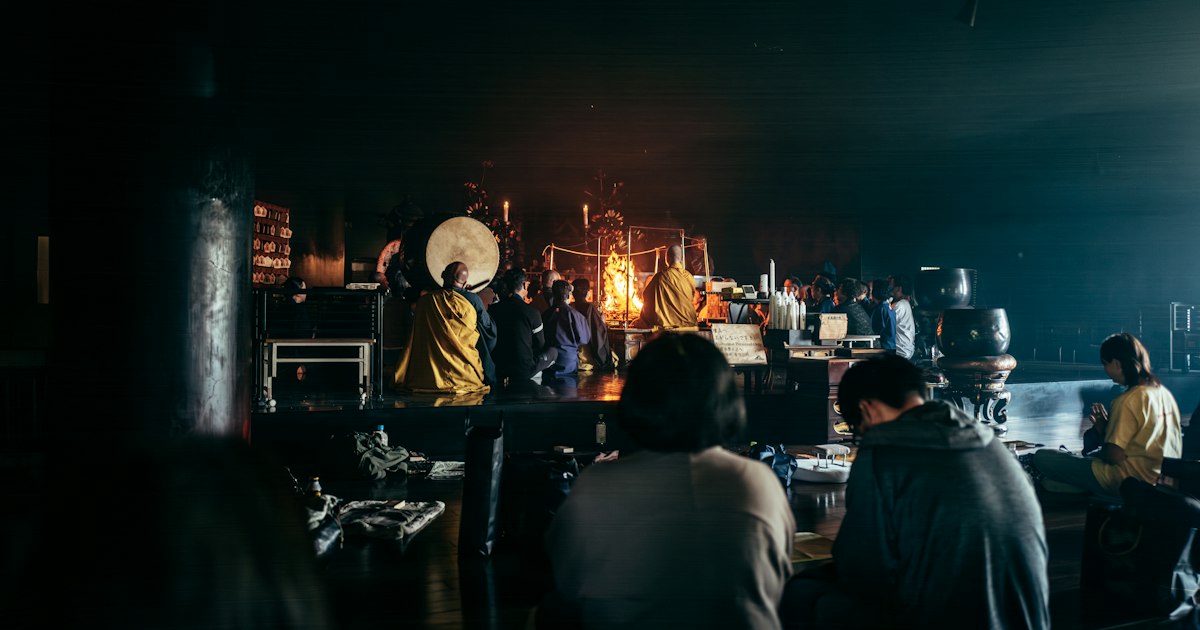
Goma is a Shingon esoteric Buddhist rite centered on Fudo Myoo (Acala), the fierce, sword-wielding deity who burns away ignorance and obstacles. A priest sits before a sunken hearth, feeds it wooden sticks inscribed with prayers (gomagi), and chants mantras while drums beat and flames leap, sometimes a meter or more. Smoke fills the hall, taiko drums thunder, and the air genuinely smells of cedar and incense. It’s one of the few Buddhist rituals in Japan where you can sit a few meters away and watch something loud, hot, and visually dramatic happen in real time — no reservation, no fee just to watch, and none of the crowd you’d fight through at Narita. If you’re the type who chases Japan’s bigger ritual spectacles — think the log-riding drama of the Onbashira Festival in Nagano — goma temples offer a smaller-scale, far more frequent version of that same intensity.
Nishiarai Daishi (Soji-ji): Adachi Ward’s Grand but Overlooked Fire Temple
Nishiarai Daishi’s formal name is Soji-ji, a Shingon Buzan-sect temple founded in the Heian period and traditionally grouped with Kawasaki Daishi as one of the region’s major “Daishi” (Kobo Daishi-dedicated) temples. The grounds are genuinely impressive: a vermilion main gate, a multi-story pagoda, a large main hall, and — if you visit in late April — a peony garden packed with blooms that draws its own crowd of camera-toting retirees. Despite all this, it barely registers on foreign-visitor itineraries, which is exactly the appeal. At New Year it’s one of the busiest hatsumode temples in greater Tokyo, pulling crowds in the hundreds of thousands over the first few days of January, but visit on an ordinary weekday and you’ll have the incense smoke mostly to yourself.
Goma rituals are held here with unusual frequency compared to most city temples — multiple times across the day on a regular basis, not just on a single monthly date — which makes it one of the easiest places in Tokyo to catch one without timing a special festival. That said, exact daily start times shift with the season and with the temple’s own calendar, so it’s worth checking the schedule board posted near the main hall entrance (in Japanese) or asking at the reception counter (nōkyōjo) when you arrive, rather than planning your whole day around a specific time found online in advance.
Getting There and When to Time Your Visit
The temple is served by its own tiny branch line: the Tobu Daishi Line, a single-stop shuttle running the short hop between Nishi-Arai Station (on the Tobu Skytree Line) and Nishiarai Daishi-mae Station, right at the temple’s gate. The ride takes about a minute. To get to Nishi-Arai Station itself, take the Tobu Skytree Line from Asakusa or connect via Kita-Senju from the Tokyo Metro/JR network — the whole trip from central Tokyo runs under 40 minutes door to door, with a fare well under ¥500 each way on an IC card.
Best timing: weekday mornings for a quiet, meditative visit; late April for the peony garden in bloom (go on a weekday to avoid the garden’s own fan crowd); and the first week of January if you want to see Tokyo hatsumode at full intensity rather than avoid it. Avoid Japanese national holidays that fall near the temple’s bigger seasonal events unless crowds are part of what you’re after.
What to Expect, Costs, and Temple Etiquette
Watching a goma ritual from the viewing area of the main hall is free. If you want to participate more directly — buying a wooden gomagi slat to write a wish on and have burned in the fire, or requesting a larger prayer petition for something specific like health or exam success — expect a posted price list at the counter, typically starting around ¥1,000 for a basic slat and rising toward ¥3,000–¥5,000 for bigger petitions. Goshuin temple stamp books are available for the usual ¥300–¥500 per stamp if you’re collecting them on your trip.
A few etiquette notes that trip up first-timers: remove hats before entering the main hall, keep your voice down during the chanting (phones on silent, no flash photography during the active ritual — check posted signs, since rules vary by hall), and don’t walk directly in front of seated worshippers who are praying. The ritual itself can run 20–40 minutes, so budget real time rather than popping in for five minutes expecting to catch the whole thing.
Two More Lesser-Known Goma Temples Worth the Detour
- Takahata Fudoson (Kongo-ji), Hino City — A Shingon temple in western Tokyo counted among the Kanto region’s most important Fudo Myoo temples, with its own dedicated goma hall and a famously packed New Year’s fire ritual. Reached via the Keio Line to Takahatafudo Station, it’s an easy add-on to a day exploring Tokyo’s quieter western suburbs.
- Meguro Fudoson (Ryusen-ji), Meguro Ward — One of Edo’s historic “five-color Fudo” temples, close enough to central Tokyo that you can combine it with a day of shopping or dining in Meguro. It’s a short walk from Fudomae Station on the Tokyu Meguro Line (a station literally named after the temple) and holds regular goma rites in its Fudo hall.
Neither draws meaningful tourist traffic, which means you can usually walk right up to the viewing area without jostling for a spot — a sharp contrast to Narita-san on a weekend.
Common Mistakes First-Time Visitors Make
The biggest one is showing up expecting a fixed, single daily showtime like a theater performance — goma schedules at smaller temples shift, and the only reliable fix is checking the board on-site or asking staff that morning. The second is treating it purely as a photo opportunity; priests and regular worshippers notice tourists filming through the whole ritual, and it reads as disrespectful even when unintentional. Third, people underestimate travel time on the smaller branch lines — the Tobu Daishi Line itself takes a minute, but connections to and from it can add 20–30 minutes if you misjudge transfers, so build in buffer rather than cutting it close to a specific goma start time.
Planning Your Day Trip
Adachi Ward isn’t set up for tourists the way Asakusa is, so plan your own comforts. For a budget break, chain coffee shops cluster around Nishi-Arai Station — if you’re weighing Doutor against a kissaten or Komeda’s loungier seating, our budget coffee shop showdown breaks down what you’re actually paying for. Mid-range travelers can treat this as a half-day loop combined with Meguro Fudoson or Takahata Fudoson on the same ticket. If you’d rather explore Adachi’s backstreets by bike between temple stops, renting or buying secondhand locally is common — just know that police do occasionally stop cyclists for registration checks, covered in our guide to koban bicycle checks. For a splurge, time your visit to New Year’s hatsumode or peony season and build in an extra hour simply to stand in the smoke and watch — it’s one of Tokyo’s few genuinely free, genuinely dramatic things to do that costs nothing but a little planning.