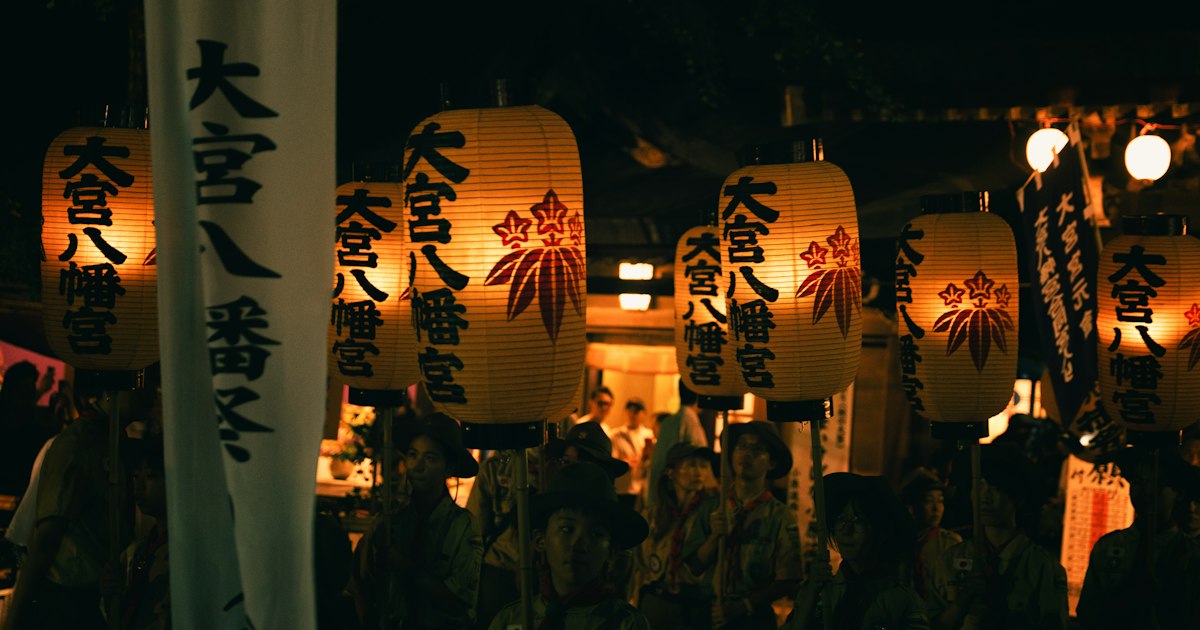
Photo by ayumi kubo on Unsplash
Every summer, two festivals with almost identical names light up neighboring cities in Aomori Prefecture, and visitors mix them up constantly. Aomori City’s Nebuta Matsuri gets the international fame, but 40 minutes away by train, Hirosaki runs its own version with fan-shaped lanterns, a different history, and a fraction of the crowds. If you’re planning a Tohoku summer trip and want the atmosphere of a major lantern festival without fighting for sidewalk space, Hirosaki’s Neputa Festival deserves a slot on the itinerary.
What Makes Neputa Different From Aomori’s Nebuta
The names sound like a typo of each other, and that’s not a coincidence — both trace back to the same Tsugaru-region bon lantern tradition. But the floats themselves are built on opposite principles. Aomori’s Nebuta are three-dimensional, almost sculptural warrior figures lit from within, designed to be seen in the round as they pass. Hirosaki’s Neputa are flat, fan-shaped (sensu-gata) lanterns, painted on both faces: the front carries a “kagami-e,” a fierce mirror image of a warrior or mythical figure, while the back has an “okuri-e” or “biting-e” — typically a serene, almost melancholic painting of a beautiful woman, sometimes with the word “mentsukoi” (roughly, “what a pity” in the local dialect) worked into the design. Dancers and drummers chant “Yah-ya-doh” as the floats roll past, a slower, more hypnotic rhythm than Nebuta’s energetic “Rasse-ra.”
Practically, this means Neputa is a quieter, more painterly festival to watch — you’re looking at moving artwork more than a dance party. Roughly 80 floats of varying sizes, from small neighborhood lanterns to towering centerpiece floats over 10 meters tall, take part across the week.
When to Go: Dates, Times, and the Parade Route
Hirosaki Neputa runs August 1–7 every year, overlapping almost entirely with Aomori’s Nebuta Matsuri — a deliberate historical alignment that lets Tsugaru-region families attend both. The schedule shifts slightly day to day:
- August 1–4: evening parade only, starting around 19:00 and running roughly two hours, moving toward JR Hirosaki Station.
- August 5–6: an additional daytime parade from around 10:00, plus the evening parade, with the route reversing to head toward the city center and Hirosaki Castle area.
- August 7: the finale, a morning-only “nukan-shiki” procession along Dote-machi, after which the lantern paintings are ceremonially removed before the frames are stored.
If you only have one evening in Hirosaki, aim for August 3–4: the full lineup of floats is typically out, the weather has usually settled into steady summer heat, and it’s before the final-night crowds. Arrive at your viewing spot at least 45 minutes early — the parade itself is a single pass, not a loop, so position matters more than patience.
Getting to Hirosaki
Hirosaki doesn’t have its own Shinkansen stop, which is part of why it stays less crowded than Aomori City. The standard route from Tokyo is the Tohoku Shinkansen to Shin-Aomori Station (about 3 hours), then a transfer to a local or limited-express train on the JR Ou Line to JR Hirosaki Station (35–50 minutes depending on the train). From Aomori Station itself, Hirosaki is a straightforward 35–40 minute ride on the Ou Line. If you’re coming from Akita or further south in Tohoku by rail, you can connect through Ou Line services without backtracking through Tokyo at all.
During festival week, book Hirosaki accommodation as early as you can — the city has far fewer hotel rooms than Aomori, and rates climb noticeably in the weeks before August 1. If Hirosaki rooms are sold out, staying in Aomori City and day-tripping in for the evening parade is a reasonable backup, since the last trains back run until around 22:30–23:00.
Where to Watch and What It Costs
Watching from the street is free, and most of the route along Dote-machi and near Hirosaki Station has open public sidewalk space. For a guaranteed seat, the city sells paid reserved viewing seating (yuryo kanran-seki) along part of the route, generally priced in the ¥2,000–3,000 range per seat — worth it if you’re traveling with kids, elderly family members, or simply don’t want to stand for two hours. These go on sale ahead of the festival through the city’s tourism office and sell out for the final weekend first.
Budget travelers can get the same view for free by claiming a spot at a street corner early; mid-range comfort means a reserved seat ticket; a splurge option some hotels and ryokan near the route offer is a festival-viewing package with dinner and a window or balcony seat overlooking the parade — ask when booking, as these are limited and not always advertised publicly.
Beyond the Parade: Neputa Village and Off-Season Viewing
If your trip doesn’t line up with early August, Tsugaru-han Neputa Village (ねぷた村) in central Hirosaki keeps a large Neputa float and related exhibits on permanent display, with live Tsugaru-shamisen performances several times a day. Admission is inexpensive — budget around ¥500–600 for an adult ticket — and it’s an easy way to see the lantern artwork up close, which you can’t really do mid-parade. It’s open daily, roughly 9:00–17:00, a short walk from Hirosaki Castle Park, so it pairs naturally with a visit to the castle grounds (spectacular for cherry blossoms in late April, if you’re weighing seasons).
Common Mistakes to Avoid
- Confusing it with Aomori Nebuta and booking the wrong city’s hotel. Double-check “Hirosaki” vs “Aomori” when reserving — they’re different cities 40 minutes apart, each with its own festival and hotel market.
- Showing up for the evening parade on August 7. The finale is a morning-only event; there’s no evening parade that day.
- Assuming you can see both festivals back to back easily. It’s possible, since dates overlap and the cities are close, but evening parades on both sides end late and trains thin out — plan a specific transfer time rather than winging it.
- Skipping sun protection for daytime parade days. The August 5–6 daytime parades run in full summer heat with little shade along most of the route.
Pairing Neputa With the Rest of Tohoku
Hirosaki works well as one stop on a wider Tohoku festival-and-scenery loop. If local lantern and ritual festivals interest you, the Onbashira Festival in Nagano is a very different but equally regional tradition worth knowing about for comparison, even though its six-year cycle means it won’t line up with most trips. For food along the way, Akita’s Hinai-jidori free-range chicken is worth seeking out if you’re routing through Akita Prefecture. And if you have extra days before or after the festival, Fukushima’s Tadami Line and the thatched-roof village of Ouchi-juku make a scenic, low-crowd detour on the way back south — a good contrast after a few loud festival nights in Aomori.