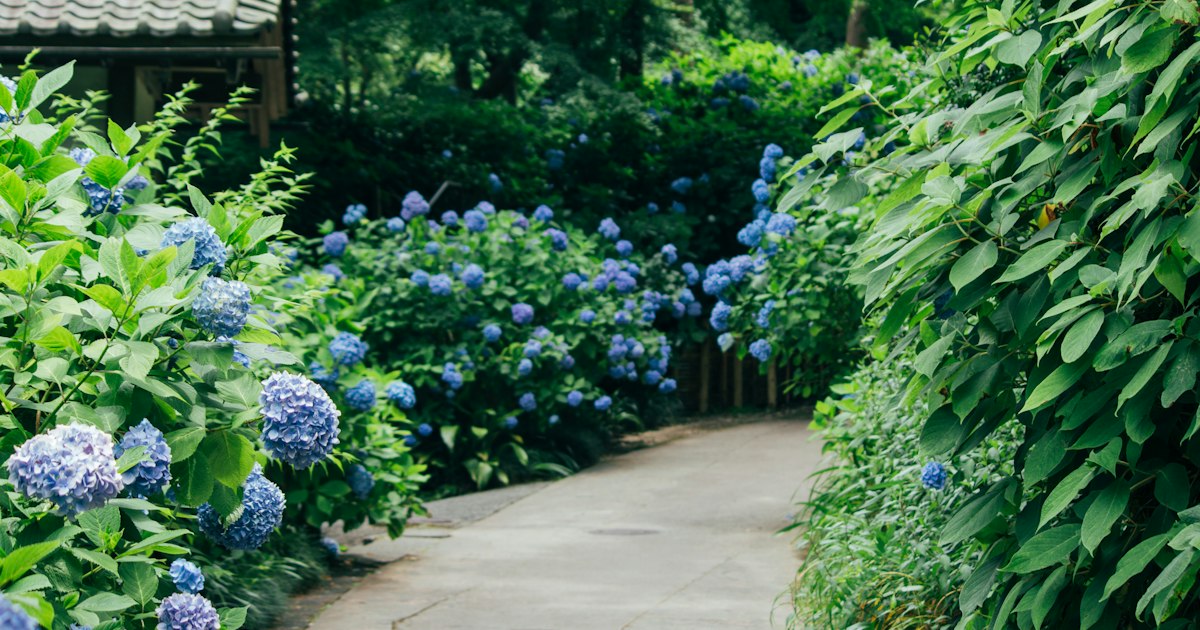
Photo by Atul Vinayak on Unsplash
Every June, Instagram fills up with photos of Meigetsu-in’s blue hydrangeas framing a round window in Kita-Kamakura. What those photos rarely show is the line: on a good weekend, visitors wait 60–90 minutes just to get through the gate, then shuffle past the flowers in a single-file crowd. A ten-minute train ride away, Hase-dera Temple has its own hydrangea path — arguably prettier, since it climbs a hillside with Sagami Bay as a backdrop — and a crowd-control system that, while not empty, actually works. Here’s how to do it right.
Why Hase-dera Instead of Meigetsu-in
Meigetsu-in (“Ajisai-dera,” the Hydrangea Temple) is small and essentially one-note: a single path of hydrangeas and that famous window. Hase-dera is a larger temple complex with a lot more to see even outside of flower season — an 11-meter wooden statue of Kannon (one of the largest wooden Buddhist statues in Japan), a sutra repository with a spinning wheel said to grant the merit of reading all the sutras if you turn it, a cave shrine to Benzaiten, and an observation terrace looking out over the rooftops of Hase and the ocean beyond. The hydrangea path itself runs up the hillside behind the main hall, so you get flowers and a sea view in the same frame — something Meigetsu-in’s valley setting can’t offer.
It’s not a secret spot. On a June weekend it’s busy too. But because the temple is bigger and the paths are more varied, the bottleneck is less severe, and the viewing system (below) keeps the worst crowding off the narrow sections of trail.
Getting There
From Kamakura Station, take the Enoshima Electric Railway (Enoden) toward Fujisawa and get off at Hase Station — it’s a 4-minute ride, roughly ¥200 one way. From Hase Station it’s about a 5-minute walk to the temple entrance. If you’d rather walk the whole way from Kamakura Station, it’s about 25–30 minutes on foot, flat and easy, passing through ordinary residential streets rather than anything scenic.
Hase-dera sits about 7 minutes on foot from Kotoku-in, home of the Great Buddha (Daibutsu), so most visitors pair the two in one trip. If you’re coming from Tokyo for the day, the JR Yokosuka Line from Tokyo, Shinagawa, or Yokohama runs direct to Kamakura Station (around 55 minutes from Tokyo Station, roughly ¥950 one way), where you transfer to the Enoden.
Season and Timing
Hydrangeas in Kamakura typically bloom from early June through early July, with peak color usually in the second and third weeks of June. Weather varies year to year, so if your trip dates are flexible, check a current bloom-status report (Kamakura’s tourism association and several Japanese weather sites post real-time hydrangea forecasts each spring) rather than planning purely off last year’s calendar.
Hase-dera opens at 8:00 and closes at 17:00 from March through September (16:30 October–February), with last entry 30 minutes before closing. During hydrangea season, go right at 8:00. The temple is noticeably calmer in the first hour, before tour groups and day-trippers arrive from Tokyo and Yokohama mid-morning. Weekday mornings are the single best window; Saturday and Sunday afternoons are the worst.
The Hydrangea Path and Its Ticket System
Admission to Hase-dera is ¥400 for adults and ¥200 for elementary school children, payable at the entrance gate. The hydrangea path is a separate, narrow hillside trail behind the main hall, and because it can only safely hold a limited number of people at once, the temple issues numbered entry tickets during peak bloom. You collect a number near the path entrance and wait until it’s called, rather than queuing in place — which means you can wander the main grounds, visit the Kannon hall, or get a drink while you wait instead of standing in a line. On a busy weekend the wait can still run 30–60 minutes for a number to come up, but it’s a far less miserable wait than Meigetsu-in’s standing queue, and the exact system (numbered tickets vs. timed entry) is adjusted year to year, so take the staff’s instructions on the day rather than assuming last year’s process applies exactly.
Once you’re on the path itself, budget 15–20 minutes to walk it at a comfortable pace with photo stops. Wear real shoes — the steps are uneven stone, and flip-flops or sandals are a genuine hazard on the way down.
Budget, Mid-Range, and Splurge Options Nearby
- Budget: Komachi-dori, Kamakura’s main shopping street near the station, has cheap snack stalls — shirasu (whitebait) rice bowls, croquettes, and soft-serve from around ¥300–¥500 — good for a light lunch before or after the temple.
- Mid-range: Several small restaurants along the road between Hase Station and the temple serve shirasu-don or tempura set lunches in the ¥1,200–¥2,000 range; arrive before noon to beat the lunch rush. Keep in mind that most of these places won’t pack up leftovers for you to take away — portions here are sized to be finished on the spot, which is worth knowing if you’re used to taking restaurant leftovers home.
- Splurge: Yuigahama Beach, a 10-minute walk from Hase-dera, has beachfront cafés with ocean-view seating where a seasonal set meal can run ¥3,000–¥5,000 — a nice way to end the day if the weather’s clear.
Common Mistakes to Avoid
- Going on a weekend afternoon. This is the single biggest crowd mistake. If your schedule allows any flexibility, shift to a weekday, or at least to the first hour after opening.
- Assuming hydrangea season lines up with sakura trip planning. These are different flowers on different calendars — hydrangeas are a early-summer bloom, nothing like the famously early Kawazu-zakura cherry blossoms in February. Don’t try to catch both on the same trip unless you’re visiting Japan twice in one year.
- Skipping the ticket/number step because the main grounds look uncrowded. The bottleneck is specifically on the hillside hydrangea trail, even when the rest of the temple feels calm. Check with staff at the hydrangea path entrance as soon as you arrive so you’re not caught off guard by a wait later.
- Not checking hotel costs and taxes if you’re staying overnight near Kamakura or basing yourself in Tokyo. If your itinerary includes a hotel stay in Tokyo, Kyoto, or Osaka around this trip, factor in the local accommodation tax (shukuhakuzei), which is charged per person per night on top of the room rate.
- Treating Hase-dera as a 20-minute stop. Between the Kannon hall, the Benten cave, the observation terrace, and the hydrangea path itself, most visitors spend 60–90 minutes here comfortably — build that into your day alongside the Great Buddha rather than rushing both.
Quick Reference
Hase-dera Temple, 3-11-2 Hase, Kamakura. Open 8:00–17:00 (March–September) or 8:00–16:30 (October–February); last entry 30 minutes before close. Admission ¥400 adults, ¥200 children. Nearest station: Hase Station on the Enoden line, 5 minutes on foot. Hydrangea season: roughly early June to early July, peak in mid-June. Arrive at opening on a weekday for the shortest waits, and ask about the numbered-ticket system for the hydrangea path as soon as you arrive.