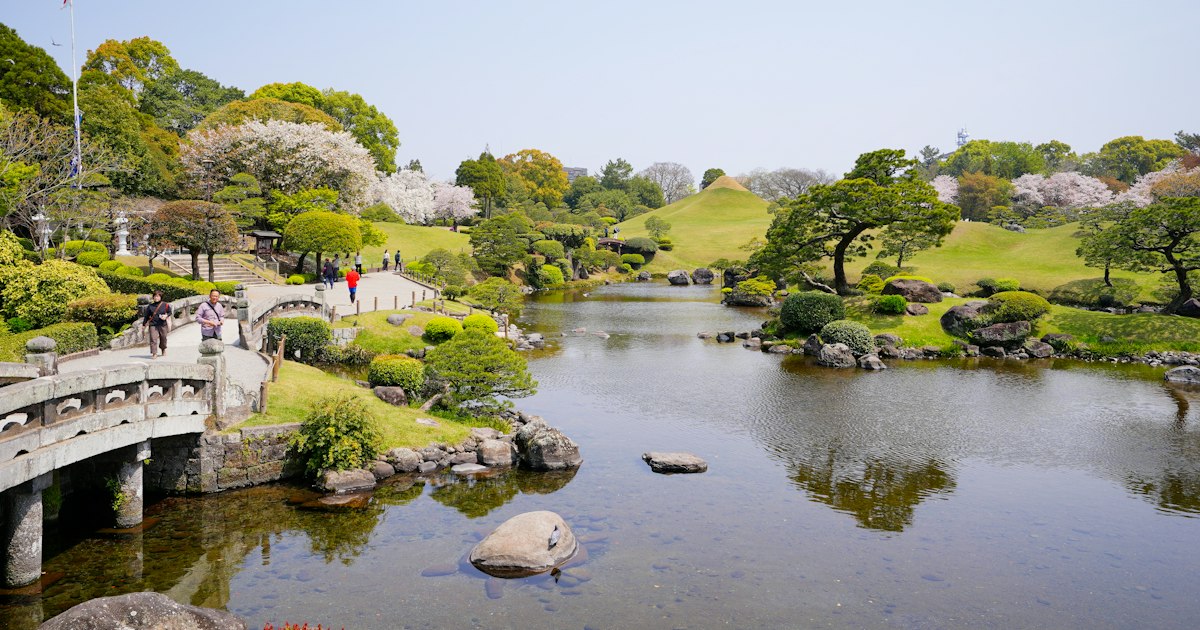
Most visitors to Kumamoto come for the castle and leave without realizing there’s a 17th-century garden a few tram stops away where someone built a scale model of the entire Tokaido road — including a grassy little hill standing in for Mount Fuji. Suizenji Jojuen is small enough to walk in under an hour, cheap enough that it barely dents a day’s budget, and specific enough in its symbolism that a little context before you go makes the visit far more rewarding than just wandering past a pond.
What Makes This Garden Different
Suizenji Jojuen (水前寺成趣園) was started in 1646 by Hosokawa Tadatoshi, the local feudal lord, and finished over three generations of his family by around 1671. It’s a kaiyu-shiki teien — a “stroll garden” meant to be walked around a central pond, with the scenery changing at every bend. What sets it apart from other Edo-period gardens is the theme: the paths, mounds, and plantings are a deliberate miniature of the Tokaido, the historic highway connecting Edo (Tokyo) and Kyoto. The famous grass-covered cone near the pond represents Mount Fuji, and other features nod to specific stations along the route. You don’t need to spot every reference to enjoy the walk, but knowing the garden is a condensed “road trip” changes how you read the layout.
If the idea of a pocket-sized Fuji has you thinking about the real mountain, it’s worth knowing the actual Fuji five lakes area is a very different kind of day trip logistically — our Fuji Hakone Pass vs Hakone Free Pass comparison covers how to get around that region if you’re adding it to a longer itinerary.
The Spring Water Story
The pond isn’t fed by a river or pump — it’s spring water that fell as rain on Mount Aso decades earlier and filtered slowly through volcanic rock before resurfacing here, which is also why Kumamoto City’s tap water is drawn entirely from groundwater rather than treated river water. The clarity of the pond is part of the attraction; on a calm morning you can see straight to the bottom in the shallows. This underground connection became headline news after the April 2016 Kumamoto earthquakes, when shifting groundwater flows caused the pond to visibly drop and parts of it to dry out for weeks. It has since recovered, but it’s a reminder that this “static” garden sits on an active, living water system.
Izumi Shrine and the Teahouse
Partway around the pond is Izumi Jinja, a shrine dedicated to the Hosokawa lords, popular with local families for shichi-go-san ceremonies and small weddings — you may well see one in progress. Nearby stands Kokindenju no Ma, a teahouse structure relocated here from Kyoto’s Imperial Palace grounds. You can sit on tatami, look out over the garden, and order matcha with a seasonal wagashi sweet for roughly ¥500–600. It’s an easy, low-pressure way to experience a tea ceremony-adjacent moment without booking a formal session.
Hours, Fees, and Getting There
The garden is open daily, no closed days. Opening hours run 7:30am–6:00pm from March through November, and 8:30am–5:00pm from December through February. Admission is ¥400 for adults and ¥200 for children (elementary through middle school); it’s a cash-at-the-gate operation, so bring small bills and coins.
From Kumamoto Station, the easiest route is the Kumamoto City Tram (shiden). Board a tram heading toward Kengun or Suizenji and ride roughly 20–25 minutes to the “Suizenjikoen” stop; it’s a short walk from there to the entrance. Tram fare is a flat rate of around ¥180–200 per ride, paid in cash or with an IC card as you exit. Buses also run from the station area to the same stop in about 30 minutes, but the tram is more straightforward for visitors unfamiliar with local bus routes. If you’re coming from Kumamoto Castle or the central Karashimacho area, the tram ride is shorter — closer to 10–15 minutes.
Best Time to Visit
Suizenji Jojuen is pleasant in every season, but a few windows stand out. Spring (late March into early April) brings cherry blossoms around the pond. Early summer, roughly May into June, is when irises bloom near the water’s edge and the greenery is at its most vivid — this is arguably the garden’s best-kept secret, since most Kumamoto visitors are timing trips around cherry blossoms or autumn color elsewhere. Autumn, typically mid-to-late November in this part of Kyushu, brings maple color around the teahouse area, a few weeks later than Kyoto or Tokyo. Midweek mornings right after opening are the quietest time of day — the garden is small, so even moderate tour-bus traffic midday can make it feel crowded.
Common Mistakes to Avoid
- Rushing through in 15 minutes. The garden’s full loop is walkable in under 20 minutes if you don’t stop, but that skips the point entirely — budget 45 minutes to an hour, including tea.
- Not bringing cash. Entry and the teahouse service are both cash-based; don’t assume card payment will be available.
- Treating it as a castle-day add-on without checking the clock. Many visitors pair Suizenji with Kumamoto Castle, but the garden closes earlier in winter (5pm) than people expect — check the season-specific hours above before planning your route.
- Skipping it because it’s “just a pond.” Without knowing the Tokaido theme, it’s easy to walk through without noticing the symbolism at all. Read up before you go, not after.
Budget, Mid-Range, and Splurge Options
Budget: Garden admission alone (¥400) is the whole experience if you’re tight on time or money — it’s one of the least expensive sightseeing stops in Kumamoto.
Mid-range: Add the matcha and wagashi set at Kokindenju no Ma (~¥500–600) for a proper sit-down pause, bringing the total to under ¥1,000.
Splurge / extend the day: Combine the garden with Kumamoto Castle and an evening at a private bath. If your itinerary includes an overnight somewhere with a ryokan, our guide to booking a private onsen room (kashikiri buro) is useful background for travelers heading on to Kyushu’s onsen towns after Kumamoto. And if gardens-as-destinations are your thing, our first-timer’s guide to the Hakone Open-Air Museum covers a very different but equally rewarding garden-and-art day trip on the other side of the country.
Suizenji Jojuen won’t take an entire day, and that’s exactly its appeal — it’s a tightly scoped, inexpensive, historically layered stop that fits neatly alongside Kumamoto Castle without demanding a detour. Go once you know what you’re looking at, and the miniature Fuji and the quiet spring water start to feel like more than just a pretty pond.