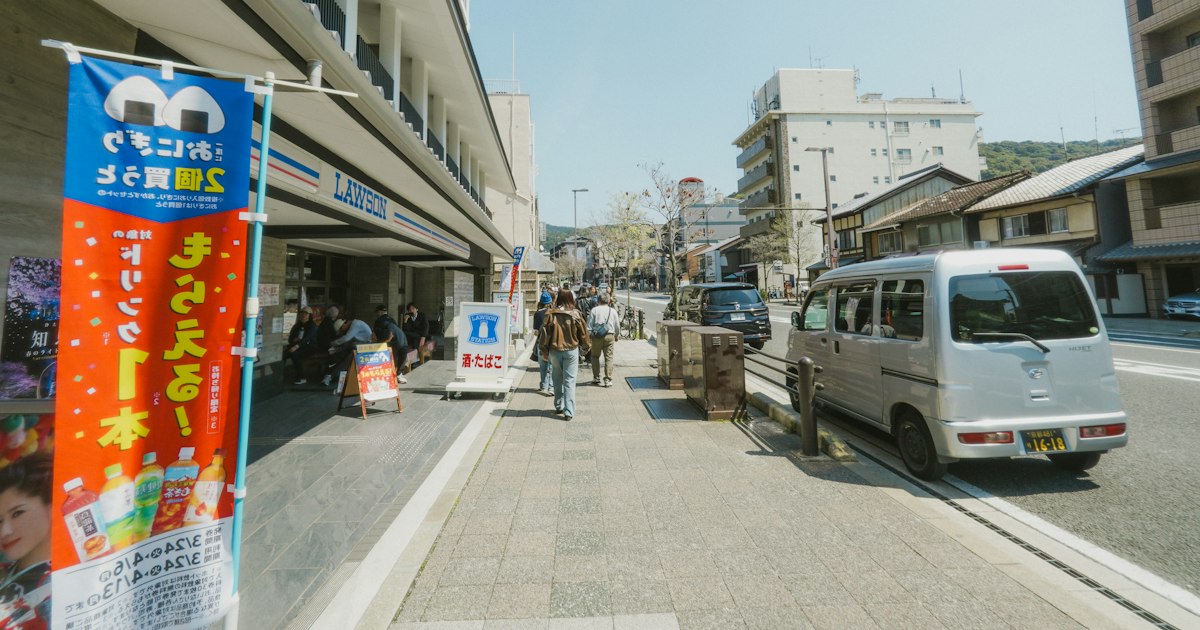
Every convenience store in Japan has a wall of triangular rice balls wrapped in crinkly plastic, and almost none of them have English labels. For a first-time visitor, onigiri shopping can feel like a gamble between tuna mayo and something you really don’t want at 7am. The good news is that you don’t need to read kanji to shop confidently — you just need to recognize a handful of recurring characters, colors, and package shapes. Here’s how to actually know what you’re buying.
Where to find onigiri and what they cost
The three big chains — 7-Eleven, Lawson, and FamilyMart — all stock onigiri, and you’ll find at least one of these stores within a few blocks almost anywhere in urban Japan, open 24 hours. Prices run from about ¥120 for simple pickled plum or salmon flake onigiri up to ¥180–¥240 for premium versions with thicker nori, better rice, or fillings like wagyu beef or uni (sea urchin). Each chain has its own standout: 7-Eleven’s grilled salmon (shio-zake) and FamilyMart’s tarako (cod roe) mayo are reliably good budget picks around ¥140–¥160. Lawson’s “Oniguiri” premium line, sold in a slightly thicker wrapper, runs closer to ¥200 and is worth the splurge if you’re curious about higher-end rice.
Supermarkets like Life, Seiyu, and Ito-Yokado also sell onigiri, usually a touch cheaper (¥100–¥130) but with a smaller selection and shorter shelf life — check the discount sticker that appears a few hours before the printed “best by” time, often cutting 20–50% off in the evening.
The anatomy of the wrapper label
Onigiri wrappers follow a near-universal layout, which makes pattern recognition easier even without reading ability. The filling name is almost always printed in large characters at the top center, often in a different color or font weight than the rest of the text. Below that, smaller text lists ingredients, allergens, calories, and the price. A photo of the cross-section (showing the filling inside the rice) is usually printed just below or beside the name — this single image is your most reliable clue, since photos of salmon flake, tuna mayo, and plum all look distinctly different even if you can’t read a word.
Look for the furigana (small hiragana characters floating above or beside kanji) — convenience stores often add these specifically so children and less-literate shoppers can sound out the word phonetically. If you’ve learned even basic hiragana, this turns an unreadable kanji compound into a readable syllable string.
The fillings you’ll see most often — and their kanji
- 梅 (ume) — pickled plum, sour and salty, usually the cheapest option (~¥120)
- 鮭 / さけ (sake) — grilled salmon flake, mild and widely liked by first-timers
- ツナマヨ (tsuna mayo) — tuna mayonnaise, written in katakana so it’s often easier to sound out; a safe, popular default
- たらこ / 明太子 (tarako / mentaiko) — cod roe, plain or spicy; salty and a little fishy-sharp
- 昆布 (kombu) — simmered kelp, savory and slightly sweet, vegetarian-friendly
- おかか (okaka) — bonito flakes in soy sauce, umami-forward but contains fish
- 焼肉 (yakiniku) — grilled beef, heartier and usually pricier (~¥180–¥220)
- からあげ (karaage) — fried chicken, a filling, kid-friendly option
Katakana fillings (written in the angular script, like ツナマヨ) are often loanwords or modern combinations, and they’re genuinely easier to puzzle out phonetically than kanji — “tsu-na-ma-yo” sounds close enough to “tuna mayo” to guess correctly even if you’ve never seen the characters before.
Reading allergen and dietary icons
Japan mandates labeling for seven major allergens, and convenience store onigiri wrappers list them in a small boxed section near the ingredients, usually under the heading アレルギー (allergy) or 特定原材料 (specified raw materials). Common ones to watch for: 卵 (egg), 乳 (dairy), 小麦 (wheat), そば (buckwheat/soba), 落花生 (peanut), えび (shrimp), かに (crab). Tuna mayo onigiri will list 卵 because Japanese mayonnaise is egg-based, which surprises some vegetarian travelers.
If you’re vegetarian, your safest bets are ume (plum), kombu (kelp), and some vegetable-only varieties, but double-check — bonito-based dashi stock sneaks into many “vegetable” fillings, including kombu occasionally. There’s no reliable universal vegetarian icon on these wrappers, so when in doubt, ask a staff member “kore, niku ya sakana ga haitte imasu ka?” (does this contain meat or fish?) or use a translation app’s camera function to scan the ingredient list directly.
The pull-tab trick nobody explains
Even once you’ve picked the right filling, onigiri wrappers have a famously counterintuitive opening mechanism designed to keep the nori seaweed crisp until the moment you eat it. The wrapper has two plastic tabs, usually numbered ① and ②, or marked with arrows. Pull tab ①, which splits the wrapper’s outer layer in half, then pull tab ② straight across horizontally — not downward. Done correctly, the entire wrapper comes away in one motion and the nori wraps itself around the rice as you unwrap it. Done wrong, you get a mangled mess of rice and plastic. If you’ve torn one apart in frustration before, you’re not alone — even some Japanese children struggle with this on the first few tries, which is why many wrappers include tiny numbered diagrams for self-instruction.
Seasonal and limited-edition onigiri
Convenience stores rotate limited-edition onigiri fillings seasonally, often tied to regional specialties or seasonal produce — think ikura (salmon roe) and kinoko (mushroom) varieties in autumn, or cold soba-inspired fillings in midsummer. These seasonal items usually carry a small colored banner (red or gold) on the wrapper reading 期間限定 (period-limited) or 新発売 (new release), so even without translating the filling name, that banner signals “this won’t be here next month, try it now.” If you enjoy exploring how Japanese cooks balance sweet and savory in small, everyday dishes, the seasonal rotation logic is similar to what you’ll find in home-style sides like kinpira gobo — simple ingredients, strong seasoning, and regional variation.
Common mistakes first-time buyers make
The most common misstep is assuming the cross-section photo matches the actual size of the filling — the pocket of filling inside is usually smaller than it looks pictured, concentrated right at the center. Another frequent mix-up is confusing mentaiko (spicy cod roe, orange-red and genuinely spicy) with plain tarako (not spicy) because both wrappers look similar at a glance — check for 辛 (spicy) or a red chili icon if you’re heat-sensitive. Travelers also sometimes microwave onigiri still wrapped in plastic out of habit; always unwrap it first, since the plastic-wrapped nori is meant to be removed before eating, not heated.
Lastly, don’t let the fear of picking “wrong” stop you from trying something unfamiliar — at ¥120–¥200 a piece, an onigiri is one of the lowest-stakes food experiments you’ll make in Japan. If you’re already building a self-guided food crawl through convenience stores and local eateries, pairing an onigiri with a side like satsuma-age or a light sunomono salad from the same store makes for a genuinely balanced, cheap meal — easily under ¥500 total.