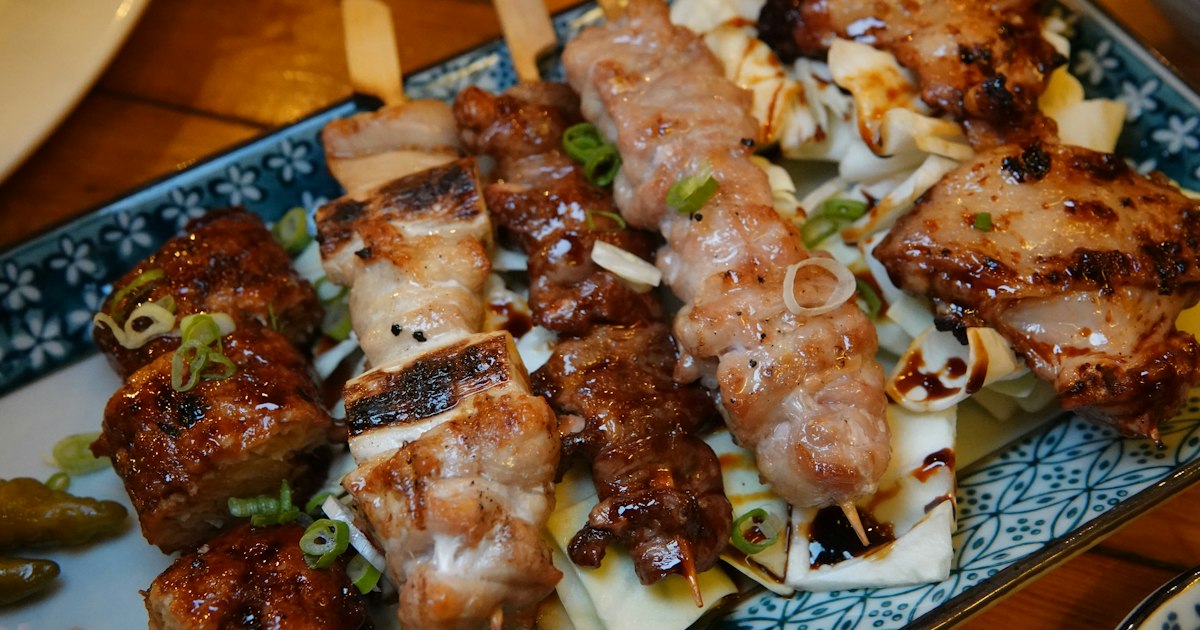
Of all the skewers lined up on a yakitori grill, tsukune is the one that trips up first-timers most. It isn’t a cut of chicken at all — it’s minced chicken formed into an oblong meatball, threaded onto a stick, and grilled over charcoal until the outside caramelizes and the inside stays juicy. Order it right and it’s one of the best bites in Japanese izakaya food; order it blind and you might miss the raw egg dip or end up with a sauce you didn’t want. Here’s how to find it, order it, and eat it like someone who’s done this before.
What Is Tsukune, Exactly?
Tsukune is ground chicken — usually thigh, sometimes a thigh-and-breast blend — mixed with grated ginger, scallion or onion, egg, and a starch binder, then hand-shaped around a skewer and grilled. Many shops fold in nankotsu (chicken cartilage) for a crunchy contrast against the tender meat; menus sometimes list this version separately as “nankotsu tsukune.” It’s distinct from other chicken skewers like negima (chicken thigh chunks with leek) or momo (plain thigh meat) — if you ask for “chicken skewer” without specifying, you’ll likely get one of those instead, so learn the word tsukune specifically if that’s what you’re after.
How to Order It Like a Local
Two decisions come up almost everywhere you order tsukune:
- Shio or tare? Shio means a salt-and-pepper finish that lets the ginger and chicken flavor come through. Tare is a sweet, slightly thick soy-mirin glaze brushed on during grilling — closer to a teriyaki flavor. If the server asks “shio ka tare?” and you have no preference, tare is the safer crowd-pleaser; shio is better if you’ve already ordered several sauced items.
- Raw egg dip? Better yakitori-ya offer tsukune no tamago-otoshi — a small bowl of raw egg yolk (sometimes a whole raw egg) for dipping the skewer before each bite. It sounds risky to visitors, but Japan holds eggs to strict salmonella-testing and distribution-chill standards, and this is a completely normal, safe order for most people. If you’re pregnant, immunocompromised, or just not an egg-dip person, simply say “tamago nashi de” (without the egg) when ordering.
Order two or three skewers at a time rather than everything at once — they come off a hot grill, and a tsukune that’s sat for ten minutes loses the crisp exterior that makes it worth ordering.
Where to Find Great Tsukune: Budget to Splurge
Budget (¥140–350 per skewer): Nationwide standing-bar chains like Torikizoku price every single skewer the same — around ¥350 tax included — which makes it easy to sample tsukune alongside five or six other cuts without doing math. These chains open around 15:00–17:00 and run until midnight or later, and you order by tapping a tablet at the table.
Mid-range (¥150–350 per skewer, courses from ¥3,000–5,000 per person): Independent yakitori-ya are the sweet spot for quality. Look for smoke drifting from a narrow shopfront with a charcoal grill visible from the street. Tokyo’s go-to hunting grounds are the yakitori alleys under the train tracks around Yurakucho and Shinbashi stations, and Omoide Yokocho near Shinjuku Station’s west exit; in Osaka, try the retro lanes of Shinsekai. Most independent shops open for dinner only, roughly 17:00–23:00, and many close on Sundays or Mondays — check before you walk over.
Splurge (courses often ¥8,000–20,000+ per person): A handful of yakitori specialists hold Michelin stars, serving an omakase-style procession of skewers where tsukune might be one of a dozen courses, each cut sourced from a specific chicken breed. These need reservations, often weeks ahead, and are worth it if you want to see how far a “humble” meatball skewer can go in skilled hands.
Convenience Store and Festival Tsukune: The Fast Option
You don’t need a restaurant at all. The hot food counter near the register at 7-Eleven, FamilyMart, and Lawson almost always stocks tsukune skewers for roughly ¥140–230, kept warm all day and restocked at intervals through opening hours (many urban branches are open 24 hours, but skewers are freshest around lunch and early evening restocks). It’s a genuinely good snack, not just a backup plan, and pairs well with an onigiri from the same counter if you’re assembling a quick meal between sightseeing stops.
At summer festivals (natsu matsuri, roughly July–August) and New Year shrine visits in early January, yatai food stalls sell tsukune for about ¥300–500 a stick — cash only, and lines move fast, so have coins ready.
Best Timing and Common Mistakes
Tsukune is a year-round food, but it shows up in two particular contexts worth planning around: summer festival stalls (for the atmosphere) and winter evenings (because a charcoal grill and a hot skewer are genuinely appealing once it’s cold out). Dinner service at most yakitori-ya starts around 17:00, and the best cuts can sell out by 21:00 at popular small shops, so going right at opening gets you the widest selection.
Mistakes visitors make most often:
- Assuming “chicken skewer” and “tsukune” are interchangeable — ask by name if that’s specifically what you want.
- Skipping the shio/tare choice and getting whatever the shop defaults to, then being surprised by the sweetness.
- Ordering an all-you-can-eat (tabehodai) course expecting unlimited tsukune — some premium or hand-formed items are often excluded from these courses, so check the fine print on the menu.
- Over-ordering in one go at a grill-focused shop, so half the plate arrives lukewarm.
Pairing Tsukune with the Rest of Your Meal
Tsukune’s richness holds up well against a cold beer or a glass of chilled sake, and most yakitori-ya have both on hand. If you’re building out a fuller food itinerary for your trip, it’s worth contrasting a smoky, grilled meal like this with something completely different the next day — a bowl of Wakayama-style ramen is a good change of pace, and finishing any hot meal with something cold and sweet like Yukimi Daifuku from the same convenience store you got your onigiri from rounds out a genuinely satisfying, low-cost day of eating.
Tsukune rarely gets top billing on a menu the way sushi or ramen does, but it’s exactly the kind of dish that rewards a little vocabulary and a little curiosity — order it by name, pick your sauce, and you’ll have one of the best few hundred yen you spend in Japan.