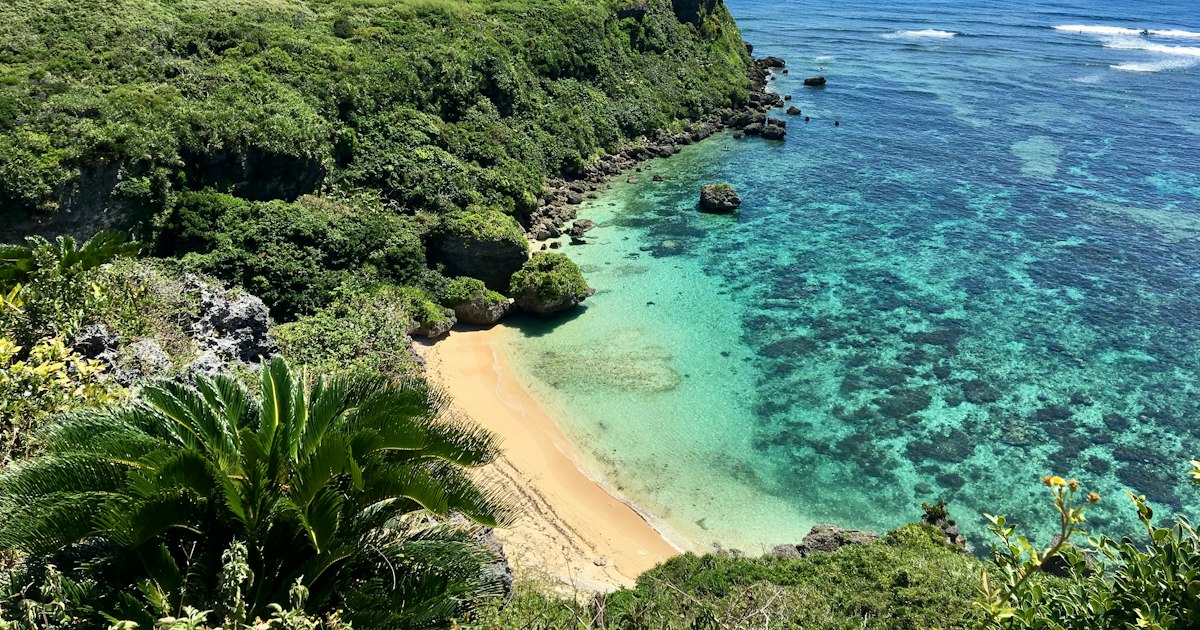
Photo by Yasuaki Uechi on Unsplash
Cape Manzamo is the single most photographed stretch of coastline on Okinawa’s main island, and for good reason: a limestone cliff shaped unmistakably like an elephant dipping its trunk into the East China Sea, with turquoise water crashing against the rock below. It’s also squarely on the Naha-to-Churaumi-Aquarium tour bus circuit, which means midday visits can feel more like a parking lot than a nature spot. The good news is that with a little timing and a rental car, you can see Manzamo at its best and barely share it with anyone.
What Manzamo Actually Is (and Why It’s Called That)
Manzamo sits in Onna Village on Okinawa’s west coast, inside the Okinawa Kaigan Quasi-National Park. The name translates roughly to “a field where ten thousand people could sit,” a phrase attributed to the 18th-century Ryukyu king Sho Kei, who is said to have admired the view from this exact clifftop. The star attraction is a wave-eroded limestone outcrop that juts into the sea in the unmistakable curve of an elephant’s trunk — most visible from the main observation deck rather than from directly above it, so don’t be surprised if the “trunk” isn’t obvious the moment you arrive. Give it a minute and the right angle and it clicks into place.
Entry is free and the site is open to the public with no gate hours, though the visitor facilities (described below) run on a daytime schedule. There’s no ticket booth, no reservation, and no entrance fee — a rarity for a sight this famous.
Getting There: Your Realistic Options
A rental car is genuinely the best way to reach Manzamo. From Naha Airport it’s about 60–75 minutes via the Okinawa Expressway (exit at Okinawa Minami IC, toll roughly ¥700–900 for a standard car) followed by local roads, or closer to 90 minutes if you take the scenic coastal Route 58 the whole way without expressway tolls. GPS/car navigation apps handle it fine, but if you’re relying on your phone’s data connection for turn-by-turn directions through rural stretches of Onna Village, it’s worth sorting out your eSIM situation before you leave Naha — see SIM Card or eSIM Won’t Connect in Japan? Try These Fixes Before You Give Up if you hit trouble mid-drive.
Because Manzamo is a cliff-edge car park with no train line anywhere near it, public buses exist along Route 58 but drop you a 15–20 minute walk away at best, which isn’t pleasant in Okinawa’s heat and humidity. Taxis from Naha run upward of ¥10,000 one-way and aren’t meant to wait around for you, so they only make sense as part of a private day-tour booking. If you’re renting a car for the trip, it’s worth understanding how Japan’s standard rental insurance actually works before you drive on unfamiliar coastal roads — the excess waiver details are covered in Rental Car Damage in Japan: How the NOC Insurance Excess Waiver Actually Works.
Parking at Manzamo is free, with a large lot (several hundred spaces) that separates car and tour-bus parking. The lot rarely fills completely, but the walk from the farthest car spaces to the viewpoint still takes a few extra minutes during peak hours.
When to Go: Beating the Tour-Bus Rush
This is the part that actually matters. Manzamo is a fixed stop on nearly every Naha–Churaumi Aquarium coach tour itinerary, and those buses cluster heavily between roughly 10:00 and 15:00, with the worst crush around midday when multiple tours overlap at once. The fix is simple: arrive right at opening in the early morning, or come in the late afternoon heading toward sunset.
- Best time: Sunrise to around 8:30am, before the first tour buses arrive — the cliff and water are at their most dramatic in soft morning light, and you may have the main viewpoint almost to yourself.
- Second-best time: Roughly 90 minutes before sunset through sunset itself. Manzamo faces west, making it one of Okinawa’s best sunset-watching spots, and by then most tour groups have moved on to dinner or their next stop.
- Avoid: Weekends and Japanese holidays between late morning and mid-afternoon, especially in the busy summer season (July–September) and around Golden Week in early May.
Best overall season is spring (April–May) or autumn (October–November), when temperatures are more bearable than Okinawa’s brutal summer humidity and typhoon risk is lower. If you’re traveling in September or October, check typhoon forecasts before committing to a specific day — the cliffside paths close in high wind and heavy swell.
What to Actually Do Once You’re There
From the parking lot, a short paved, stroller- and wheelchair-friendly path (about 5–10 minutes) leads to the main observation area, where the elephant-trunk rock formation comes into full view below and to the side. Stick to the marked paths and railings — the limestone edges are sharper and more crumbly than they look, and there’s no barrier stopping you from wandering dangerously close to unstable drop-offs if you go off-trail.
The Manza Information Center, a modern visitor building near the parking area, has restrooms, a souvenir shop selling Okinawan snacks and crafts, and a small café, generally operating from about 9:00am to 6:00pm (hours can shift seasonally). It’s a sensible stop for a cold Okinawan blue-sky-colored soda or salt-flavored soft-serve ice cream (roughly ¥400–500) rather than a destination in itself.
Budget: The visit itself costs nothing beyond transport — pack your own water and snacks and treat it as a free stop on a self-driven loop. Mid-range: Combine it with lunch at one of the seafood or Okinawan-soba restaurants along Route 58 near Onna Village (around ¥1,000–1,800 per person). Splurge: Several luxury resorts sit along this same stretch of coastline (the Busena area a bit further north is one cluster), so this makes an easy half-day add-on if you’re already staying west-coast rather than in Naha.
Common Mistakes Worth Avoiding
- Arriving at 11am thinking you’ll “beat the crowds”: that’s peak tour-bus hour, not off-peak.
- Treating it as a half-day destination: most independent visitors spend 30–45 minutes here, including the information center. Build it into a bigger west-coast loop rather than a dedicated round trip.
- Skipping the information center entirely: it’s the only reliable restroom stop for a while if you’re continuing north toward Nago and Churaumi Aquarium.
- Ignoring wind warnings: on gusty days, staff may rope off the outermost viewpoint. Don’t try to duck around barriers for a better photo.
Building a Full Day Around It
Manzamo pairs naturally with a west-coast Okinawa day trip: American Village’s shops and cafés near Chatan to the south, Moon Beach or Busena Marine Park for swimming and glass-bottom boats, and Churaumi Aquarium another 40–50 minutes north if you have a full day to spend. If dramatic natural rock coastlines are your thing beyond Okinawa, Aomori’s Hotokegaura white rock coast on the opposite end of the country is a striking, far less crowded counterpart worth comparing — both are proof that Japan’s coastline rewards travelers willing to look past the headline sights in the guidebooks.
However you build the day, Manzamo itself takes under an hour to appreciate properly. The trick isn’t finding extra things to do there — it’s simply showing up before the buses do.