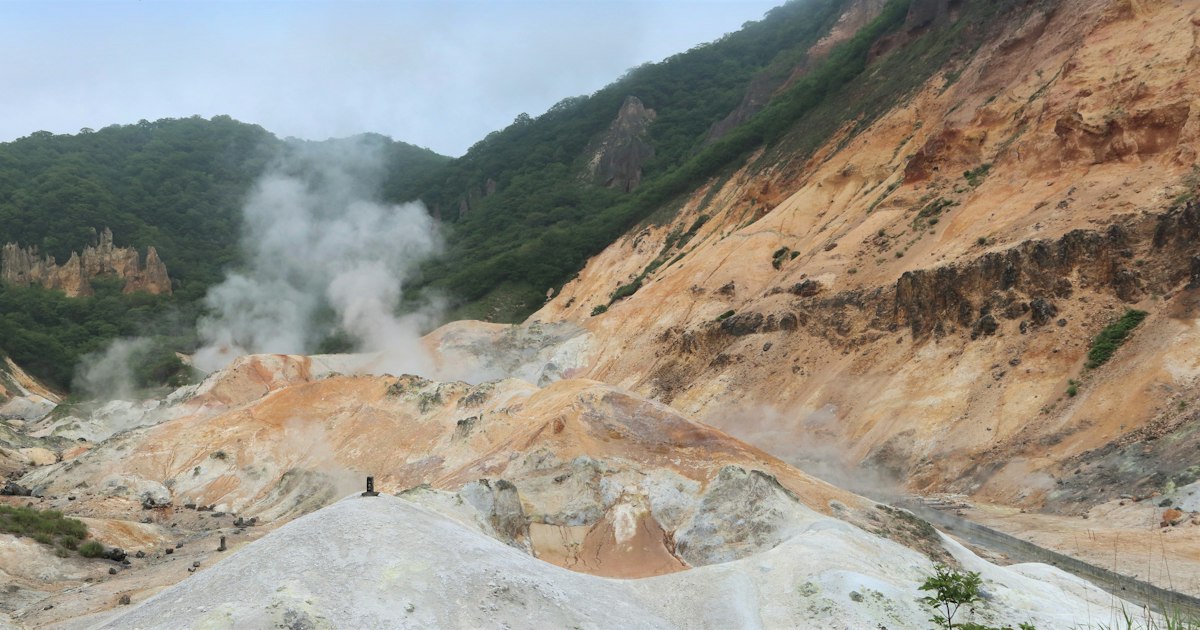
Few places in Japan live up to their reputation as literally as Osorezan. The name means “Mount Fear,” and the barren, sulfur-streaked volcanic basin on Aomori’s Shimokita Peninsula has been treated as one of the actual entrances to hell for over a thousand years. It’s remote, it’s strange, and if you time your visit right, you may witness blind mediums channeling the voices of the dead for a line of grieving visitors. This guide covers what you’ll actually see, what it costs, and how to get there without wasting a day of your trip.
What Makes Osorezan “Hell on Earth”
Osorezan sits inside an active volcanic caldera, and the ground shows it. Vents hiss steam, the rocks are bleached white and yellow with sulfur deposits, and the air carries a sharp rotten-egg smell the moment you step out of the car. Walking paths wind through named “hells” (jigoku) — Chi no Ike Jigoku (Bloody Pond Hell), Shine no Umi (Sea of Death), and others — each a small barren crater or discolored pool meant to represent a Buddhist realm of suffering.
The path eventually opens onto Lake Usori, an eerily still, milky turquoise crater lake that contrasts with the grey volcanic rock around it. Near the shore is Sai no Kawara, a riverbed scattered with small stone cairns and pinwheels left by parents for children who died young — in Japanese Buddhist folklore, this is where the souls of children gather to wait for passage to the afterlife. It’s one of the most quietly affecting sights in the country; plan to spend at least 45–60 minutes walking the full loop rather than rushing through.
The Blind Itako and Their Spirit-Channeling Kuchiyose
Osorezan’s fame comes from the itako, traditionally blind women trained from childhood to perform kuchiyose — a ritual in which they go into a trance-like chant and speak as the voice of a deceased relative on behalf of the person consulting them. It’s genuinely moving to watch even if you don’t understand the dialect being spoken; many visitors come specifically to have a session with a recently lost parent, spouse, or child.
The important thing to know: itako are not stationed at Osorezan year-round. The tradition has aged out considerably, and today mediums gather mainly for two festival periods — the Osorezan Taisai (Grand Festival), held around July 20–24, and a smaller autumn festival in early-to-mid October. Outside those windows you can still visit the temple and hell valley, but you likely won’t find an itako on site. If seeing a kuchiyose session is your main reason for coming, build your trip around the July festival dates specifically — check the current year’s exact dates with Mutsu City tourism before booking travel, since they shift slightly year to year. A reading typically costs somewhere in the ¥3,000–4,000 range and is conducted in Japanese, so going with a Japanese-speaking companion or guide makes a real difference.
Bodaiji Temple and the Free Hot Spring Baths
The temple complex itself, Osorezan Bodaiji, was founded in 862 by the monk Ennin and belongs to the Soto Zen sect. Admission to the temple and hell-valley grounds is ¥500 for adults (children pay less). Inside the grounds you’ll also find several rustic, free-to-use hot spring bathhouses — simple wooden huts fed by the same volcanic water that creates the “hells” outside. They’re basic (bring your own towel, no soap allowed, gender-separated), but soaking in sulfur water a few steps from a literal hell valley is one of the more memorable baths you’ll take in Japan. Towels and basic supplies can be bought cheaply at the entrance if you forget yours.
How to Get to Osorezan
Osorezan is genuinely out of the way, which is part of its appeal but also means you need a plan. It sits about 15 km from central Mutsu City on a mountain road through cedar forest.
- From Aomori: Take a highway bus or drive from Aomori City or Shin-Aomori Station to Mutsu Bus Terminal (roughly 2.5–3 hours), then continue to Osorezan by taxi, rental car, or a seasonal shuttle bus that runs during the festival periods.
- By train: JR Ominato Line connects Noheji Station to Ominato Station near Mutsu; from there it’s a taxi or bus the rest of the way.
- By car: This is by far the easiest option if you’re comfortable driving in Japan — the Mutsu–Osorezan road is well-paved but narrow and winding, and a car lets you combine the trip with other spots on the Shimokita Peninsula.
If you’re relying on your phone for maps and transit info out here, be aware that Shimokita Peninsula has patchy coverage in spots; it’s worth knowing the fixes in this guide to SIM and eSIM connection problems before you set off, and keep in mind that rural public phone booths still exist for genuine emergencies in areas like this.
Best Time to Visit and Opening Hours
Osorezan closes completely for winter. The site is generally open from May 1 through October 31, with daily hours roughly 6:00 to 18:00 (these can shift slightly by season, so confirm locally if visiting at the edges of the window). Heavy snow makes the mountain road impassable outside this period, so there’s no way to visit in winter regardless of how you’re traveling.
For atmosphere alone, a clear summer or early autumn day works well — the sulfur smell and stark white rock are striking in good light. For the fullest experience, aim for the July Taisai festival week when the itako are present and the grounds are busiest with pilgrims; if you’d rather have the eerie landscape to yourself, a quiet weekday in September is a good compromise.
Common Mistakes to Avoid
- Assuming you can see an itako any day you show up. As noted above, they’re mainly present during the two festival windows — check dates before planning a special trip around this.
- Underestimating the access time. This isn’t a quick stop on the way to somewhere else; budget most of a day from Aomori City, especially without your own car.
- Treating it as just a scenic stop. This is an active site of mourning and pilgrimage — many visitors are there to grieve. Keep voices down and be respectful around Sai no Kawara in particular.
- Not checking seasonal closure dates. Arriving outside the May–October window means a locked gate and a wasted drive.
Where to Stay and Budget Notes
Mutsu City is the practical base, with simple business hotels running roughly ¥6,000–9,000 a night. There are also a small number of temple lodgings (shukubo) near Osorezan itself for travelers who want to wake up next to the hell valley — book these well ahead of the July festival, as rooms fill fast. For a splurge, consider pairing the trip with an onsen ryokan stay elsewhere on the Shimokita Peninsula before or after your Osorezan day, since the peninsula’s coastline has some good traditional inns away from the main tourist circuit. If you enjoy offbeat, nature-heavy day trips like this one, the windswept coastline at Cape Erimo is a similarly remote, elemental destination worth comparing notes with, if a bit further afield in Hokkaido.