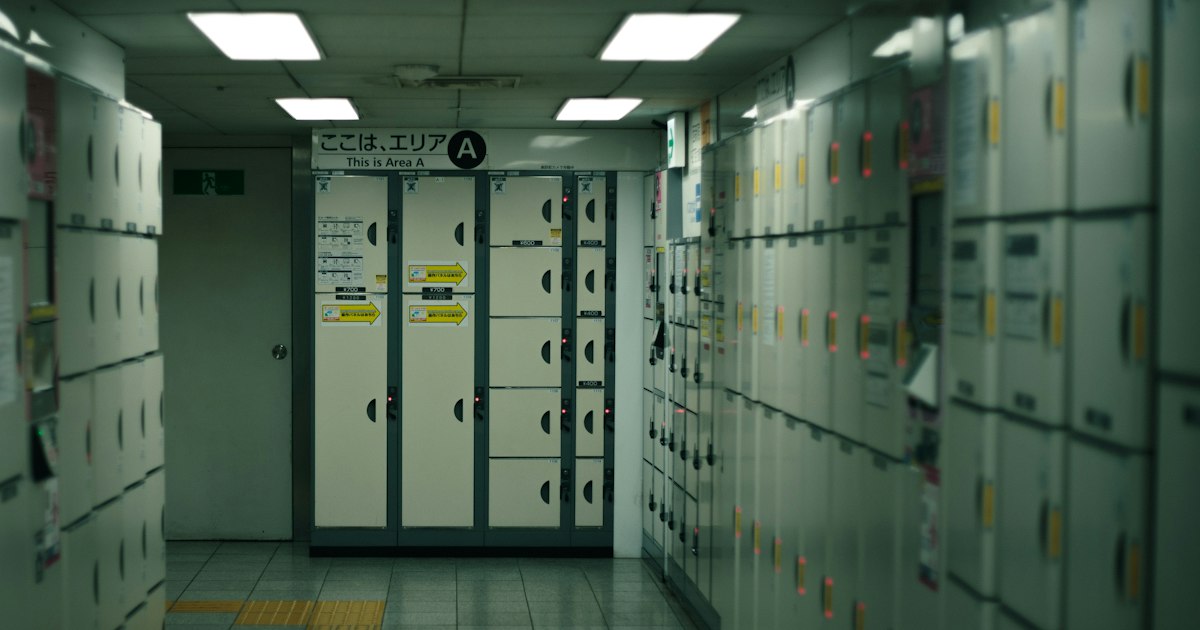
Photo by Thiago Yonamine on Unsplash
Nothing derails a good sightseeing day like dragging a suitcase up and down station stairs. Japan’s coin lockers solve this cheaply and reliably — but only if you know which size you need, how much cash (or IC card balance) to carry, and what to do when every locker at Kyoto or Shibuya Station is full, which happens more often than guidebooks admit. Here’s what actually works.
How Coin Lockers Work in Japan
Coin lockers are self-service, pay-on-entry storage units found at train and subway stations, airports, shopping malls, and tourist sites. You pick an empty locker, load your bag, pay, and take a key or a printed receipt with a QR code or PIN. Older lockers use physical keys; most stations have now switched to keyless systems where you pay by card, IC card (Suica, PASMO, ICOCA), or cash and unlock the locker later by scanning a receipt or entering a code at a touch panel.
Almost all lockers accept 100-yen coins, and newer touch-panel units take IC cards and sometimes credit cards. Carry a stack of 100-yen coins anyway — rural stations and older locker banks are still coin-only, and change machines nearby aren’t guaranteed.
One important rule: most coin lockers are day-use only, resetting at midnight or at the start of station operating hours (typically around 4:00-5:00 AM). If you leave a bag in overnight, you’ll usually owe an extra day’s fee, sometimes double, when you return. A few 24-hour lockers at major hubs like Tokyo, Shinjuku, and Osaka Station are built for multi-day storage and charge per calendar day instead.
Locker Sizes and Prices
Sizes are fairly standardized nationwide, though pricing varies slightly by operator (JR East, JR West, Kotsu Kaikan, and private mall operators all run their own networks):
- Small (S) — roughly 34 x 34 x 57 cm, fits a backpack or small daypack. ¥300-¥500/day.
- Medium (M) — roughly 57 x 34 x 57 cm, fits a carry-on suitcase (20-22 inch). ¥400-¥700/day.
- Large (L) — roughly 57 x 57 x 57 cm or bigger, fits a large checked suitcase. ¥600-¥900/day.
- Extra-large — found mainly at airports and Shinkansen hubs, big enough for oversized luggage or two suitcases. ¥800-¥1,200/day.
Budget travelers: a small locker is enough for a day pack while you explore, freeing you from carrying souvenirs or a jacket. Mid-range: most visitors need a medium locker for one rolling suitcase. Splurge/family trips: at Tokyo, Shin-Osaka, or Kyoto Station, book the extra-large lockers early in the day — they’re the first to sell out, especially during cherry blossom season (late March-early April) and autumn foliage season (mid-November), when everyone is switching hotels mid-trip.
Best Apps and Tools for Finding an Empty Locker
The single biggest headache with coin lockers isn’t cost — it’s availability. Popular stations sell out of lockers by mid-morning during peak travel weeks. A few tools help:
- Coin Locker Navi (coinlocker-navi.com) — a Japanese-run site and app showing real-time-ish locker locations and sizes at major stations in Tokyo, Osaka, Kyoto, and beyond. Not always live-updated for vacancy, but excellent for finding where locker banks physically are, since they’re often tucked behind concourses or on different floors than you’d expect.
- Google Maps — search “coin locker” near your station; user-submitted photos often show whether a bank looked full recently.
- Ecbo Cloak and Nimble Storage — apps that let you reserve luggage storage in advance at partner shops, cafes, and hotels rather than gambling on station lockers. Useful backup when lockers are the bottleneck, and bookable ahead of a big travel day.
None of these apps show live vacancy for every locker bank — Japan doesn’t have a unified national system — so the real strategy is arriving early (before 9:00 AM) or having a backup plan ready.
Where to Find Them: Stations, Airports, and Tourist Spots
Coin lockers cluster around ticket gates, but the biggest banks are usually one level up or down from the platforms, near coin locker signage (a suitcase icon with a key). At sprawling stations — Tokyo, Shinjuku, Osaka, Kyoto — lockers are scattered across multiple exits (Yaesu vs. Marunouchi side at Tokyo Station, for example), so check a locker map before you start walking with a heavy bag.
At airports, Narita and Haneda have locker banks in the arrival and departure lobbies, plus luggage forwarding counters (takkyubin) that can ship your suitcase ahead to your hotel or back to the airport for ¥2,000-¥3,000 — genuinely worth it if you’re doing a multi-city trip and don’t want to lug everything through every transfer.
Tourist areas with heavy foot traffic — Kyoto Station (the gateway if you’re heading to the Arashiyama Bamboo Grove), Asakusa, Dotonbori — also have locker banks, though these fill fast on weekends. If you’re day-tripping somewhere remote, like Amanohashidate or the boathouses at Ine no Funaya, check locker availability before you go — smaller stations may have only a handful of units, or none at all, and the nearest tourist information center is often your best bet for staffed storage instead.
Common Mistakes to Avoid
- Losing your receipt or key. Keyless lockers print a receipt with a barcode or PIN — photograph it immediately as backup. Losing it means finding station staff, showing ID, and possibly paying a fee to prove the bag is yours.
- Assuming 24-hour access. Many station lockers are only accessible during station operating hours, generally around 5:00 AM to midnight. If your locker is behind ticket gates, you’ll also need a valid ticket to reach it, which matters if you’re storing bags before an early Shinkansen and returning after using a different ticket.
- Not carrying coins. Even in cashless-friendly Japan, plenty of locker banks — especially outside big cities — are coin-only. Keep a stash of 100-yen coins for this exact purpose, alongside vending machines and Setsubun-season shrine offering boxes.
- Overpacking a locker last-minute. If you’re heading out shopping — for pottery in Mashiko or Bizen, or fountain pens in Jimbocho — remember lockers have fixed dimensions; fragile or oddly shaped purchases (a folded wagasa umbrella, boxed ceramics) may need to go in your carry bag instead, not jammed into a locker door.
When Lockers Are Full: Backup Options
If every locker at your station is taken, don’t panic. Larger stations often have a staffed baggage counter (temporarily storing bags for a flat daily fee, usually ¥500-¥1,000 per item, no size limit). Hotels — even before official check-in time — will almost always hold luggage for guests, and many now do so for non-guests too via the Ecbo Cloak network. Convenience stores don’t offer storage, but tourist information centers near major shrines and stations sometimes do, particularly in Kyoto and Nara.
For longer stretches — say you want your bags gone for several days while you island-hop or take a long-distance ferry — luggage forwarding (takkyubin, run by Yamato or Sagawa) is more reliable than hoping a locker stays free. Drop your suitcase at a hotel front desk or convenience store in the morning, and it typically arrives at your next hotel by early evening the next day for ¥1,500-¥3,000 depending on size and distance.
Plan your locker strategy the way you’d plan a train transfer: know the size you need, arrive early at busy stations, and always have a plan B. It’s a small detail, but it’s the difference between a relaxed day of sightseeing and an hour spent circling a station concourse with a suitcase.