Photo by Dynamic Hong Kong on Unsplash
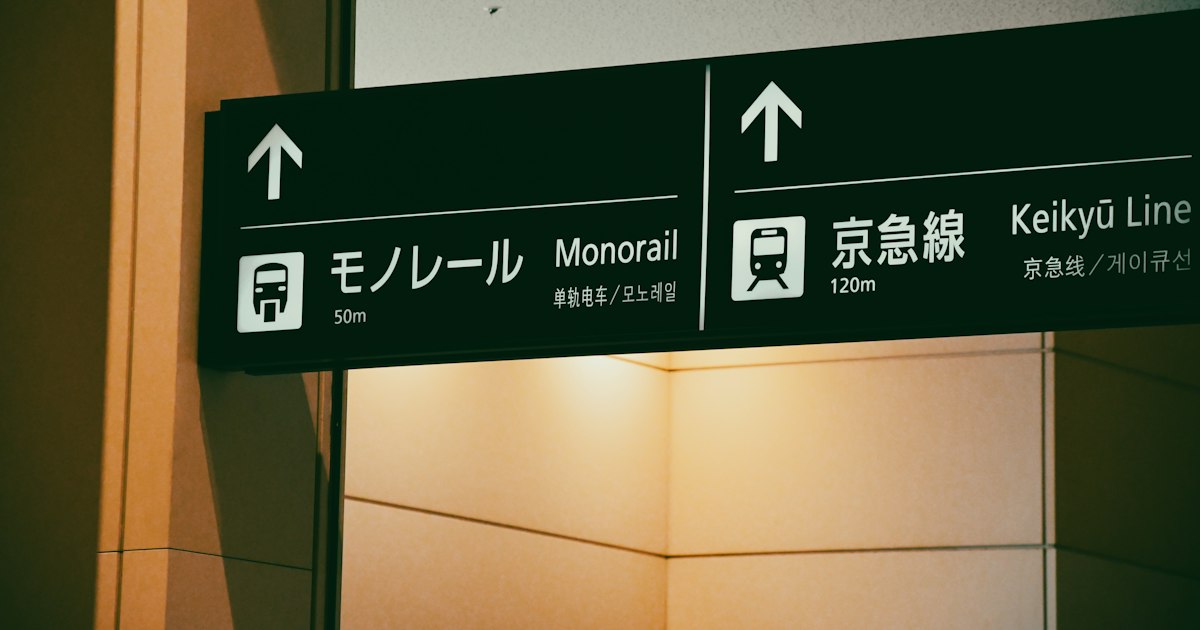
Landing at Haneda Airport puts you closer to central Tokyo than almost any other major international airport puts you to its city center — but that still leaves you with a choice the moment you clear customs. Do you take the Tokyo Monorail or the Keikyu Line? Both run from Haneda into the city in roughly the same amount of time, but they go to different stations, cost different amounts, and suit different travelers. Here’s how to pick the right one in about ten seconds flat.
The Two Options at a Glance
Both lines depart from stations directly inside the airport — Haneda Airport Terminal 1, Terminal 2, and Terminal 3 (international arrivals) — so you won’t need a shuttle bus to reach either platform. Signage in English is clear throughout both terminals, with escalators and elevators down to the ticket gates.
- Tokyo Monorail runs to Hamamatsucho Station, where it meets the JR Yamanote Line. Fastest trains (the Haneda Express) take about 13–15 minutes from Terminal 3; fare is around ¥500 with an IC card.
- Keikyu Line (Keikyu Airport Line) runs to Shinagawa Station, where it meets JR lines including the Tokaido Shinkansen. Fastest trains take about 13–20 minutes; fare is around ¥300 with an IC card.
Tokyo Monorail: Scenic and Convenient for the Yamanote Loop
The monorail glides above Tokyo Bay for part of the ride, so you get a real view — container ports, the bay, and on a clear day a glimpse of the Rainbow Bridge area — before the train dips inland toward Hamamatsucho. It’s a nice first (or last) impression of Tokyo if you’re not completely jet-lagged.
Hamamatsucho sits directly on the JR Yamanote Line, the loop line that touches Tokyo Station, Shimbashi, Shinjuku, Ikebukuro, and Ueno. If your hotel is anywhere on that loop, the monorail gets you there with just one more hop and no need to navigate the subway. At monorail ticket machines you can also buy a combined ticket bundling the monorail fare with one onward Yamanote Line ride for the same ¥500 total — worth asking about if you’re headed somewhere like Shinjuku or Ikebukuro, since it can work out cheaper than paying the two fares separately.
Keikyu Line: Cheaper and Better Connected South and East
The Keikyu Line is the budget pick — about ¥200 less than the monorail for a comparable trip — and it lands you at Shinagawa, a major Shinkansen and JR hub. If you’re continuing on to Yokohama, Kamakura, or catching a bullet train onward, Shinagawa is the more useful station to arrive at.
Keikyu’s other advantage is through-service: some trains continue past Shinagawa onto the Toei Asakusa Line without requiring a transfer, running all the way to Asakusa in around 45 minutes. That’s a genuinely handy shortcut if your first stop is Asakusa or if you’re planning a Sumida River water bus ride from there — you can go straight from the airport to the river without ever surfacing from the station network. A handful of Keikyu trains each day even continue through to Narita Airport via the Keisei line, which is occasionally useful for an airport-to-airport transfer, though it’s a long ride and most travelers are better off with the Narita Express or a bus for that specific trip.
Which One Should You Take?
In practice, the decision usually comes down to where you’re staying:
- Staying near Shinjuku, Ikebukuro, Ueno, or anywhere else directly on the Yamanote loop: take the monorail to Hamamatsucho.
- Staying near Shinagawa, Yokohama, or needing a Shinkansen connection: take Keikyu to Shinagawa.
- Staying in Asakusa or planning to head there first: take Keikyu and look for a train continuing through to the Toei Asakusa Line — check the platform display for “Asakusa-bound via Toei Asakusa Line” to avoid an unnecessary transfer.
- On a tight budget and not fussed about the view: Keikyu wins on price every time.
If you’re simply trying to get to Ginza, Shibuya, or Roppongi, either line works fine since you’ll be transferring once more regardless — pick whichever arrives at a station slightly closer to your transfer line.
Tickets, IC Cards, and Fares
The simplest approach for almost everyone is an IC card — Suica, Pasmo, or a tourist Welcome Suica bought at the airport. Tap in at the Haneda gate and tap out at Hamamatsucho or Shinagawa; the correct fare is deducted automatically and you skip the ticket machine entirely. Both lines also sell paper tickets from machines with English-language menus if you’d rather not deal with a card, though you’ll pay a slightly higher fare than the IC rate.
Avoid the common mistake of buying a ticket for the wrong train type: both lines run limited-stop express services and slower all-stop locals on the same tracks, and ticket machines don’t distinguish between them — the fare is the same, but local trains can take 10 minutes longer. Check the platform board for the fastest departure (Haneda Express on the monorail, Airport Limited Express on Keikyu) rather than just boarding the first train that pulls in.
Timing and Practical Tips
Both lines start running around 5am and the last trains leave Haneda a little after midnight, so late international arrivals are rarely stranded — but double-check the last-train time for your specific line on arrival night, since missing it means a considerably pricier taxi into the city. Morning rush hour (roughly 7:30–9am) and evening rush (5:30–7pm) make both lines crowded if you’re connecting to the Yamanote or Toei Asakusa Line at the city end, so build in a few extra minutes if you’re hauling large suitcases through those transfers.
Both stations have elevators and luggage-friendly routes throughout, so neither line is a bad choice if you’re dragging oversized bags. If you’ve got a layover feeling before you even leave the station area, Hamamatsucho and Shinagawa both have standing eki soba counters right near the platforms — a fast, cheap way to get your first real meal in Japan before heading to the hotel. And if the weather’s cold, both stations are stocked with hot canned coffee vending machines, a small but welcome reintroduction to Japan after a long flight.