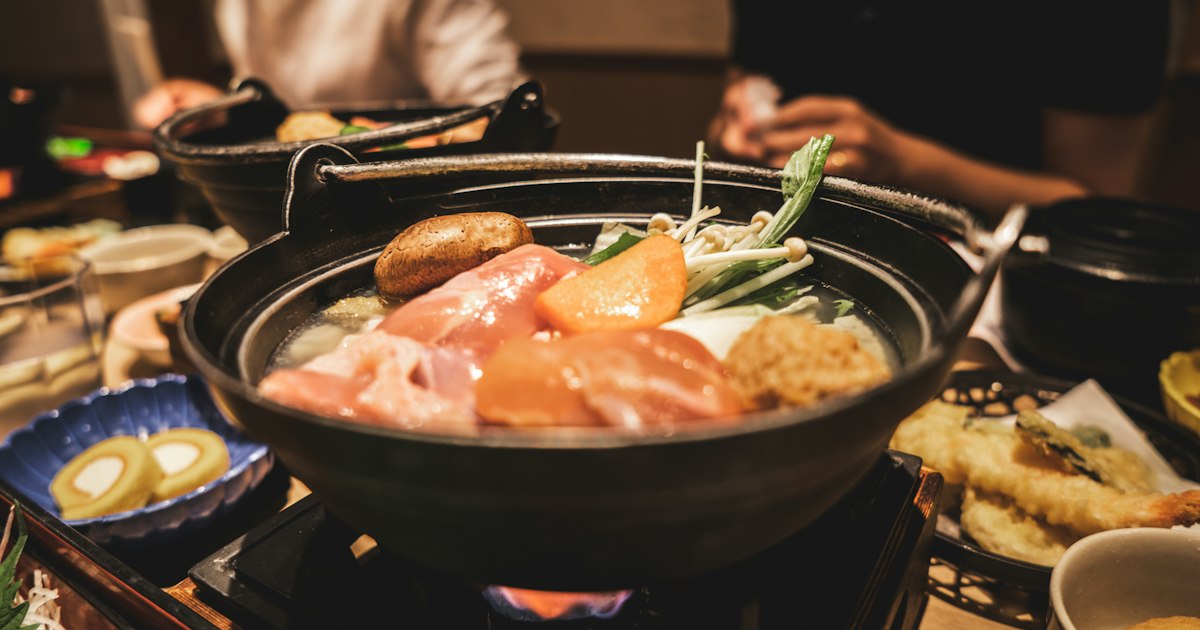
Photo by Alexandre Valdivia on Unsplash
When the mountains get their first real cold snap, menus across rural Japan quietly change. Deer, duck, and wild boar start showing up on chalkboards outside family-run restaurants, and one dish in particular draws people out of the cities: botan nabe, a miso-based hot pot built around thinly sliced wild boar. It’s hearty, a little rustic, and tied so tightly to winter that ordering it in July would get you a blank stare. Here’s what it actually is, when it’s on the menu, and where to go eat it.
What Is Botan Nabe, and Why Is It Shaped Like a Flower?
Botan nabe (牡丹鍋) is a hot pot of wild boar (inoshishi) simmered with vegetables in a miso-flavored broth — usually napa cabbage, burdock root, carrot, mushrooms, tofu, and konnyaku, with the boar providing a rich, slightly sweet fat that the miso balances out. The name comes from presentation: thinly sliced raw boar meat is fanned out in overlapping circles on the serving plate before cooking, resembling the layered petals of a botan (peony) flower.
That naming convention isn’t unique to boar. During the Edo period, eating four-legged animals carried a Buddhist stigma, so cooks gave game meats flower or plant code names: horse meat became sakura nabe (cherry blossom), venison became momiji nabe (maple leaf), and boar became botan nabe. The names stuck, and you’ll still see all three on menus in game-meat restaurants today — useful to know so you don’t accidentally order horse when you wanted boar.
When to Go: Wild Boar’s Narrow Winter Window
This is a genuinely seasonal dish. Wild boar hunting in Japan is tied to designated seasons that run roughly from mid-November through February, varying slightly by prefecture, and restaurants serving botan nabe generally only have it on the menu during these colder months — typically November through March, tapering off once spring arrives. Outside that window, even restaurants known for boar hot pot may switch to other game or take it off the menu entirely, so don’t build a summer itinerary around it.
The sweet spot is December through February, when the meat is considered fattiest and best, since boar put on weight heading into winter. If you’re already planning a cold-season trip, this pairs naturally with other winter-only street food — keep an eye out for yakiimo trucks roasting sweet potatoes on street corners, another seasonal marker that shows up around the same time.
Tokyo’s Easiest Option: Momonjiya in Ryogoku
You don’t have to leave the city to try it. Momonjiya, in Tokyo’s Ryogoku neighborhood (a 5–7 minute walk from JR Ryogoku Station or the Toei Oedo Line Ryogoku Station), has been serving wild game since 1718, making it one of Tokyo’s oldest continuously operating restaurants. It specializes in exactly this kind of cuisine — boar, venison, and other game — and botan nabe is its signature winter dish.
It’s old-fashioned in the best and most inconvenient sense: expect limited seating, a traditional interior, and a strong recommendation to reserve ahead rather than walk in, especially on winter weekends. Course meals here run firmly into splurge territory, but you’re paying for three centuries of history as much as the meal itself. Ryogoku is also home to the Sumo Museum and Edo-Tokyo Museum, so it’s easy to fold into a half-day in the area.
Tanba Sasayama, Japan’s Botan Nabe Capital
If you want the dish in its heartland, head to Tanba Sasayama in Hyogo Prefecture, widely considered the spiritual home of botan nabe. The surrounding mountains have long supplied boar fattened on acorns and chestnuts, and the old castle town — with its preserved Edo-era streets — fills with boar-hotpot banners every winter.
Getting there: from Osaka or Kyoto, take a limited express “Kounotori” train on the JR Fukuchiyama Line to Sasayama-guchi Station (roughly an hour from Osaka), then transfer to a local bus for about 15–20 minutes into the historic town center. It’s a comfortable day trip, though staying overnight lets you catch the castle town in the early morning before day-trippers arrive. Local shokudo and minshuku throughout town serve boar sets from November into March — walk the main streets and you’ll see handwritten menus advertising it everywhere.
Other Regions Worth the Detour
Sasayama isn’t the only option. A few other areas have their own strong boar hot pot traditions:
- Kutsuki, Takashima (Shiga Prefecture) — a mountain district near Lake Biwa known locally for its own version of shishi nabe, popular with day-trippers from Kyoto and Osaka.
- Hida region (Gifu Prefecture) — better known for Hida beef, but mountain inns here often serve boar hot pot alongside it in winter, giving you two specialties in one trip.
- Boso Peninsula (Chiba Prefecture) — wild boar numbers have grown sharply here in recent years, and local restaurants near the coast and inland hills increasingly feature inoshishi dishes as a result.
Many of these spots sit well outside train access and are far easier to reach with your own wheels — if you’re building a longer winter itinerary through rural Japan, renting a camper van is a practical way to chase boar hot pot towns without worrying about the last bus back.
Budget, Mid-Range, and Splurge Prices
Prices scale with how much of a production the meal is:
- Budget (around 3,000–4,500 JPY per person) — a single-pot botan nabe set at a casual local shokudo or izakaya, usually just the hot pot with rice and pickles.
- Mid-range (around 5,000–8,000 JPY per person) — a fuller set at a restaurant specializing in game meat, often including boar sashimi or tataki alongside the hot pot, plus noodles or rice cooked in the leftover broth at the end.
- Splurge (10,000–20,000 JPY per person) — multi-course kaiseki-style meals at historic restaurants like Momonjiya, or a ryokan stay in Tanba Sasayama with a full boar-centric dinner included in the room rate.
Some specialty butchers in boar-hunting regions also sell processed boar meat and boar-based croquettes to go — worth a look if you’re already seeking out butcher shops for good korokke, since the same shops sometimes carry both.
Common Mistakes First-Timers Make
A few things trip people up with this dish specifically:
- Assuming it’s available year-round. It isn’t. Outside roughly November to March, don’t expect to find it, even at restaurants that feature it prominently in winter.
- Expecting a strong “gamey” taste. Properly processed Japanese wild boar, slow-simmered in miso broth, tends to be mild and rich rather than pungent. A heavy gamey smell is usually a sign of poor processing, not authenticity — don’t assume that’s how it’s supposed to taste.
- Not booking ahead. Many of the best places are small, family-run, and seasonal, with limited tables. Winter weekends in places like Sasayama fill up fast with domestic visitors, so reserve where you can, especially at well-known spots.
- Mixing up the flower-coded names. If a menu lists sakura nabe or momiji nabe alongside botan nabe, remember those are horse and venison, respectively — easy to order the wrong animal if you’re going on name alone.
Timed right, botan nabe is one of the better reasons to brave a cold Japanese winter — a slow, warming meal that’s deeply tied to the season and the mountains it comes from, rather than something you’ll find on offer any time you happen to ask for it.