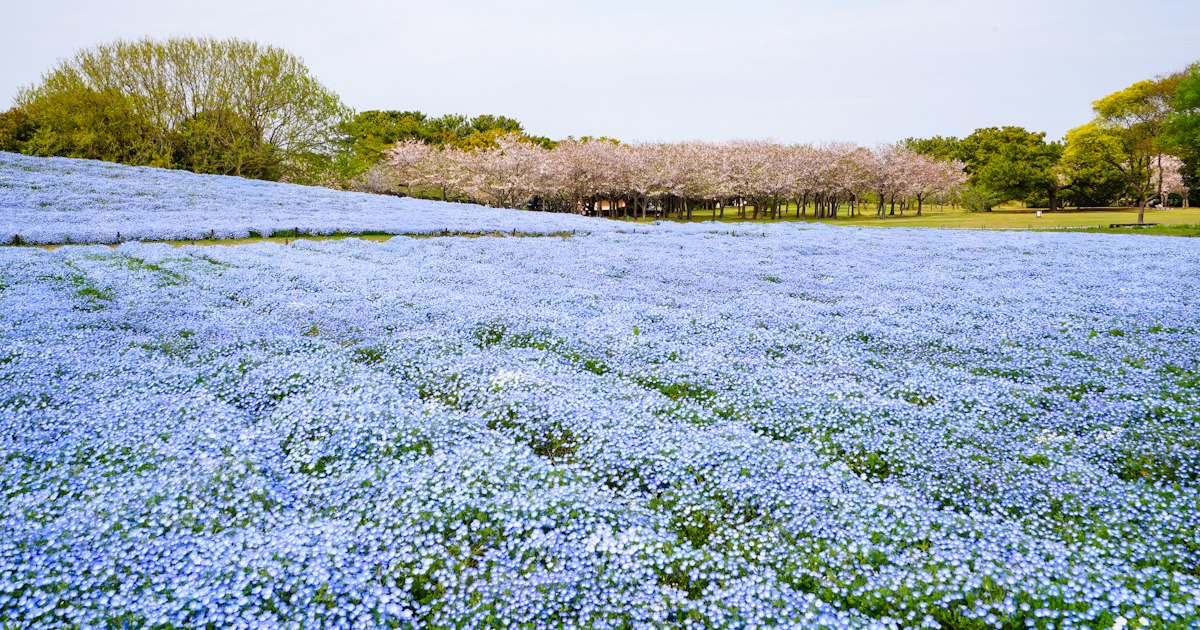
Twice a year, a hillside in Ibaraki Prefecture turns into one of the most photographed landscapes in Japan. In spring, Miharashi Hill at Hitachi Seaside Park disappears under 3.5 million nemophila (“baby blue eyes”) flowers, turning the slope and sky into one continuous shade of blue. In autumn, the same hill is covered in kochia bushes that blaze from green to a deep, fiery red. Neither bloom lasts long, and neither is well known outside Japan, which makes the park a rewarding detour for visitors willing to go an hour and a half past Tokyo’s usual day-trip radius.
Why Hitachi Seaside Park Is Worth the Trip
Hitachi Seaside Park (ひたち海浜公園) sits in Hitachinaka City on Ibaraki’s Pacific coast, about 140 km northeast of Tokyo. It’s a large national government park — roughly 350 hectares — with a Ferris wheel, cycling paths, a beach, and seasonal flower fields that rotate through the year: tulips and nemophila in spring, kochia and cosmos in autumn. The nemophila and kochia seasons are the two that draw international attention, largely because of photos of Miharashi Hill’s gradient of blue or red sweeping down toward the ocean. Unlike more famous flower spots such as Chichibu’s shibazakura hill (covered in our Chichibu day-trip guide), Hitachi Seaside Park still feels relatively uncrowded on weekdays, even at peak bloom.
When to Go: Nemophila vs. Kochia Season
Nemophila typically blooms from mid-April to early May, peaking around Golden Week (late April to May 5). This is the single busiest stretch of the park’s year, since it overlaps with Japan’s biggest domestic holiday period — book trains and nearby accommodation well in advance if you’re traveling then.
Kochia season runs roughly from mid-September through early October. The bushes start green and gradually redden, with the deepest crimson color usually appearing in the first one to two weeks of October — often alongside a wide field of cosmos flowers blooming at the same time nearby. Bloom timing shifts by a week or two depending on the year’s weather, so check the park’s official site or its social media accounts for real-time bloom reports within a month of your visit rather than relying on fixed calendar dates.
Getting There from Tokyo
The standard route is by train and bus. From Tokyo or Ueno Station, take the JR Joban Line “Hitachi” or “Tokiwa” limited express to Katsuta Station (about 80–90 minutes). Reserved seats on these limited expresses can be booked through JR East’s Ekinet system, the same type of online reservation covered in our guide to booking Shinkansen and limited express tickets online — it’s worth reserving ahead during nemophila and kochia weekends, since unreserved cars fill up fast. From Katsuta Station’s east exit, an Ibaraki Kotsu bus bound for “Kaihin Koen” (海浜公園) takes about 20 minutes and drops you near the park’s West Entrance; one-way fare is around ¥400–500.
During peak nemophila and kochia weekends, direct highway buses also run from Tokyo Station (Yaesu side) straight to the park, taking roughly 2 hours 20 minutes for about ¥2,000–2,600 one way — slower than the train but no transfers. If you’re flying rather than taking the train, Ibaraki Airport (IBR) near Omitama is only about 40 minutes from the park by car or bus and is served by budget domestic carrier Skymark; our comparison of LCCs versus JAL and ANA for domestic flights is useful if you’re connecting from Fukuoka, Kobe, or Naha rather than coming from Tokyo.
Admission, Hours, and Park Layout
Standard admission is ¥410 for adults (ages 15–64), ¥210 for seniors 65 and over, and free for anyone 14 and under. During the nemophila season in spring, the park switches to special “flower season” pricing, raising adult admission to roughly ¥900, since it’s the single most popular stretch of the entire year; kochia season sometimes carries a smaller surcharge as well, so confirm current pricing on the official site before you go. The park is generally open 9:30 am to 5:00 pm (last entry around 4:00 pm), with extended hours in midsummer. It’s typically closed on Tuesdays outside peak flower seasons, but stays open daily during the nemophila and kochia weeks — still worth double-checking, since maintenance closures occasionally fall on other weekdays.
Miharashi Hill, where the nemophila and kochia are planted, is a 10–15 minute walk from the West Entrance, or reachable by a paid shuttle train (the “Kaiyu-go”) that loops through the park for around ¥320 per ride — useful if you don’t want to tackle the hill’s slope on foot, especially with kids or in the heat.
Tips for Photos and Avoiding Crowds
Arrive right at opening. The classic wide shot — flowers in the foreground, Ferris wheel and ocean in the distance — gets crowded with other photographers by mid-morning on weekends, and the hill offers limited shade once the sun is high. Weekday mornings, especially Tuesday through Thursday, are dramatically quieter than weekends during both bloom seasons. For nemophila, the most photogenic days are typically clear and not too windy, since overcast light flattens the blue, and strong wind makes the thin flower stems blur in photos. For kochia, go slightly later in the season than you might expect — many visitors show up while the bushes are still green and miss the deeper red that develops closer to early October.
Budget, Mid-Range, and Splurge Options
On a tight budget, a day trip is entirely doable: round-trip train plus bus runs roughly ¥6,000–7,000 from central Tokyo, admission is ¥410–900, and the park has reasonably priced food stalls selling items like grilled squid or soft-serve ice cream for ¥400–600. Mid-range travelers often rent bicycles inside the park (around ¥540 for an adult bike per use) to cover the large grounds faster and combine the visit with a seafood lunch at nearby Oarai, a fishing port about 20 minutes away by car or bus. For a splurge, consider staying overnight in Oarai or Mito rather than rushing back to Tokyo same-day — it lets you catch the park at opening for uncrowded photos and still have time afterward for Mito’s Kairakuen, one of Japan’s three great gardens, which is a reasonable add-on if you’re already this far north.
Common Mistakes to Avoid
The most common mistake is timing: because nemophila and kochia peak for only a week or two, travelers who lock in dates months ahead based on “average” bloom calendars sometimes arrive to find the hill still mostly green or already past its best color. Check recent bloom-status updates close to your travel date rather than trusting a fixed date from a prior year. The second mistake is underestimating the walk — Miharashi Hill is larger and more exposed than photos suggest, so bring sun protection and water, especially during the warmer end of nemophila season or early autumn kochia visits. Finally, don’t plan a rushed half-day trip squeezed between other Tokyo activities; between the train, the bus connection, and the time needed to actually enjoy the hill without rushing, this works best as a dedicated full day out from Tokyo.