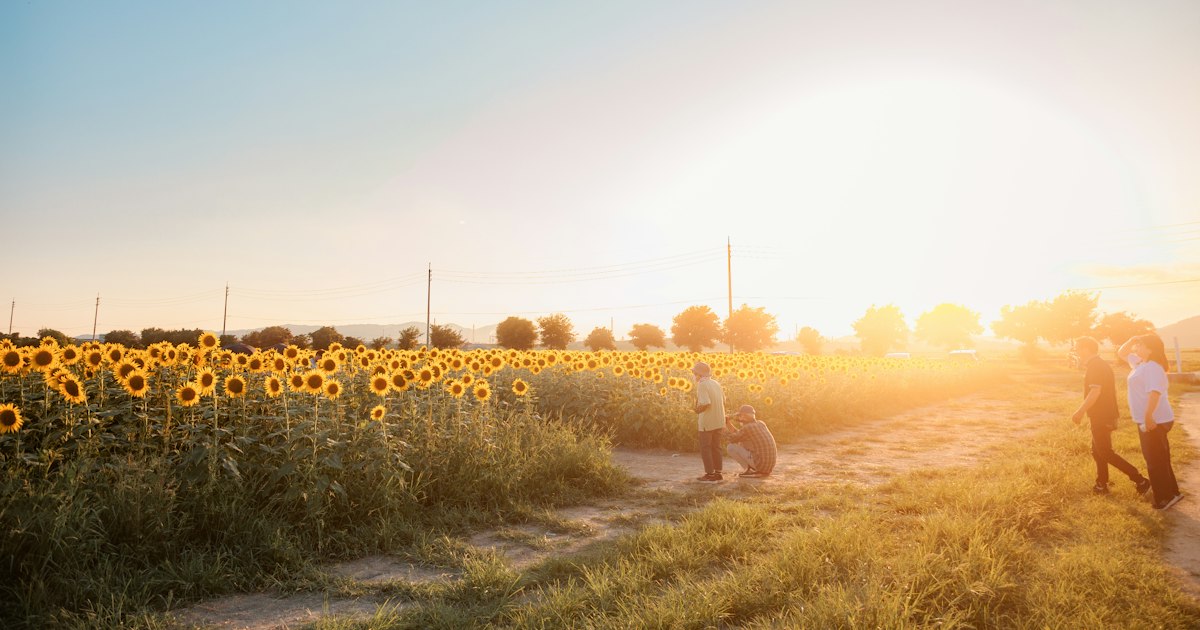
Photo by Gaku Suyama on Unsplash
Every July, Japanese social media fills up with the same handful of sunflower photos — a wall of yellow with Mount Fuji poking out behind it, or a single perfect stalk backlit at golden hour. What those photos don’t show is that sunflower season in Japan lasts about three weeks per location, the “best” field changes depending on which prefecture you’re in, and showing up on the wrong weekend means wilted brown heads instead of the postcard. Here’s how to actually plan around it.
Why Sunflower Fields Are a Summer-Only Window
Unlike cherry blossoms, which bloom on a predictable national wave, sunflowers are planted in staggered batches by local farms and city governments specifically to hit a festival weekend, and the flowers themselves only stay fresh for 10–14 days before they droop and go to seed. That means the “same” field looks completely different depending on whether you arrive on day 3 or day 13 of bloom. As a rough map of the season:
- Mid-to-late July: Kanto-area fields (Kanagawa, Saitama, Chiba) typically peak first.
- Late July–mid August: Yamanashi and other highland fields follow, roughly two to three weeks behind Tokyo due to the cooler elevation.
- Early August–early September: Hokkaido runs latest, since its growing season starts later in spring.
Always check the specific field’s official site or Twitter/X account the week before you go — most post real-time bloom reports (満開 = full bloom, 見頃 = good viewing, 終了 = finished) the way Kyoto shrines post autumn leaf updates.
Zama, Kanagawa: Tokyo’s Easiest Sunflower Day Trip
The Zama Himawari Matsuri, held along the Sagami River floodplain in Zama City, is the most convenient option for anyone based in Tokyo. The city plants roughly 450,000–550,000 sunflowers across two large fields, and the main festival weekend (usually the first weekend of August) adds food stalls, but the flowers are viewable for free any day the fields are open, dawn to dusk, for about two weeks around that peak.
Getting there: take the Odakyu Odawara Line or Sotetsu Line to Zama Station, then walk roughly 15–20 minutes to the riverside fields (shuttle buses run during the festival weekend itself). There’s no admission fee, which makes this a genuinely free half-day activity — just bring water and sun protection, since the fields have zero shade. If you’re combining a Kanagawa summer trip with other low-key day trips, the uninhabited island hike at Sarushima near Yokosuka is in the same general direction and pairs well with a sunflower morning.
Akeno, Yamanashi: Sunflowers With Mount Fuji in the Frame
If you want the Fuji-in-the-background photo, head to Hokuto City’s Akeno district, about two hours west of Tokyo by car via the Chuo Expressway (Nirasaki IC, roughly 10 minutes) or by train to JR Nirasaki Station followed by a taxi (about 15–20 minutes). The Akeno Sunflower Fiesta plants around 2 hectares with an estimated 600,000–800,000 stalks on a plateau facing Fuji directly, usually blooming from mid-July into mid-August. Admission runs about ¥300 during the festival period (children are typically free or discounted), and the field is generally open from early morning until around 17:00.
Because this field sits at elevation with an open mountain view, the best light is early — arrive by 7:00–8:00 AM both to beat the crowds and to catch Fuji before afternoon haze rolls in, which happens on most summer days by late morning. If you’re already deep into Fuji-area planning, it’s worth checking the nearby Chureito Pagoda viewpoint for another angle on the mountain, and climbers extending the trip into August should look at booking a Yoshida Trail mountain hut well in advance, since huts sell out fast in peak summer.
Hokkaido’s Biei and Furano: Sunflowers Among the Rainbow Fields
Hokkaido doesn’t do single-crop sunflower fields the way Honshu does — instead, sunflowers appear as stripes within the famous patchwork flower farms around Biei and Furano. Shikisai-no-Oka, a hillside flower farm in Biei, plants sunflowers alongside lavender, salvia, and other blooms in long color-blocked rows, generally at their fullest from late July through August. Admission is around ¥500 for adults in peak season (it’s free in winter when nothing is blooming), and the farm is typically open from around 8:30 or 9:00 AM to 17:00–18:00 depending on the month.
Because Biei’s farms are spread across rolling countryside with no real sidewalk network, a rental car is the most practical way to see more than one field in a day; if you don’t want to drive, Biei and Furano both run seasonal tourist shuttle buses in summer, but schedules are infrequent, so check timings before building a tight itinerary. Hokkaido’s later, cooler bloom also means it’s a good backup plan if a typhoon or heatwave wrecks your Kanto sunflower timing in July.
Common Mistakes to Avoid
- Treating it like a year-round attraction. Most of these fields are bare dirt or a completely different crop for 11 months of the year — there’s no “off-season visit” option.
- Going by the calendar date instead of the bloom report. The same festival date can mean full bloom one year and already-faded flowers the next, since bloom timing shifts with that year’s weather. Check the field’s own social media the week before, not a blog post from a previous summer.
- Underestimating the heat. These are open fields with no shade, visited in Japan’s most humid months. Go early morning, carry more water than feels necessary, and expect the ground to radiate heat by late morning.
- Driving to Zama or Akeno on festival weekends. Both get serious local traffic and limited parking during the main festival days; trains plus a short walk or taxi are usually faster.
- Only shooting straight-on photos. Sunflowers face the morning sun, so if you arrive in the afternoon, most of the flowers will have their backs partly turned from a direct front angle — plan your visit time around light direction, not just crowd avoidance.
Budget, Mid-Range, and Splurge Options
Budget: Zama’s free fields plus a round-trip train ticket from central Tokyo (roughly ¥600–900 each way) make for an essentially free outing beyond transport.
Mid-range: Akeno’s ¥300 entry fee plus a rental car for the day (roughly ¥6,000–9,000 depending on season and company) gets you the Fuji backdrop and the flexibility to stop at other Yamanashi sights on the way back.
Splurge: A multi-day Hokkaido itinerary covering Biei and Furano’s flower farms, with a rental car and a night or two at a local onsen ryokan, turns the sunflower stop into part of a broader countryside trip rather than a single-afternoon detour — a better use of the flight if you’re already crossing the country to get there.
However you slice it, the rule that matters most is the same everywhere: pick your field, confirm the current bloom status, and go early in the day. Sunflowers don’t wait for your itinerary to catch up.