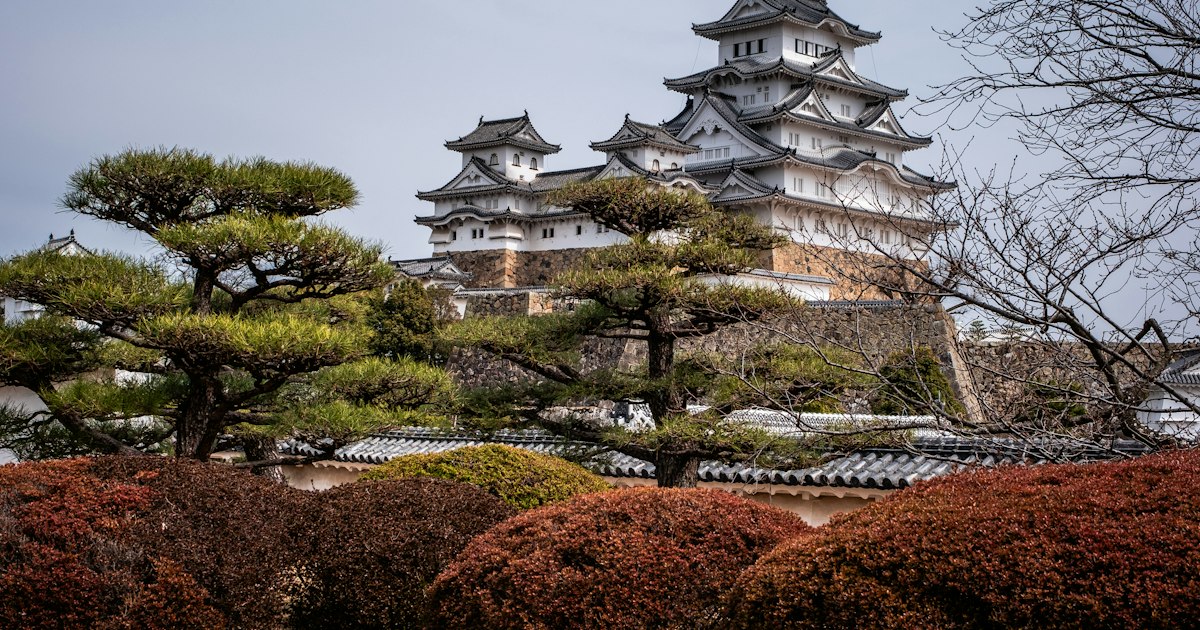
Photo by Sue Winston on Unsplash
Himeji Castle isn’t a reconstruction. While most of Japan’s “famous” castles are 20th-century concrete rebuilds of structures lost to fire, earthquake, or wartime bombing, Himeji’s six-story main keep has stood since 1609. That authenticity, combined with its brilliant white plaster walls, is why it’s nicknamed Shirasagi-jo — the White Heron Castle — and why it was one of the first two sites in Japan to be named a UNESCO World Heritage Site, back in 1993. If you only have time to see one Japanese castle in your life, most historians and architects would point you here.
Why Himeji Castle Is Different From Japan’s Other Castles
Of Japan’s roughly twelve surviving “original” castle keeps, Himeji is the largest and best preserved. Unlike Osaka Castle or Nagoya Castle, which are concrete museum buildings dressed up to look historic, Himeji’s interior is the real wooden structure: steep ladder-like staircases, centuries-old support pillars, and defensive features like gun ports, stone-dropping chutes, and a deliberately maze-like approach designed to confuse attacking samurai. The castle survived the World War II firebombing of Himeji city almost untouched — one incendiary bomb reportedly landed on the top floor and simply failed to detonate.
Getting There: Trains, Timing, and the Walk from the Station
Himeji Castle is one of the easiest major sights in Japan to reach without a car, which makes it an excellent day trip from several big cities. Himeji Station sits on the Sanyo Shinkansen line, so you can reach it by bullet train in about 40 minutes from Shin-Osaka, roughly 1 hour from Kyoto, and about 90 minutes from Hiroshima. If you’re not using a Shinkansen pass, local and rapid trains on the JR Kobe Line/Sanyo Line connect Himeji to Osaka and Kobe in 60-90 minutes for a fraction of the cost.
From Himeji Station, skip the taxis and buses — the castle is a flat, scenic 15-20 minute walk straight up Otemon-dori, the wide boulevard directly in front of the station’s north exit. The castle keep is visible almost the entire way, so navigation is simple even if you’re still getting used to how addresses and streets are laid out in Japanese cities (our guide to how Japanese addresses work is worth a skim before this trip if you plan to explore side streets or find a specific shop). If you’d rather not walk, a loop bus runs from the station to the castle gate for about ¥100-300 per ride.
Tickets, Hours, and What It Costs
The castle grounds and keep are open daily from 9:00 to 17:00, with last entry at 16:00 (extended hours of 9:00-18:00, last entry 17:00, apply during the peak late-April-to-August season). The castle closes for maintenance on December 29 and 30 — check this if you’re visiting around New Year’s.
Admission is ¥1,000 for adults and ¥300 for children (elementary through high school age); preschoolers enter free. A combined ticket covering both the castle and the neighboring Koko-en Garden costs ¥1,050 for adults — well worth the extra ¥50. Tickets can be bought at the gate, but during cherry blossom season and Japanese holidays, buying a timed-entry ticket online in advance through the official Himeji Castle website saves real queueing time, since entry into the keep itself is metered to control crowd flow on the narrow staircases.
Inside the Castle: What to Expect
Budget at least 1.5-2 hours for the castle keep alone, more if you’re visiting during busy periods. The stairs inside are original wooden staircases, steep (closer to 60 degrees in places) and narrow — there is no elevator, and this is not an easy visit for travelers with mobility issues, young children who need carrying, or large rolling suitcases (there’s no storage inside, though coin lockers are available near the station and main gate).
You’ll need to remove your shoes at the entrance to the keep and carry them in a provided plastic bag for the rest of the visit — wearing socks without holes is a small but real courtesy here, and if you’re unsure about shoe sizing for any Japan-bound footwear purchases before your trip, our clothing and shoe size conversion guide can help. Inside, there’s minimal signage translation and no air conditioning, so summer visits can get uncomfortably hot and crowded near the top floors. Photography is allowed throughout, and the view from the top floor over Himeji city is the reward for the climb.
Best Time to Visit
Spring is the signature season: roughly 1,000 cherry trees bloom on the castle grounds in late March to early April, framing the white keep in pink. This is also, predictably, the most crowded time to visit, alongside Golden Week (late April-early May) and the August Obon holiday. If you can, aim for a weekday visit either right at the 9:00 opening or in the last two hours before closing — both the crowds and the heat (in summer) thin out considerably. Autumn (mid-November) offers good weather and smaller crowds with decent foliage in the surrounding gardens, and is generally the most comfortable time for the climb inside the keep.
Common Mistakes to Avoid
- Treating it as a quick stop. First-timers often budget 30-45 minutes based on photos from outside; the queue and climb inside alone can eat 90 minutes during busy periods.
- Skipping the online ticket during peak season. On busy spring weekends, same-day entry into the keep can be delayed by an hour or more without a reserved slot.
- Wearing shoes that are a hassle to remove and re-lace repeatedly. You’ll do this once at the keep entrance, but slip-ons make the whole visit smoother.
- Visiting in the worst of summer without a plan. There’s no shade on the climb up the approach paths and no AC inside — bring water and a hat if you’re going in July or August.
- Forgetting cash for the combined ticket or small souvenir stalls. Many vendors near the castle and in the old town still prefer cash or have lower card-payment limits.
Beyond the Castle: Koko-en Garden and the Town
Koko-en, a set of nine connected Edo-period-style gardens built on the former site of samurai residences, sits just a few minutes’ walk from the castle’s west gate and is included with the combined ticket. It’s a quieter, shadier contrast to the castle’s open stone paths and has a traditional teahouse serving matcha and sweets if you want to sit down after the climb. If castle towns and samurai history interest you more broadly, Himeji pairs well conceptually with our guide to Aizu-Wakamatsu, Fukushima’s samurai castle town, for a sense of how differently preserved castle towns can feel depending on the region and era they reflect.
Before heading home, Himeji’s shopping arcade (Miyuki-dori), running parallel to the station approach, is a good spot for local snacks and crafts without the crowds of Osaka or Kyoto. If you’re stocking up on souvenirs across your trip, it’s worth checking our breakdown of Japan’s duty-free allowance for bringing goods home so you don’t get caught out at customs after a day of castle-town shopping.