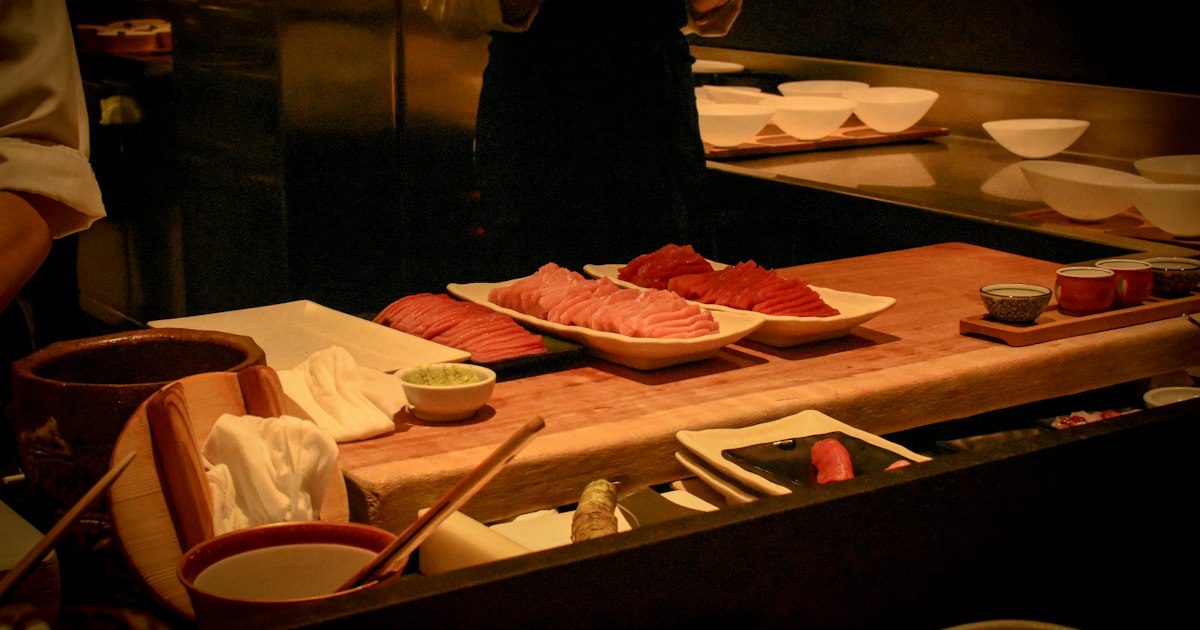
Photo by blackieshoot on Unsplash
Every December, as the Sea of Japan turns gray and choppy, Toyama Bay produces one of the country’s most sought-after fish: kanburi, the fat-laden winter yellowtail that chefs across Japan quietly rank above the summer version of the same species. If you’re planning a winter trip through the Hokuriku region, timing a stop in Toyama around this fish is one of the more rewarding, less touristy food detours you can make. Here’s what makes it special, when to go, and where to actually eat it.
What Makes Kanburi Different From Regular Buri
Buri (yellowtail, Seriola quinqueradiata) is sold year-round in Japan, but it’s a different fish in winter. As water temperatures drop, yellowtail migrating south along the Sea of Japan coast pack on fat to survive the cold — their fat content can roughly double compared to summer catches. “Kanburi” (寒鰾) literally means “cold-season buri,” and it specifically refers to fish caught in this fattened winter state, typically from December through February.
Toyama Bay is unusually well-suited to producing good kanburi because of its geography: it’s one of the deepest bays in Japan, with depths plunging to over 1,000 meters just a few kilometers from shore. That steep drop-off means cold, nutrient-rich water sits close to the coast, and migrating yellowtail pass through it on their way south, getting caught in fixed nets before they’ve burned off their fat reserves swimming further.
Himi Buri: The Brand Behind the Fish
If you see “Himi Buri” (氷見ぶり) on a menu, it refers to a specific, trademarked catch: yellowtail landed at Himi fishing port in Toyama Prefecture, caught using teichiami (fixed-net) fishing rather than nets that are towed or cast. Because the fish essentially swim into a stationary trap and are hauled in quickly, they arrive at auction with minimal stress and bruising, which matters a lot for sashimi-grade texture. To carry the Himi Buri name, a fish generally needs to meet weight and fat-content standards set by the local fisheries cooperative — lighter or leaner fish are sold as ordinary buri instead.
The most famous moment of the season is the “ichiban buri” (一番ぶり), the first major catch of a new winter run, which is auctioned at Himi port and regularly makes local news for fetching dramatically higher prices than later catches of the same size — sometimes tens of thousands of yen for a single exceptional fish. You won’t be bidding at that auction as a visitor, but the fish from those early-season landings do filter down to restaurants and markets within a day or two.
Best Season and Timing
Kanburi season runs roughly from late November to February, with most people agreeing the peak is mid-December through January, right around New Year’s — fittingly, buri has long been a traditional New Year’s fish in the Hokuriku region, much as other regions build their own New Year’s dishes like ozoni around regional specialties. By late February the migration tapers off and quality becomes inconsistent, so if you’re planning the trip specifically around this fish, book for December or January.
Catches depend on weather and sea conditions, so no restaurant can promise kanburi on a specific date — rough seas can keep boats in for a day or two. If you’re traveling a long way specifically for this, build in a buffer day or ask your hotel to call ahead and confirm availability the morning of your visit.
Where to Eat It
Himi Banya Gai (氷見番屋街) is the easiest place to eat kanburi close to its source. This is a seafood market-and-dining complex right next to Himi fishing port, with a morning fish market, casual seafood-rice-bowl counters, and several sit-down restaurants serving fresh sashimi and grilled set meals. It’s a short walk or taxi ride from Himi Station. Expect a kaisen-don (seafood rice bowl) with kanburi sashimi for roughly ¥1,500–3,000, and a more substantial sashimi or shabu-shabu course for ¥4,000–8,000. Hours vary by shop (most run from around 9:00 or 10:00 to 17:00–18:00), and some close on weekdays rather than weekends, so check the specific restaurant’s hours before heading out.
Toyama City, about 40 minutes from Himi by train, has a strong sushi culture built around Toyama Bay’s variety of fish — locals sometimes call the bay “the natural aquarium” because of how many species pass through it. Kaiten-zushi (conveyor-belt sushi) chains based in the prefecture serve kanburi nigiri in winter for roughly ¥150–500 per plate, which is an easy, budget-friendly way to try it without committing to a full sashimi course. Department store restaurant floors in central Toyama City also run seasonal kanburi menus in winter.
For a splurge, look for a ryokan or kappo-style restaurant offering a kaiseki or omakase course built around the season’s catch — a multi-course winter dinner featuring kanburi sashimi, grilled kama (collar), and nabe can run ¥10,000–20,000 per person, but it’s the most complete way to taste the fish prepared several different ways in one sitting.
Getting There
From Tokyo, the Hokuriku Shinkansen runs directly to Toyama Station (about 2 hours 10 minutes) or Shin-Takaoka Station (about 2 hours 20 minutes). From either station, local JR lines connect to Himi: from Takaoka, take the JR Himi Line to Himi Station (about 30 minutes); it’s also an easy stop if you’re already visiting nearby Takaoka’s copper and bronze casting workshops, since both towns sit on the same short rail line. If you’re hunting for a specific restaurant’s address, note that Japanese addresses in smaller coastal towns like Himi often skip street names entirely in favor of block-and-lot numbers — it’s worth reading up on how Japanese addresses work before you rely on a paper map rather than GPS.
Common Mistakes to Avoid
- Ordering buri outside winter and expecting the same fish. Buri served in summer is a different, leaner fish — it’s not mislabeled, but it won’t have the fat marbling that makes kanburi famous. If the season is wrong, ask what’s fresh instead.
- Confusing kanburi with hamachi. Hamachi, common on sushi menus year-round, is usually farmed young yellowtail. Kanburi is wild and caught specifically in winter — the flavor and price are both noticeably different.
- Assuming any Toyama restaurant will have it that day. Fixed-net catches depend on the sea; a shop can sell out of kanburi by early afternoon on a good day, or have none at all if boats stayed in. Going early, or calling ahead, helps.
- Skipping the grilled or simmered preparations. Sashimi gets the attention, but the collar (kama) grilled with salt, or a block simmered in soy and ginger (buri no arani), are where the fat really shines — don’t leave without trying at least one cooked version.
Kanburi season is short, weather-dependent, and genuinely regional — you’re unlikely to find the real thing far from the Sea of Japan coast in winter. That’s exactly what makes a dedicated stop in Himi or Toyama City worth the extra train transfer.