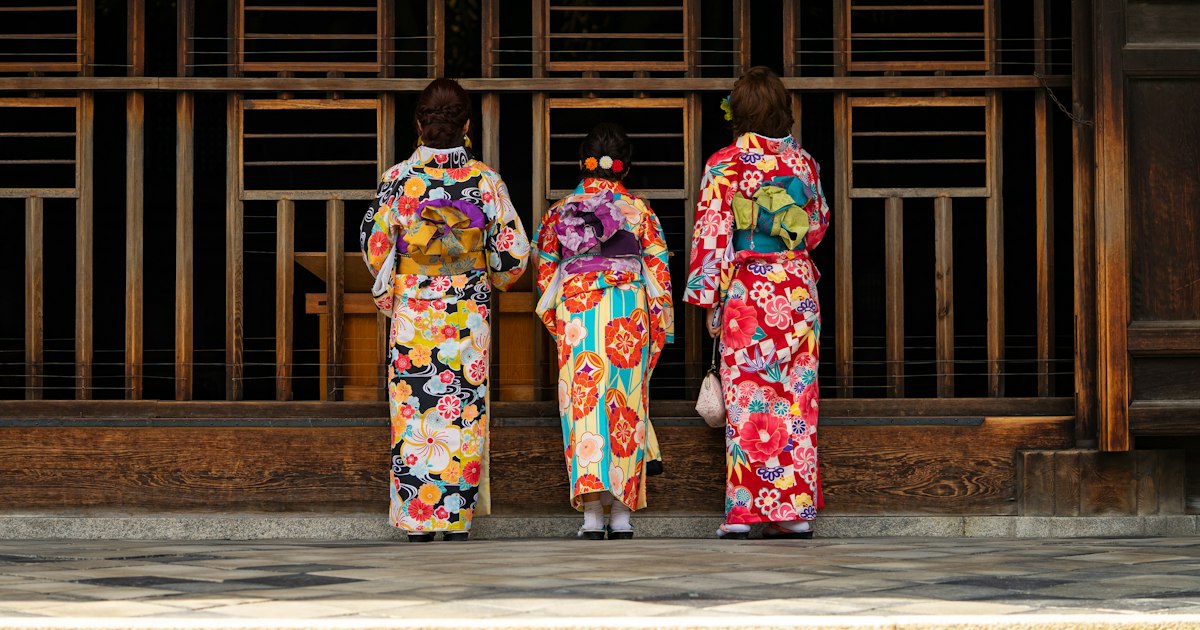
Photo by Damian Hutter on Unsplash
If you’ve searched “kimono rental Kyoto” and landed on photos of only petite models, you’re not imagining the problem. Most tourist-facing rental shops stock their racks for an average Japanese frame, and walk-in visitors over roughly a US women’s size 16-18 or men’s XL often get turned away or handed something that won’t close properly. The good news is that a real, if smaller, network of shops in Kyoto and Tokyo stocks genuinely plus-size kimono and yukata, and knowing which ones — and how to book them — makes the difference between a disappointing afternoon and great photos in front of a temple gate.
Why sizing is harder here than it looks
Kimono are wrapped, not tailored, so in theory one garment should fit a wide range of bodies. In practice, rental shops cut their stock to standard lengths of cloth, and a too-short kimono simply won’t wrap far enough around the body or won’t fold down correctly at the ohakake (the hidden fold at the waist) to sit at the right length. Shops also have to match an obi (sash) long enough to tie around a larger waist, and most of their obi are made for an average Japanese female waist of about 65-75cm. That’s the actual bottleneck more often than the kimono itself — a shop may have one large kimono in the back but run out of long obi during busy weekends.
Height is the other issue, particularly for taller male visitors. A kimono that’s too short will show too much ankle and look like a bad costume rather than proper dress, and standard rental yukata are usually only cut for up to around 175cm.
What “plus-size” actually means at Japanese rental shops
Shops that do stock larger sizes usually label them LL, 3L, 4L, or “ゆったりサイズ” (relaxed/roomy size) rather than using Western sizing. As a rough guide:
- LL/3L kimono typically fit up to around a 115-125cm bust/chest measurement.
- 4L or “tall and large” (大きいサイズ・身長対応) options, where available, stretch to about 130cm chest and accommodate heights up to roughly 180-185cm.
- Men’s plus sizes are rarer than women’s — call ahead if you’re a larger or taller man, since many shops keep only one or two large men’s sets.
Bring your actual bust, waist, hip, and height measurements in centimeters rather than a home-country dress size. Staff will ask for these to pick the right inner layers (the juban) and obi length, and a size that “sounds right” from a US or UK label often isn’t.
Kyoto: the best-stocked city for larger sizes
Kyoto has the largest concentration of kimono rental shops in Japan, which also means the largest selection of plus-size stock, mostly clustered around Kiyomizu-dera and Gion.
- Okamoto Kimono Rental (multiple branches near Kiyomizu-dera and Kinkaku-ji) explicitly lists large sizes among its women’s plans and is used to foreign visitors; a standard plan runs roughly ¥4,000-6,000 and large sizes are usually included at no extra charge, though availability is first-come during peak weekends.
- Yumeyakata in Gion is one of the oldest rental chains in the city and has offered “ゆったりサイズ” plans for years, with women’s plans from around ¥5,000-7,000 depending on obi and accessory choices.
- Rakuwasou, also near Kiyomizu-dera, is frequently recommended specifically for plus-size and tall rentals and keeps staff on hand who are experienced with larger wraps.
Most of these shops open around 9:00-10:00 and require same-day return by 18:00 (later in summer during yukata season), so plan your temple walk accordingly — you don’t want to be rushing back from a day trip to make a kimono deadline. If your trip includes an obi lover or you want to understand what you’re wearing, it’s worth reading up on traditional weaving techniques like Hakata-ori before you go — some higher-end rental sets use obi woven in this style, and recognizing it adds a little context to what you’re paying for.
Tokyo: Asakusa is your best bet
Tokyo’s rental scene is smaller than Kyoto’s but concentrated around Asakusa and Senso-ji, where the backdrop is just as photogenic.
- Asakusa Kimono Rental Wargo, a short walk from Senso-ji’s Kaminarimon gate, carries large sizes and is one of the more reliable chain options for visitors who didn’t manage to reserve in advance; women’s plans start around ¥3,980-5,500.
- Yae Kimono Rental, also in Asakusa, is smaller but known for taking time with larger or taller guests rather than rushing the fitting.
After renting, the obvious walk is around Senso-ji itself, but if you want quieter photos without the crowds, the shrine-and-garden combination at Nezu Shrine and the Nezu Museum is an easy taxi or train ride from Asakusa and gives you torii-gate photos without fighting for space — especially good in April when the azaleas are out and the light is soft.
Budget, mid-range, and splurge options
- Budget (¥3,000-4,500): Basic yukata or kimono sets at chain shops like Wargo, usually excluding hair styling. Fine for a few hours of sightseeing photos.
- Mid-range (¥5,000-8,000): Full kimono plans including obi, bag, sandals, and often a simple hair arrangement — this is where most plus-size-specific plans at Okamoto, Yumeyakata, and Rakuwasou sit.
- Splurge (¥10,000-20,000+): Premium silk kimono, professional hair and makeup, and sometimes a photographer add-on. Confirm plus-size availability in the premium tier specifically, since shops often stock fewer large sizes in their nicest fabrics.
Best timing and how to book
Cherry blossom season (late March to early April) and autumn foliage (November) are both the most beautiful times to wear kimono outdoors and the hardest times to find a plus size — shops rent out their limited large stock first. Book online at least a week ahead in these windows; during quieter months (June, September) same-day walk-ins for larger sizes are realistic. Summer (July-August) is yukata season, where lighter cotton robes are more forgiving on fit but still limited in large sizes, so the same advance-booking logic applies.
When you book, write “plus size” or “LL/3L/4L” directly in the reservation notes and give your measurements in centimeters. Many shop websites have an English reservation form; if a shop’s site is Japanese-only, a quick email with your measurements and preferred date usually gets an answer within a day or two.
Common mistakes to avoid
- Showing up without a reservation during peak season. Plus-size stock disappears first, and staff can’t conjure a larger obi on the spot.
- Converting size by guesswork. A US size doesn’t map cleanly onto LL/3L — give centimeters.
- Assuming all shops are the same. Not every rental shop in Asakusa or Kiyomizu-dera stocks large sizes even if their storefront looks identical to the one next door; check specifically before walking in.
- Forgetting shoes. Traditional geta and zori often run small; mention your shoe size when booking so staff can set aside larger sandals, or plan to wear your own socks-friendly flats as backup.
- Booking the last slot of the day. Larger kimono take a few extra minutes to wrap correctly, and a tight return deadline adds stress neither you nor the staff needs.
With the right shop and a little advance planning, there’s no reason a larger frame should mean skipping kimono photos in Japan — you just need to book the places that actually stock for one.