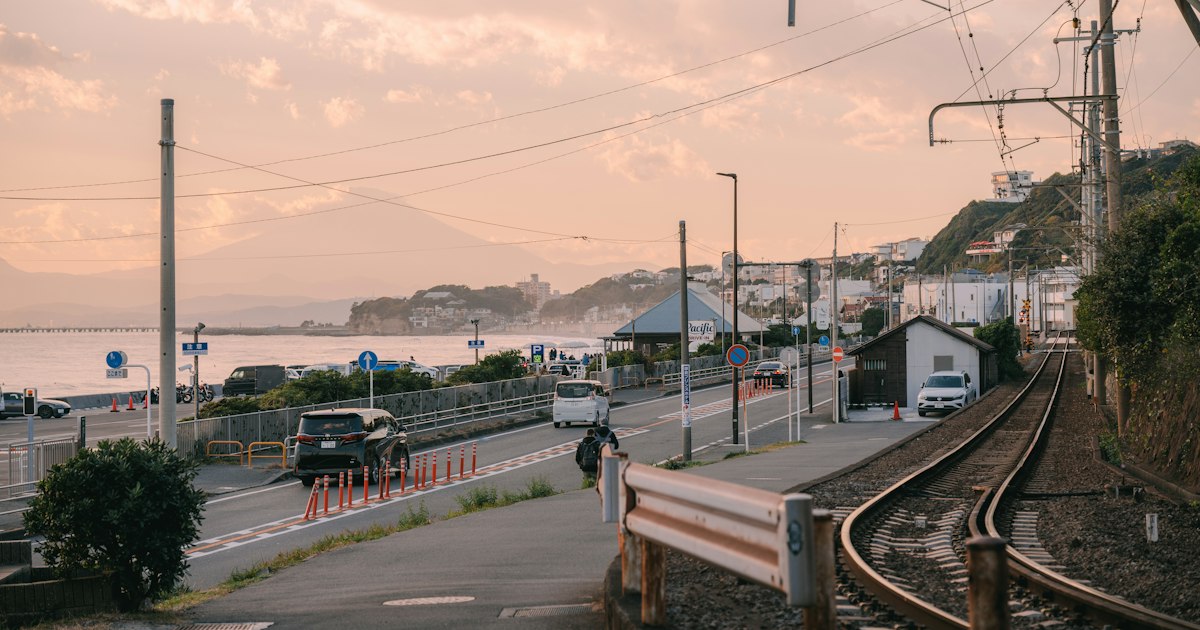
Photo by Seungmin Yoon on Unsplash
Most visitors heading to Enoshima take the slow, scenic Enoden tram from Kamakura, but there’s a second, far stranger way in: the Shonan Monorail, a suspended train that hangs beneath a single elevated rail and swings through the hills of Kamakura like a theme-park ride. It’s a genuine piece of 1970s engineering still doing its daily commuter job, and for train enthusiasts and curious travelers alike, the eight-minute ride between Ofuna and Shonan-Enoshima is worth building into your itinerary on its own merits.
What Makes This Monorail Different
Most monorails you’ve ridden — at airports, amusement parks, or Tokyo’s Yurikamome — sit on top of their rail, like a train balancing on a fence. The Shonan Monorail is a “suspended” (SAFEGE-type) system: the cars hang below the beam, gripping it from above like a coat hanger. Japan has only a handful of lines built this way, and the Shonan Monorail, which opened in 1970–71, is one of the oldest still running. Because the cars hang rather than sit, they bank hard into curves and dip over dense residential rooftops and valleys at speed, which is why regulars half-jokingly call it a roller coaster with a train schedule. The full line is just 6.6 km long, and the ride from end to end takes about 14 minutes with all stops, though many visitors do Ofuna to Shonan-Enoshima nonstop in around 8 minutes of actual travel time.
Getting to Ofuna and Buying a Ticket
Ofuna Station is the starting point and a major hub in its own right, served by the JR Tokaido Line, Yokosuka Line, Shonan-Shinjuku Line, and Negishi Line, so it’s an easy 45–50 minutes from central Tokyo or about 15 minutes from Yokohama with no transfers. The monorail platform is a short, clearly signed walk from the JR ticket gates — follow signs for “Shonan Monorail.” Buy a paper ticket from the machines or simply tap an IC card (Suica/Pasmo and equivalents all work) at the gate; there’s no need for a reserved seat or special pass for a one-way ride. The full-line one-way fare from Ofuna to Shonan-Enoshima runs around ¥320 for adults and about half that for children, and a one-day unlimited pass is available for roughly ¥600 if you plan to hop on and off at intermediate stations like Nishi-Kamakura or Shonan-Fukasawa. Trains run roughly every 10–12 minutes from around 5:40am until close to 11pm, so there’s no need to plan around a timetable — just show up and go.
The Ride Itself: Where to Sit and What to Watch For
For the best experience, stand or sit near the front window if the car allows it — on older rolling stock the very front car sometimes has a clear forward view similar to a driver’s-eye perspective. The first few minutes out of Ofuna run through ordinary suburban rooftops, but the line soon climbs and dips through wooded valleys near Nishi-Kamakura, and the final stretch into Shonan-Enoshima swings noticeably on tight curves as the train descends toward the coast. On a clear winter day you can catch glimpses of Mount Fuji to the west in the final minutes before arrival — this is genuinely one of the better casual Fuji sightings available from a train window in the Kamakura area, no special seat reservation required (unlike hunting for a window seat on the Shinkansen; see our guide to Shinkansen seating and power outlets if you’re also plotting a longer rail leg on the same trip).
Best Season and Time of Day to Ride
Clear winter days (December through February) give the sharpest Fuji views and the least haze, though the ride is enjoyable year-round. Avoid riding during the first 20 minutes after local schools let out on weekday afternoons (roughly 3:30–4:30pm), when the cars fill with students and the panoramic feel of the ride is lost in a crowd. Weekend mornings before 10am are the quietest window if you want a car to yourself for photos. Golden Week (late April–early May) and midsummer weekends bring beach-bound crowds heading to Enoshima, so arrive at Ofuna’s platform a train or two early rather than fighting for space on a packed car.
Arriving at Shonan-Enoshima: Don’t Confuse the Stations
The single biggest mistake first-time riders make is mixing up the three different “Enoshima” stations in the area. Shonan Monorail’s terminus is called Shonan-Enoshima Station, and it’s about a 10–13 minute walk from the Enoshima Benten Bridge that leads onto the island itself. This is a separate station from Enoden’s Enoshima Station (reached via the Enoshima Electric Railway from Kamakura) and from Odakyu’s Katase-Enoshima Station — all three sit within roughly a 15-minute walk of each other but serve different train lines, and typing the wrong one into a map app will send you to the right neighborhood but the wrong exit. If you’re combining this trip with a Kamakura temple day, it’s worth double-checking which station name you’ve bookmarked before you set off.
Extending the Trip: Coastal Cycling and Practical Backup Plans
The Shonan coastline between Enoshima and Kamakura is one of the most popular stretches in the region for casual cycling, and plenty of visitors rent a bike near the monorail terminus to ride the coastal road rather than walk back. If you’re renting or riding your own bicycle in the area, it’s worth knowing what a roadside koban bicycle check actually involves before an officer waves you over, since registration questions are routine here rather than a sign of trouble. And if this ride is the last stop before you fly home with a bike in tow, our guide to shipping a bicycle home from Japan covers boxing and courier options worth arranging a few days ahead rather than the morning of your flight.
Budget, Mid-Range, and Splurge Options
On a strict budget, a single one-way ticket (~¥320) plus a walk around Enoshima’s free viewpoints and shrine grounds costs next to nothing beyond train fare. Mid-range travelers should grab the roughly ¥600 one-day pass, hop off at Shonan-Fukasawa or Nishi-Kamakura for a quiet residential-area stroll, and budget another ¥1,000–2,000 for fresh shirasu (whitebait) or seafood rice bowls near the island. For a splurge, pair the monorail ride with an overnight stay at one of the onsen ryokan along the Shonan or Hakone coastline — just confirm the cancellation terms before booking, since ryokan cancellation policies can claim a surprising percentage of the room rate if weather or ferry schedules to Enoshima’s offshore spots change your plans at the last minute.
The Shonan Monorail won’t show up on most Tokyo-day-trip checklists, but for the price of a bus ticket, it turns an ordinary Enoshima excursion into a small piece of transit sightseeing — and gets you there faster than most alternatives from Ofuna.