Photo by Akira Cake on Unsplash
Odaiba is a chunk of reclaimed land in Tokyo Bay that Tokyo built for landfill and 1990s urban-planning dreams, then quietly turned into one of the city’s best weekend outings. It’s flat, walkable, full of malls with ocean views, and home to a full-scale Gundam statue that draws crowds of their own. It’s also a district that changes fast — several of its biggest former attractions have closed in the past few years — so this guide sticks to what’s actually open in 2026 and how to get the most out of a half-day or evening visit.
Getting to Odaiba
The most enjoyable way in is the Yurikamome Line, a fully automated elevated train that loops from Shimbashi Station (connected to the JR Yamanote Line, Ginza subway line, and Toei Asakusa Line) across the bay and onto the island. Because there’s no driver, grab a front-row seat for a free ride that swoops over Rainbow Bridge and gives you your first skyline view before you’ve even arrived. Fare from Shimbashi to Daiba or Odaiba-Kaihinkoen station runs about ¥330–400 with an IC card.
A cheaper alternative is the Rinkai Line, which connects from Osaki Station (also reachable via JR Saikyo Line through-trains from Shinjuku and Ikebukuro) to Tokyo Teleport Station — the stop closest to DiverCity and Aqua City. It’s faster and usually cheaper than the Yurikamome but has none of the scenery.
For something slower and more scenic, Tokyo Cruise operates water buses from Asakusa and Hinode Pier to Odaiba Seaside Park, including the futuristic Himiko and Hotaluna boats designed by anime artist Leiji Matsumoto. The ride from Asakusa takes roughly 50–60 minutes and costs around ¥1,560 one way — treat it as a scenic activity in its own right, not just transport.
The Gundam Statue and Gundam Base Tokyo
The single most-photographed thing on the island is the full-scale Gundam statue standing outside DiverCity Tokyo Plaza, near Tokyo Teleport Station. The current model is the RX-93ff ν Gundam, a roughly 19.7-meter statue that replaced the earlier Unicorn Gundam version in 2023. It periodically performs light-and-sound sequences at set times during the day — the schedule is posted near the statue and on DiverCity’s site, so check it on arrival rather than planning around a fixed time, since showtimes shift seasonally.
Inside the mall, the 7th floor holds Gundam Base Tokyo, a cavernous official store stocked with Gunpla model kits across every scale and series, plus exclusive kits you won’t find elsewhere in Japan. Even non-modelers tend to spend longer here than planned. It keeps the same hours as the mall, roughly 10:00–21:00.
Shopping: DiverCity, Aqua City, and DECKS Tokyo Beach
Odaiba’s three main malls sit close enough together to cover on foot. DiverCity Tokyo Plaza (10:00–21:00 for shops, restaurants open later) mixes fashion with the Gundam draw. Aqua City Odaiba, right on the waterfront with the best head-on view of Rainbow Bridge from its terrace, runs similar hours and has a strong food court plus a small shrine on one of its upper floors. DECKS Tokyo Beach, split into two connected buildings, leans more toward entertainment than fashion: it houses the Tokyo Trick Art Museum (around ¥1,000 admission) and LEGOLAND Discovery Center Tokyo.
None of these are duty-free bargain hunting grounds in the way Shinjuku or Ginza department stores are — treat Odaiba shopping as a bonus activity around the views and entertainment, not the main reason to come. If you’re hauling souvenirs and your existing suitcase is giving out, it’s worth knowing where to buy a replacement suitcase in Japan rather than trying to find one on the island itself.
Rainbow Bridge and the Waterfront Park
Odaiba Marine Park (Odaiba Kaihin Koen) is the free public park facing the bridge, with a small artificial beach and a replica Statue of Liberty that’s become its own photo stop. Swimming is generally not permitted here due to water quality, though the city has run occasional supervised test-swim events in recent summers — don’t plan a swim around it.
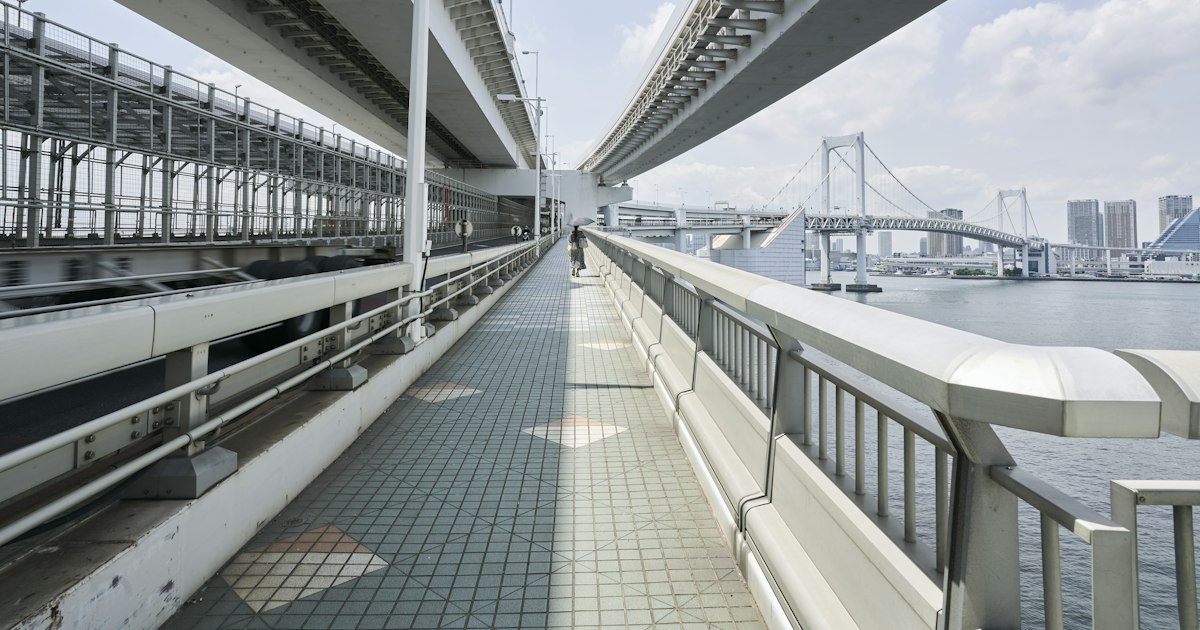
What’s genuinely worth building time for is walking Rainbow Bridge itself. A pedestrian promenade on the lower level runs between the Shibaura/Minato side and Odaiba, free of charge, taking about 30–40 minutes one way with excellent bay views. Opening hours shift by season (roughly 9:00–21:00 in warmer months, 10:00–18:00 in winter), and the walkway closes for maintenance on a rotating basis — check the Metropolitan Expressway’s posted schedule before you go so you don’t arrive to locked gates. Evening is the best time for this: the bridge’s illumination (switching between white, red, and green lighting) and the Tokyo skyline behind it are best seen after sunset, and the park benches along Odaiba Marine Park are a free, crowd-light spot to watch it with no admission fee at all.
Miraikan and Tokyo Joypolis
The National Museum of Emerging Science and Innovation, known as Miraikan, is a genuinely good science museum built around the massive spherical Geo-Cosmos display and hands-on robotics exhibits. It’s open 10:00–17:00, closed Tuesdays, with adult admission at ¥630 (the dome theater costs extra) — cheap enough to combine with anything else on the island.
Tokyo Joypolis, Sega’s indoor amusement park inside DECKS Tokyo Beach, is the pick for an evening of arcade games and VR rides regardless of weather. Pricing works two ways: a basic entrance fee of around ¥900, or an all-rides passport around ¥4,300 for adults — buy the passport only if you’re committed to riding multiple attractions, since entrance-only plus a couple of pay-per-ride tickets is often cheaper for a shorter visit. Hours vary by day of the week, so check before you go.
Common Mistakes to Avoid
Older blog posts and guidebooks still list Oedo Onsen Monogatari, the hot spring theme park that used to be Odaiba’s signature attraction — it closed permanently in September 2021 and doesn’t exist anymore. Similarly, Palette Town (the Ferris wheel, Toyota Mega Web, and Venus Fort) was fully demolished by the end of 2022; don’t plan a visit around any of it. And teamLab’s digital art museum, long associated with Odaiba, relocated: teamLab Borderless is now at Azabudai Hills and teamLab Planets is in Toyosu — neither is on the island anymore, so don’t budget Odaiba time expecting to see them.
The other common mistake is underestimating distances. Odaiba looks compact on a map, but the walk from Tokyo Teleport Station to the far end of Odaiba Marine Park is a genuine 20–25 minutes, and summer heat on the shadeless waterfront is brutal. Odaiba is as flat and step-free as Tokyo gets, which makes it one of the easier districts for anyone renting a wheelchair or mobility scooter for their trip — but you’ll still want to plan routes around indoor mall corridors during peak heat or rain.
Budget, Mid-Range, and Splurge
On a tight budget, Odaiba costs nothing beyond transport: the Gundam statue, Rainbow Bridge walk, and Marine Park views are all free, and you can spend hours mall-browsing without buying anything. Mid-range visitors should budget roughly ¥3,000–6,000 for a mix of Miraikan, Joypolis, and a meal with a bridge view at Aqua City’s food court. For a splurge, several waterfront hotels — including the Hilton Tokyo Odaiba and Grand Nikko Tokyo Daiba — offer rooms with direct Rainbow Bridge or skyline views, and are worth it if you want to watch the bridge light up without leaving your room.
If you need cash on the island, convenience store ATMs are plentiful inside the malls, and it’s worth knowing in advance how foreign cards actually work at Japan Post Bank ATMs in case you need a backup option. Odaiba pairs naturally with a full day that starts elsewhere in central Tokyo — if you’re staying near Roppongi’s museums and nightlife, it’s an easy half-day add-on via the Yurikamome or a short taxi to the Rainbow Bridge approach.