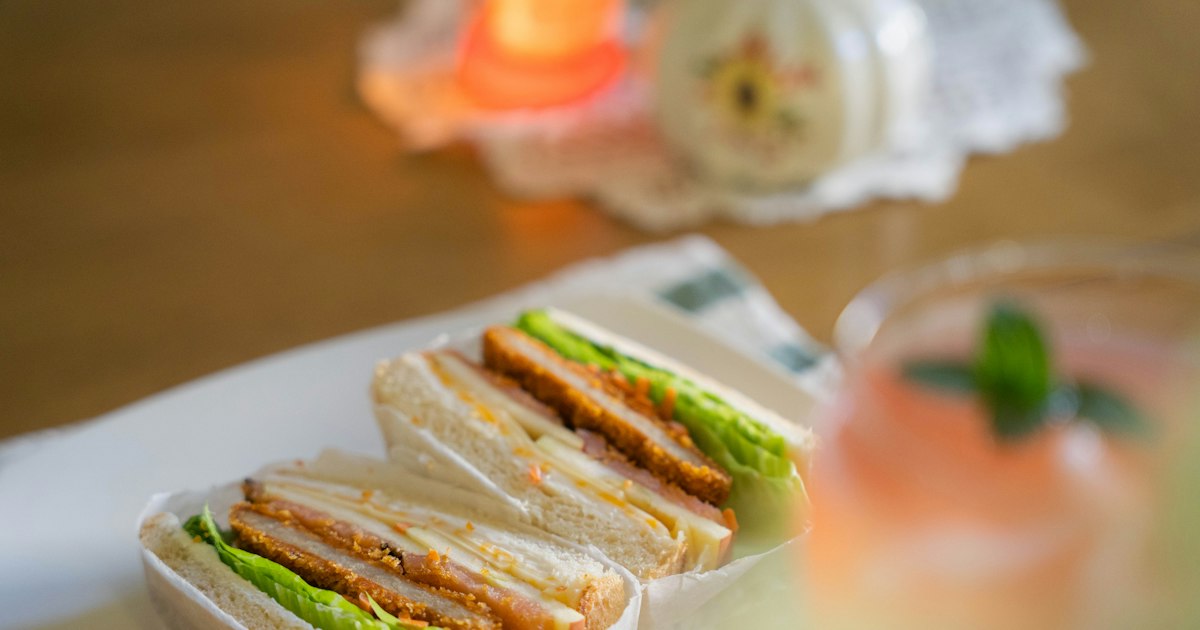
Photo by Sunny Nguyen on Unsplash
Somewhere between a snack and a full meal sits one of Japan’s most satisfying inventions: the katsu sando. It’s just a breaded, deep-fried pork cutlet pressed between two slices of soft white bread — but the combination of crisp pork, pillowy shokupan, and sweet-tangy sauce has made it a cult favorite with visitors and locals alike. Better still, you can buy a decent one for under ¥500 at almost any convenience store, or splurge on a wagyu version that costs more than a nice dinner. Here’s how to navigate the whole range.
What Exactly Is a Katsu Sando?
Katsu sando (カツサンド) is short for “katsu sandwich” — tonkatsu (breaded, fried pork loin or fillet) layered inside crustless shokupan, Japan’s fluffy milk-bread, with a Worcestershire-based tonkatsu sauce and sometimes a smear of karashi mustard. The crusts are trimmed off and the sandwich is cut into neat rectangles, which is part of why it photographs so well and why it became an internet-famous food over the past decade. It traces back to Tokyo department store basement food halls and specialty tonkatsu restaurants in the mid-20th century, long before it became a convenience store staple.
Budget Option: Convenience Store Katsu Sando (¥350–¥550)
This is the easiest way to try one. 7-Eleven, Lawson, and FamilyMart all stock katsu sando in the chilled sandwich section near the onigiri and other sandwiches, typically priced between ¥350 and ¥550 depending on the chain and whether it’s a standard pork loin version or a slightly thicker fillet cut. Quality varies — Lawson in particular has a reputation among Japanese shoppers for above-average fried items and sandwiches, so it’s worth checking a couple of nearby stores if you have options.
Timing matters more than people expect. Convenience stores restock fresh sandwiches several times a day, and stock sitting since the morning delivery by late afternoon will taste noticeably more tired than one bought shortly after a restock (late morning, around 10–11am, is a reliable window before the lunch rush thins out the shelves). Always check the “best by” time printed on the label — these sandwiches are meant to be eaten the same day, often within a few hours.
If you’re traveling in Hokkaido, don’t skip Seicomart, the region’s own convenience chain — its in-house hot food counter often has fresh fried items that outshine the big national chains’ pre-packaged offerings. And if you’re stepping out into typical Japanese drizzle to go store-hopping, the convenience store umbrella culture is worth knowing about too.
Mid-Range: Specialty Tonkatsu Shops and Department Store Basements (¥800–¥1,800)
For a meaningfully better sandwich, go to a dedicated tonkatsu restaurant that sells sando as takeout. Maisen, founded in 1965 and still operating from a converted bathhouse in Aoyama, Tokyo (a short walk from Omotesando Station, exit A2), is the benchmark — its rosu (loin) and hire (fillet) katsu sando run roughly ¥1,000–¥1,600 for a takeout pack and use noticeably fresher oil and thicker-cut pork than any convenience store version. Expect a short queue around lunchtime (11:30am–1:30pm); going right at opening avoids the wait.
Department store basement food halls, known as depachika, are another reliable mid-range source. Isetan Shinjuku’s basement food floor carries katsu sando from several well-regarded vendors, and these make genuinely good gift boxes if you want to bring something home for a host. Go before 6pm — the evening rush of office workers buying dinner takeout can clear out the good stuff fast, and some stalls start marking down prices for same-day sale closer to closing.
Splurge: Wagyu Katsu Sando (¥3,000–¥5,000+)
Wagyumafia, the Tokyo-based wagyu specialist with shops in Roppongi and other locations, built part of its reputation on an extravagant wagyu katsu sando — thick-cut, marbled wagyu breaded and fried, served in small portions given the richness. Prices run well into the ¥3,000–¥5,000+ range for a sandwich that’s closer to a fine-dining course than a quick bite. It’s genuinely excellent if you want to taste what wagyu does to this format, but it’s a special-occasion purchase, not a snack.
Common Mistakes to Avoid
- Buying one that’s sat too long. A soggy, cold katsu sando is a different (worse) food than a fresh one — check the time stamp and buy from a store that’s clearly had recent deliveries.
- Refrigerating and reheating later. The bread turns gummy in a fridge. If you can’t eat it within a few hours, it’s better to buy fresh again later than to save it.
- Confusing katsu sando with katsudon. Katsudon is the same fried pork served over rice in a bowl with egg — a completely different dish, usually found at restaurants rather than convenience stores.
- Assuming all branches of one chain are equal. Sandwich quality and freshness can vary store to store even within the same chain, especially between high-traffic urban locations and quieter suburban ones.
- Skipping the sauce check. Some convenience store versions come with a thin layer of sauce already applied, while higher-end versions include a small extra sauce packet — don’t assume there’s enough seasoning without checking.
Best Time to Eat It
There’s no real seasonal angle here — katsu sando is sold year-round and tastes the same in July as in January, unlike seasonal foods such as sanma. The timing that actually matters is time of day: mid-morning for convenience store freshness, right at opening for specialty shops to avoid queues, and before early evening at depachika before the dinner rush picks over the selection. It also makes an excellent cold-weather station platform snack if you’re traveling by train — similar in spirit to grabbing a kamameshi ekiben for a long ride, except a katsu sando travels better since it doesn’t need reheating.
Pairing It Properly
If you want to turn a katsu sando into more of an occasion, pick one up and head to Ebisu, where the neighborhood’s beer-hall heritage makes it a natural spot to pair a crisp pork cutlet sandwich with a cold draft. It’s a simple but genuinely good combination, and Ebisu’s walkable beer gardens make for an easy, low-key afternoon stop between sightseeing.
Whether you grab one from a Lawson fridge for ¥400 on your way to the station or queue up at Maisen for the real thing, katsu sando is one of the few Japanese foods that rewards curiosity at every price point. Start cheap, work your way up, and you’ll understand exactly why this humble sandwich has such a following.