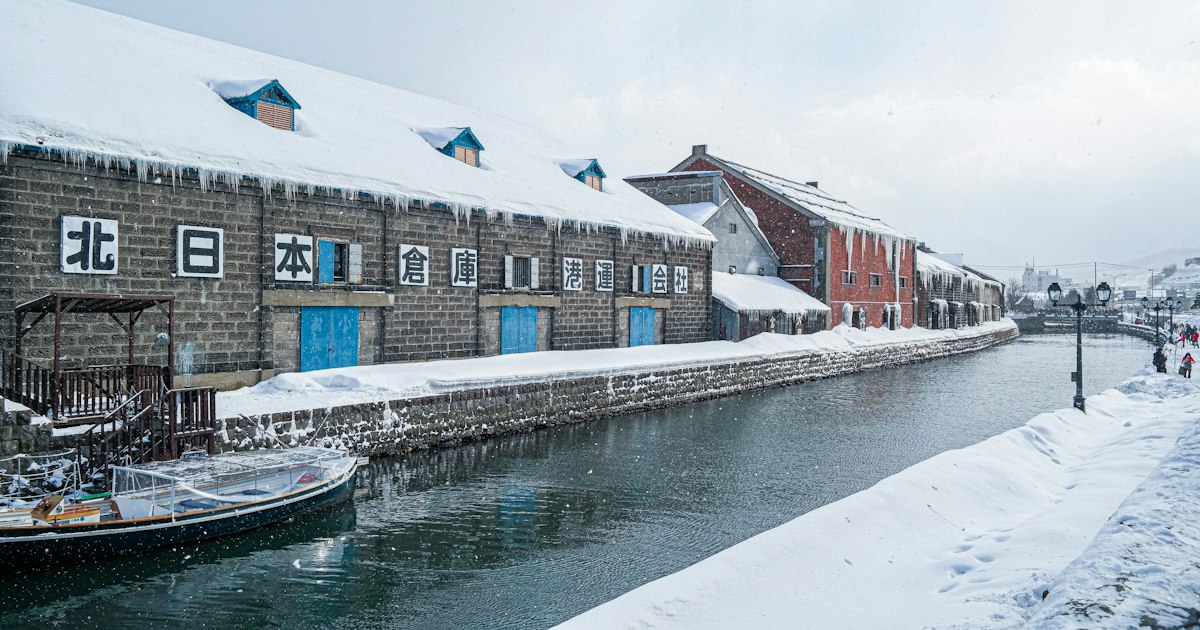
Photo by KWON YOUN on Unsplash
Thirty minutes west of Sapporo by train, Otaru trades the city’s grid of department stores for a stone canal lined with converted warehouses, gas lamps, and glass shop after glass shop. It’s an easy half-day or full-day trip, but the towns that work best as day trips are also the ones people rush through — Otaru rewards a bit of pacing, especially once you factor in the glassblowing studios, the music box halls, and a sushi scene good enough that locals from Sapporo drive out just to eat here.
Getting to Otaru from Sapporo and New Chitose Airport
From Sapporo Station, take the JR Rapid Airport (Kaisoku Airport) line bound for Otaru or New Chitose Airport — it takes about 32 minutes and costs around ¥640 one-way for an unreserved seat. Slower local trains run the same route for the same base fare, just taking closer to 50–60 minutes, which is a fine trade if you’re not in a hurry. Trains run roughly every 15–20 minutes, so there’s no need to pre-book.
Coming straight from New Chitose Airport, you can take a direct Rapid Airport train to Otaru without changing at Sapporo — budget around 70–80 minutes and roughly ¥2,000 one-way. If you’re arriving from Narita or Haneda first, note that domestic connections to New Chitose are a separate leg entirely; it’s worth checking Narita to Haneda (and Back): Routes, Time & Cost Compared if your itinerary involves switching Tokyo airports before heading north.
Otaru Station itself is a short, mostly downhill 10–15 minute walk to the canal — easy, but worth knowing if you’re hauling luggage, since the last stretch has stairs.
Walking the Canal: What to See and When
The Otaru Canal was built in 1914 to let cargo boats unload directly into the brick and stone warehouses that still line its banks. Today those warehouses hold cafés, glass shops, and a brewery, and the canal itself is at its best in two windows: early morning, before the tour buses from Sapporo arrive (typically mid-morning onward), and after dark, when around 60 gas lamps light the water. Both ends of the canal path are free to walk at any hour.
A 40-minute canal cruise runs during the day and in the evening for around ¥2,000 per adult — pleasant, but skippable if your budget’s tight, since you can see most of the same scenery on foot for free. The evening lamplight is genuinely photogenic, and if you’re the type who likes a physical print rather than just a phone photo, it’s a good excuse to bring along an instant camera — see Instax Cheki Culture: Japan’s Instant Camera Craze and Where to Buy Film if you need film while you’re in Hokkaido.
Don’t skip the former Bank of Japan Otaru Museum, a five-minute walk from the canal — free admission, open 9:30–17:00, closed Mondays. Otaru was once a major financial hub for Hokkaido’s herring and coal trade, and the old vault and banking hall are worth the detour even if banking history isn’t normally your thing.
Kitaichi Glass and Otaru’s Glassblowing Tradition
Otaru’s glass industry didn’t start as souvenirs — it started with oil lamps and the glass floats (bidama/uki) used by local herring fishermen to keep their nets afloat. When the fishing industry declined and electric lighting replaced oil lamps, glassmakers pivoted to tableware, lamps, and ornaments, and that’s the industry you see today along Sakaimachi Street.
Kitaichi Glass (Kitaichi Garasu), founded in 1901, is the biggest name and has several shop buildings scattered within a few minutes’ walk of each other, generally open from around 8:45 or 9:00 AM to 6:00–7:00 PM. The main Sangokan building, lit by hundreds of oil lamps, is worth visiting even if you don’t buy anything.
Several studios, including Kitaichi and smaller independent glassblowing workshops nearby, offer hands-on experiences where you make your own paperweight, cup, or small vase under a craftsperson’s guidance — expect roughly ¥3,300 to ¥6,600 depending on the piece, with sessions taking 20–40 minutes plus cooling/pickup time (some pieces ship home instead of being handed to you same-day). Reserve ahead in peak summer and around the February festival, since slots fill up with day-trip tour groups.
Otaru Orgel Hall and the Music Box Shops of Sakaimachi Street
A few steps from the glass shops, Otaru Orgel Hall occupies a 1912 building with a steam clock replica out front that whistles and puffs on the hour. Entry is free; you’re browsing a working music box shop and small museum rather than a paid attraction. Hours run roughly 9:00–18:00. Inside, you can build or customize a music box — picking the mechanism, the figures on top, and the music — for somewhere between ¥2,000 and ¥5,000 depending on complexity, making it one of the more personal souvenirs you’ll find in Japan. A second, smaller antique hall nearby displays vintage European and Japanese music boxes, some over a century old.
If you’re generally drawn to Japanese craft shopping, Otaru’s glass and music box trade sits alongside a broader world of regional specialty goods — similar in spirit to guides like Obi Belts: A Buying Guide to Japan’s Kimono Sashes as Everyday Fashion Accessories, if you want to round out a souvenir list with something wearable too.
Best Time to Visit
Summer (July–August) is the busiest season, partly because Otaru is a regular stop for cruise ships docking in Hokkaido, which can flood Sakaimachi Street with foot traffic by midday. Spring and early autumn are quieter and comfortable for walking. If your trip falls during Japan’s autumn holiday cluster, it’s worth checking Japan’s Silver Week: The Autumn Holiday Cluster and How to Plan Around It, since domestic tourism spikes nationwide during that window and Otaru is a popular Hokkaido stop for it.
Winter brings the Otaru Snow Light Path Festival (Yuki Akari no Michi), usually held in mid-February, when snow lanterns and candles line the canal and a disused rail line nearby. It’s the town’s most atmospheric moment, but temperatures regularly sit well below freezing — dress for it, and expect some shops to keep shorter hours in deep winter.
Where to Eat: Otaru’s Sushi Streets
Otaru’s harbor still lands excellent seafood, and the town has two sushi-dense streets, Sushiya-dori and Dekimachi-dori, within walking distance of the station. Budget-wise, a casual sushi set lunch runs around ¥1,500–2,500, a solid mid-range omakase is roughly ¥5,000–8,000, and the top-tier counters known for uni and seasonal Hokkaido catch can run ¥10,000–15,000 or more per person. If you’d rather eat on the move before browsing glass shops, a quick seated counter meal works the same way as Tokyo’s standing sushi culture described in Tachigui Sushi: Tokyo’s Standing Sushi Bars for a Fast, Affordable Meal — fast, no-frills, and good value.
Common Mistakes to Avoid
- Coming only as a rushed midday stop. Tour buses cluster between late morning and early afternoon; arriving before 10 AM or staying until the gas lamps light up gives a much calmer experience.
- Not booking a glassblowing slot ahead in peak season. Walk-in availability shrinks fast in summer and during the February festival.
- Underestimating winter cold. Canal-side wind off the harbor makes February feel colder than the thermometer suggests.
- Assuming everything opens early. Most Sakaimachi Street shops open around 9:00–9:30 AM, so an 8 AM arrival means waiting around before shops are ready.