Kusatsu Onsen, tucked into the mountains of northwestern Gunma Prefecture, is routinely ranked among Japan’s three or four most famous hot spring towns, and locals have a saying to back up the reputation: the water here cures “every illness except lovesickness.” That’s not just marketing — Kusatsu produces more raw hot spring water per minute than almost anywhere else in the country, and its steaming, strongly acidic springs have drawn bathers since at least the Muromachi period. The town’s signature experience, the yumomi water-cooling show, is a genuinely unusual piece of living history, not a tourist invention, and it’s reason enough to build a day or overnight trip around.
Why Kusatsu’s Water Is Different
The spring water bubbling up around town emerges at well over 50°C and sits at a pH of roughly 2 — acidic enough to sting an open cut and strong enough to tarnish silver jewelry, so take rings and necklaces off before you bathe. That acidity is also what locals credit for the water’s reputed effects on skin conditions and muscle pain. Because the water is too hot to enter straight from the source, Kusatsu developed a distinctive solution centuries ago: rather than diluting the spring with cold water (which bathing-cure traditionalists believe weakens its properties), bathers would stir and fan the water with long wooden paddles to cool it down while keeping its mineral strength intact. That technique is yumomi, and it’s still demonstrated daily in town.
The Yumomi Show at Netsu-no-Yu
The best place to see yumomi is Netsu-no-Yu (熱の湯), a wooden hall right beside the Yubatake in the center of town. Performers in traditional dress plunge long paddles into a huge tub of scalding spring water, stirring and lifting it in rhythm while singing the folk song “Kusatsu Kouta.” Shows run multiple times a day — typically mid-morning and mid-afternoon, with extra performances added on weekends and holidays — and each lasts about 20 minutes. Admission runs around ¥600 for adults and ¥300 for elementary-school children; some sessions also let visitors grab a paddle themselves for a small additional fee. Because showtimes shift with the season, check the board posted outside Netsu-no-Yu or ask at the tourist information center near the bus terminal when you arrive rather than relying on an old printed schedule.
Yubatake: The Town’s Beating Heart
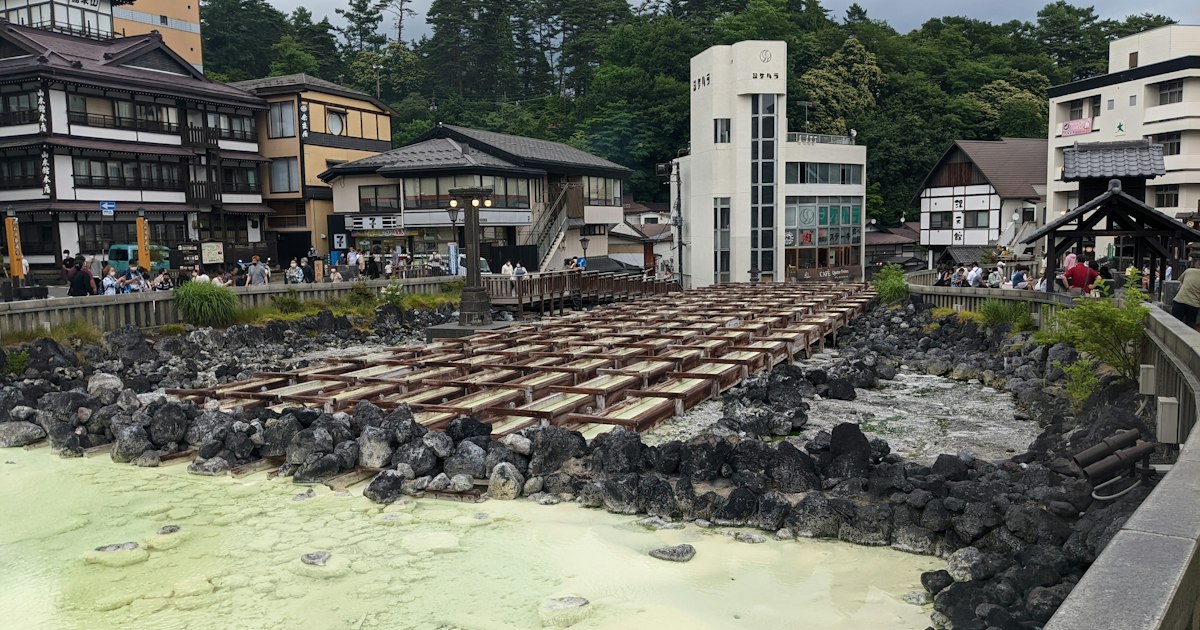
Yubatake literally means “hot water field,” and it’s the open channel system in the middle of town where spring water flows down wooden gutters to cool naturally before being piped to the town’s ryokan and public baths. It’s free to walk around at any hour, and it’s particularly striking after dark when the whole field is lit up and steam rises against the night sky. Scattered around the perimeter you’ll find free footbaths (ashiyu) — bring a small towel, since none are provided, to dry your feet afterward. A few minutes’ walk uphill, Sainokawara Park has a large open-air bathing area (around ¥700 admission, separate men’s and women’s sides) set among rocks and a shallow stream, plus another free footbath if you’d rather not undress.
Getting to Kusatsu Onsen
From Tokyo, the standard route is Joetsu Shinkansen from Tokyo or Ueno Station to Takasaki (about 50 minutes, roughly ¥5,000–6,000 for a reserved seat), then a transfer to the local JR Agatsuma Line to Naganohara-Kusatsuguchi Station (about 70 minutes, around ¥1,200). From there, a JR Bus Kanto connecting bus covers the final stretch up into the mountains to the Kusatsu Onsen bus terminal in about 25 minutes (around ¥700). All together, budget roughly 2.5–3 hours of travel time.
If you’d rather skip the transfers, a direct highway bus runs from Shinjuku (and some departures from Tokyo Station) straight to Kusatsu Onsen in about 3.5–4 hours, usually priced between ¥3,500 and ¥5,000 one-way depending on the season and seat class — slower but cheaper and simpler with luggage. Reserve a seat in advance during weekends, holidays, and ski season, since buses do sell out.
If you’re the type who prefers to drive the mountain roads yourself, Kusatsu sits near the base of the Shiga-Kusatsu Kokudo, Japan’s highest paved through-road, which is a spectacular ride in its own right; anyone considering a two-wheeled approach should look at renting a motorcycle or scooter in Japan before the trip, since license requirements catch a lot of visitors off guard.
Best Time to Visit
Kusatsu is a year-round destination, but the character of the trip changes a lot by season. Winter (December–February) is the classic draw — snow piled around steaming footbaths, and Kusatsu Onsen Ski Resort a short bus ride away for anyone who wants to combine soaking with skiing. Autumn (mid-October to early November) brings strong foliage color to the surrounding hills without the crowds or extreme cold. Summer is cool and pleasant relative to lowland Tokyo, which makes Kusatsu a popular heat-escape. Whatever season, avoid arriving during Obon (mid-August) or the New Year holidays unless you’ve booked lodging well ahead — the town is small, and ryokan fill up fast.
Where to Stay and Soak
Budget travelers can find simple guesthouses and family-run lodgings in and around town for roughly ¥6,000–9,000 a night without meals; if you want that homestay feel, look into booking a minshuku rather than a hotel. Mid-range ryokan with half-board (dinner and breakfast included) run roughly ¥15,000–25,000 per person per night and typically include access to an indoor and outdoor bath fed directly by the springs. For a splurge, several larger ryokan offer rooms with private open-air baths (kashikiri-buro) starting around ¥30,000 per person — worth it if you want unlimited private soaking rather than sharing communal baths on a schedule. Whatever your budget, pack or buy a padded hanten or tanzen jacket for lounging between baths in cooler months — most ryokan provide a yukata, but it’s not always warm enough once the sun goes down. After a long soak, warm up with a bowl of zenzai or oshiruko at one of the small shops near Yubatake — it’s the classic post-bath treat in mountain onsen towns like this one.
Common Mistakes to Avoid
The biggest mistake is treating Kusatsu as a quick stopover — the town itself is compact, but travel time from Tokyo eats a big chunk of a day trip, so an overnight stay gets you far more value. Don’t skip the yumomi show thinking it’s just a photo-op for tourists; it’s one of the few hands-on demonstrations of a genuinely functional historical bathing technique left in Japan. Avoid touching the water directly at the source points around Yubatake — it’s hot enough to burn and acidic enough to irritate skin before it’s been cooled and piped to the baths. Finally, don’t wear anything silver or gold-plated into the baths, and check with your ryokan about which of their baths (if any) restrict visible tattoos, since policies vary more at smaller, traditional establishments than at large hotels.