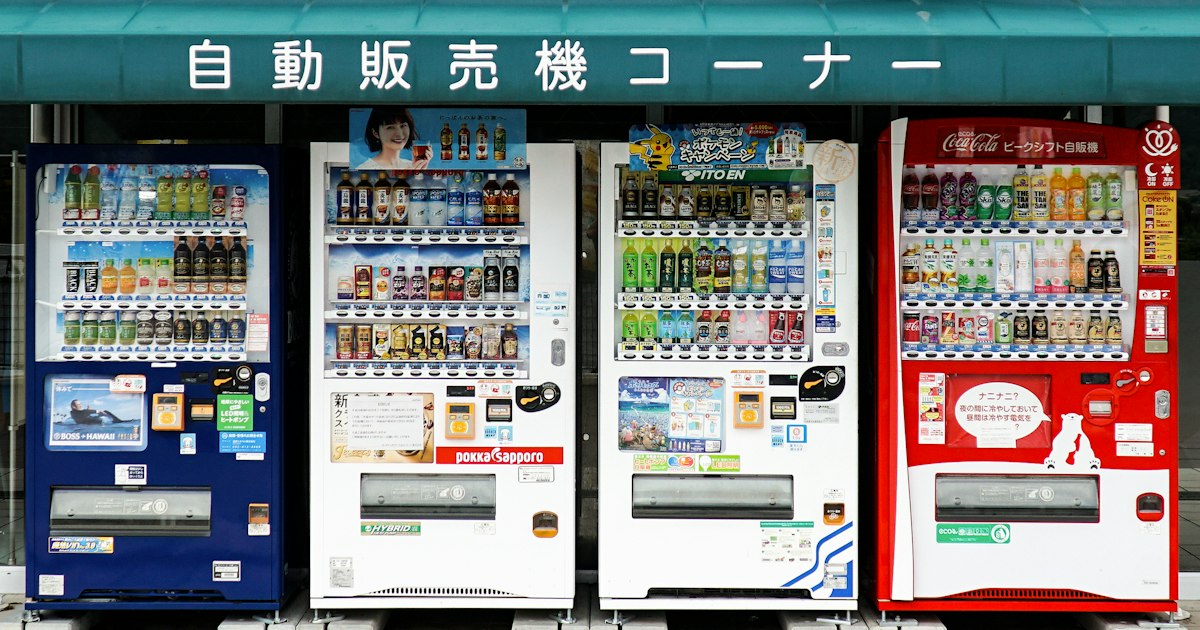
Photo by Ji Seongkwang on Unsplash
If you’ve spent more than a day in Japan, you’ve probably noticed two things: vending machines (jihanki) are everywhere, and public trash cans are almost nowhere. That combination confuses a lot of first-time visitors who end up carrying an empty can around for an hour. The good news is that Japan has built a quietly impressive system for handling all those bottles and cans — it just doesn’t look like a trash can, and it’s not the cash-back deposit machine you might know from Germany or Scandinavia. Here’s how it actually works, and how to use it without accidentally annoying anyone.
Why There’s No Trash Can Next to the Vending Machine
Public bins became scarce in Japan after security concerns in the 1990s led many cities and train operators to remove them from streets and station concourses. The upside is that Japan still manages a PET bottle collection rate estimated at around 90–95%, among the highest in the world — it’s just that the infrastructure moved to specific collection points instead of general street bins. For visitors, the practical rule is: a street vending machine’s attached bin is only for containers bought from that machine, not general litter. If you’re also trying to figure out where to handle other bathroom-break logistics while you’re out walking around, the same “look for the konbini or station, not the street corner” logic applies — see our guide on finding a public restroom in Japan for the parallel situation.
What Counts as a “Reverse Vending Machine” Here
There are actually two different machines that get lumped together as “reverse vending machines” in Japan, and it’s worth knowing the difference:
- Simple collection bins beside street vending machines — these are just open-top recycling bins, usually two slots (PET bottles and cans), bolted next to the drink machine. No scanning, no reward, free to use for anyone who bought a drink there.
- True reverse vending machines (RVMs) — found at supermarket entrances (AEON, Ito-Yokado and similar chains run these widely), some train stations, and a smaller number of standalone units from beverage makers like Suntory and Coca-Cola. You feed in an empty bottle or can one at a time, a sensor checks it, the machine crushes it internally, and you get something back — usually loyalty points rather than coins.
Unlike Europe’s Pfand-style deposit systems, Japan never built a national bottle deposit into the retail price, so there’s no guaranteed per-bottle cash refund. What you get instead is typically a store loyalty point (1 point is usually worth ¥1) credited to a card or app — AEON’s WAON POINT and JR East’s JRE POINT programs are the two you’ll see most often at RVMs.
Where Tourists Will Actually Run Into One
You’re most likely to encounter a genuine RVM at:
- Supermarket entrances or exterior walls — look for a cluster of machines near the bicycle parking, often with separate slots for PET bottles, aluminum cans, and sometimes food trays or milk cartons.
- Larger train stations in the Tokyo and Osaka areas, near ticket gates or in the concourse — these are usually tied to the local rail operator’s point program.
- Shopping mall common areas, especially near the food court.
Plain collection bins (the non-rewarding kind) are everywhere a vending machine stands — outside convenience stores, at rest stops along highways, next to machines in parks and near shrines. Convenience stores themselves (7-Eleven, Lawson, FamilyMart) generally do not take back empty bottles at the counter; use the exterior bin by their vending machine if there is one, or carry your empty to the next station.
How to Use One Without Getting It Wrong
The machine itself is simple, but the sorting rules trip up almost everyone the first time:
- Remove the cap and the plastic label before inserting the bottle. In Japan, a PET bottle is sorted into three separate streams — clear bottle body, cap, and label — because they’re different plastic types. Most bottles have a perforated tear line on the label for exactly this reason. Caps and labels go in a separate “plastics” (purasuchikku) bin, not with the bottle.
- Give the bottle a quick rinse if there’s visible liquid left — sticky residue is the most common reason machines jam or reject a container.
- Insert containers one at a time and wait for the machine to process before putting in the next one; rushing it is the usual cause of an error light.
- Cans don’t need label removal, just a quick shake to confirm they’re empty.
- If you’re earning points, you’ll need the store’s point card or its smartphone app set up beforehand — tourists without a WAON or JRE POINT account usually can’t collect the reward on the spot, so don’t expect cash or a receipt discount as a walk-up option.
Timing and Everyday Etiquette
There’s no real seasonal angle to recycling, but there is a practical timing tip: bins at busy stations and tourist areas fill up fastest in the late afternoon and after major events, so if you’re near capacity-limited sightseeing spots (think cherry blossom season crowds or summer festival nights), it’s worth carrying an empty bottle a bit further to a quieter machine rather than overstuffing a nearly-full bin. Supermarket RVMs are typically available during store hours only, roughly 9:00 or 10:00 to 21:00–23:00 depending on the chain, while machine-side street bins are accessible anytime the vending machine itself is running, which is usually 24 hours.
Common Mistakes Visitors Make
- Treating a vending machine’s recycling bin as a general trash can — it fills up fast and store staff do notice when it’s used for convenience store food wrappers or tissues.
- Forgetting to peel the label and remove the cap, which is the single most common reason a bottle gets rejected by an automated RVM.
- Expecting a cash refund — Japan’s system runs on points and environmental good-will, not a per-bottle deposit, so don’t be surprised when nothing comes out.
- Assuming every convenience store takes bottles back — most don’t; the collection point is the vending machine’s own bin, not the store counter.
None of this is complicated once you know the pattern — sort by material, strip bottles down to just the clear body, and use the machine tied to where you bought the drink. It’s one of those small, unglamorous systems that quietly explains why Japanese streets stay as clean as they do, and now you’ll know exactly where to put that empty can instead of carrying it around all afternoon.