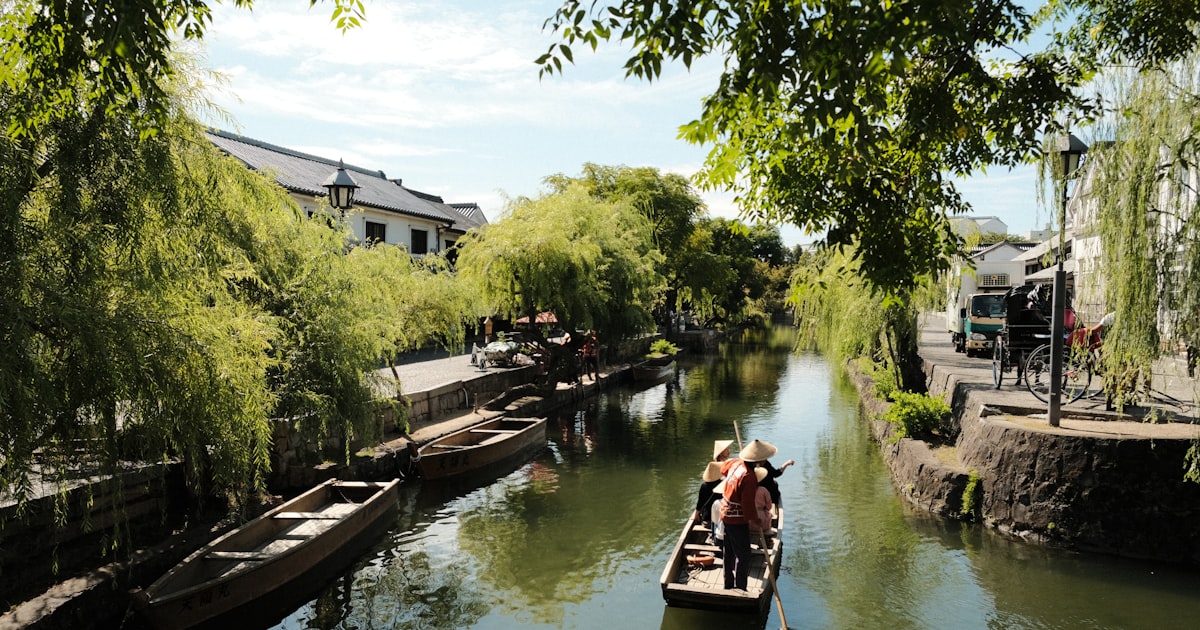
Photo by Austin Curtis on Unsplash
An hour or so west of Osaka, the city of Kurashiki hides a few blocks of white-walled storehouses, black tile roofs, and weeping willows draped over a canal that once floated rice and cotton down to the port. The Bikan Historical Quarter survived Japan’s 20th-century rebuilding boom because Kurashiki’s merchant families and a wealthy industrialist family, the Oharas, protected it — and today it’s one of the best-preserved Edo-period townscapes in the country, small enough to see properly in half a day. Here’s how to actually plan the visit.
Getting to Kurashiki
The gateway is Okayama Station, on the Sanyo Shinkansen line — about 45 minutes from Shin-Osaka, 3 hours 10 minutes from Tokyo, and roughly 35 minutes from Hiroshima. From Okayama Station, take the JR Sanyo Line to Kurashiki Station (15–17 minutes, around ¥330 one-way; rapid trains are a couple of minutes faster). The Bikan Historical Quarter is then a flat, easy 15-minute walk south from Kurashiki Station’s south exit — just follow the signs and the crowds.
One trap to avoid: some Shinkansen trains (Kodama services only) stop at a station called Shin-Kurashiki, not Kurashiki Station. Shin-Kurashiki is nowhere near the canal district and requires a bus or taxi to reach it — always route through Okayama Station and the regular Kurashiki Station instead. If you’re working out rail passes for the wider region, it’s worth reading up on the Regional JR Rail Passes before you go, since a JR West pass covering the Sanyo corridor can cover this leg along with Osaka, Kyoto, and Hiroshima.
What to See in the Canal District
The quarter itself — the canal, the willow-lined stone paths, the rows of former rice and sugar warehouses (kura) now housing cafés and shops — costs nothing to wander, and that’s really the main event. Give yourself at least an hour just to walk the length of the canal and duck down the side streets.
A few specific stops worth building time around:
- Ohara Museum of Art — Japan’s first museum of Western art, opened in 1930 by industrialist Ohara Magosaburo. The main gallery holds genuine works by El Greco, Monet, Gauguin, Matisse, and Picasso, which is a genuinely startling thing to find in a small Japanese canal town. Open roughly 9:00–17:00 (last entry 16:30), closed Mondays (if Monday is a public holiday, it closes the following Tuesday instead). Adult admission is around ¥2,000 — check the museum’s own site for current pricing before you go, since it has risen in recent years.
- Kurashiki River boat ride — a short traditional boat trip along the canal, running most days (weather permitting) for roughly ¥500 for adults and ¥300 for children. Tickets are sold same-day at a booth near Nakabashi Bridge on a first-come basis and do sell out on busy afternoons, so buy yours early if you want to ride.
- Kurashiki Ivy Square — a former Meiji-era textile mill, its red brick walls now thick with ivy, converted into a hotel, restaurants, and small museums (including a memorial hall on the mill’s history). Free to walk through even if you’re not staying or dining there.
- Japan Rural Toy Museum and Kurashiki Archaeological Museum — smaller, cheap (a few hundred yen each), and good rainy-day fillers if the main museum feels like too much of a detour.
Shopping for Local Crafts
Kurashiki has its own craft identity worth shopping for beyond generic souvenirs. Look for hand-blown Kurashiki glass (Kurashiki garasu) — cloudy, slightly greenish glassware made in small workshops around the quarter — and Bizen ware pottery from the nearby town of Bizen, which is sold in several shops here even though it’s fired elsewhere. If denim interests you, Kurashiki’s Kojima district is considered the birthplace of Japanese domestic jeans manufacturing; Kojima Jeans Street is about 20–30 minutes away by bus or train from Kurashiki Station and is a worthwhile add-on for denim fans with a bit more time.
If you end up buying pottery, glass, or anything bulky and fragile, it’s usually easier to ship it home rather than carry it — our guide to shipping souvenirs home from Japan compares post office and courier options and pricing.
Best Time to Visit
Spring (late March–April) brings the willows into fresh green leaf alongside cherry blossoms along the canal, and it’s the most photogenic — and most crowded — season. Autumn, especially November, turns the Ivy Square walls red and brings pleasant walking weather. Early June through mid-July is Japan’s rainy season; it’s quieter and the canal still looks good under an umbrella, but expect intermittent rain. Weekends and national holidays (especially Golden Week in early May) bring heavy day-tripper crowds by late morning — arriving before 9:30am, or visiting on a weekday, makes a real difference to how peaceful the streets feel.
Budget, Mid-Range, and Splurge Options
Budget: The canal walk itself is free, and a convenience-store or bakery lunch runs ¥500–800. Skip the museums and you can spend an enjoyable couple of hours here for the cost of the train ticket.
Mid-range: Add Ohara Museum admission (~¥2,000), a canal boat ride (~¥500), and lunch at one of the local udon or kappo restaurants in a converted kura (¥1,200–2,500), and you’re looking at a full, satisfying half-day for around ¥4,000–5,000.
Splurge: Stay overnight in one of the historic ryokan built into the old merchant houses right in the Bikan Quarter, such as Ryokan Kurashiki, or in a room at Kurashiki Ivy Square. Rates for a proper heritage ryokan stay run well above standard business hotel prices — expect a premium for the atmosphere — but it buys you the canal at dusk and dawn without a single tour group in sight, which is a genuinely different experience from a daytime visit.
Common Mistakes to Avoid
- Visiting on a Monday and finding the Ohara Museum, the district’s headline attraction, closed.
- Getting off at Shin-Kurashiki instead of Kurashiki Station and adding an unnecessary taxi ride.
- Treating it as a 30-minute photo stop. Between the museums, the boat ride, and lunch, most visitors are happier with 3–4 hours than a rushed hour between trains.
- Arriving at midday on a weekend and fighting crowds along the narrowest stretch of towpath — an early morning or late afternoon visit is far more pleasant.
Kurashiki pairs naturally with a wider Chugoku/Kansai itinerary — it sits roughly between Kyoto/Osaka and Hiroshima on the Shinkansen line, and travelers extending south can combine it with a cycling day on the Shimanami Kaido. If it’s the preserved streetscape itself that appeals to you, it’s also worth comparing notes with Tsumago and Magome on the old Nakasendo highway — a very different, mountain-postal-town take on the same idea of protecting old Japan from the wrecking ball.