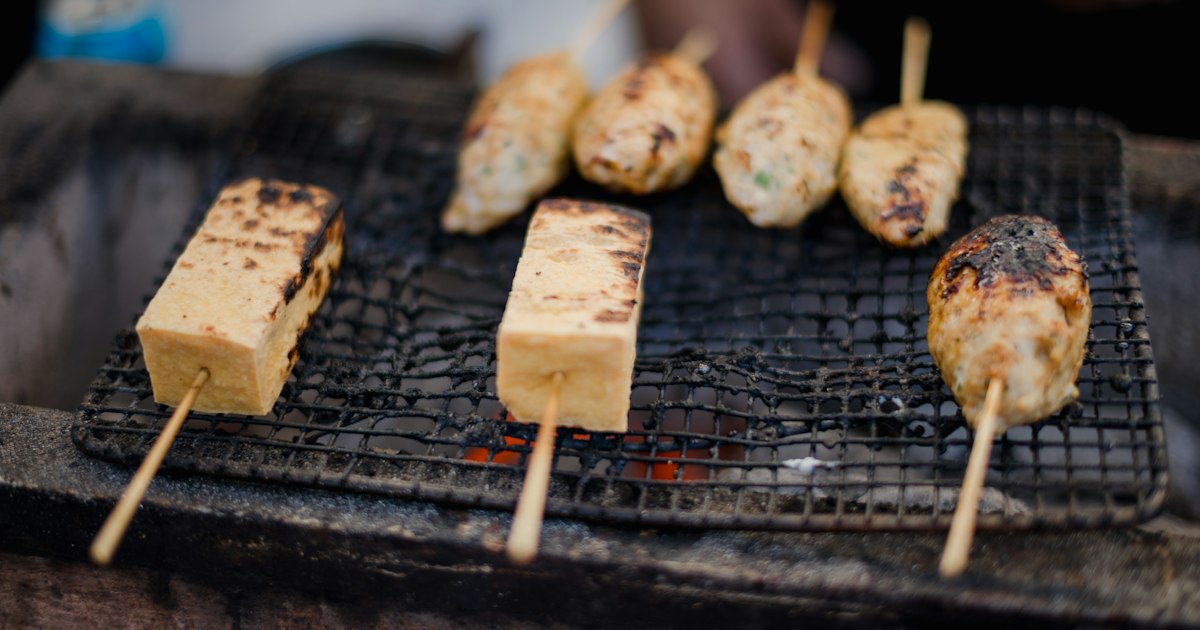
Photo by Jason Leung on Unsplash
Long before miso ramen or miso soup became Japan’s culinary ambassadors abroad, there was dengaku — blocks of tofu, konjac, or vegetables skewered on a stick, grilled over charcoal, and slathered in a thick, sweet-savory miso glaze. It’s one of the oldest prepared foods still served in Japan today, dating back to the Muromachi period (1336–1573), and it remains a quiet staple on izakaya menus and in old-town restaurants from Kyoto to Nagoya. If you’ve only ever had miso as soup, dengaku will change how you think about it: here the miso is caramelized, almost like a glaze on yakitori, and it clings to soft tofu in a way that’s hard to stop eating.
What Dengaku Actually Is
The name comes from dengaku-mai, a rice-planting dance performed on stilts in medieval Japan — the skewered food on a stick apparently resembled dancers balanced on single poles. The modern dish keeps the skewer but drops the dancing. A typical plate holds two or three rectangular blocks of firm tofu (often grilled tofu, or yaki-dofu), each pierced lengthwise with a flat bamboo skewer, then brushed with miso paste that’s been cooked down with sugar, mirin, and sometimes egg yolk or sake until it’s glossy and slightly sticky. The whole thing gets a final pass under a grill or over charcoal to set the glaze and add light char.
Tofu is the most common base, but konjac (konnyaku) dengaku is just as traditional, especially in Kyoto and in mountain regions where konjac has long been cheaper and more available than tofu. You’ll also find eggplant, satoimo (taro), and even fish versions. Miso itself varies by region: Kyoto leans on sweet white saikyo miso, Nagoya uses the darker, more mineral haccho miso, and some shops serve a two-tone plate with both so you can compare them side by side.
Where to Try It: Kyoto
Kyoto is the best base for dengaku because it sits at the intersection of two food cultures that both prize it: shojin ryori (Buddhist temple cuisine) and old-town izakaya cooking. Several tofu specialists near the city’s famous temples serve dengaku as a side or starter alongside their main yudofu (simmered tofu) sets — if you’re already comparing temple-district tofu restaurants, it’s worth reading Yudofu Tofu Shops in Kyoto’s Arashiyama vs Nanzen-ji, since many of the same shops that do yudofu also do a very good dengaku, and ordering both lets you taste tofu prepared two completely different ways in one sitting.
Expect to pay around ¥500–900 for a dengaku set of two to three skewers at a casual tofu restaurant, or ¥300–500 as an a la carte add-on at an izakaya. Lunch sets that bundle dengaku with rice, pickles, and soup typically run ¥1,500–2,500. Many of these restaurants are old wooden machiya buildings with limited seating, so arrive right at opening (usually 11:00 or 11:30) on weekends to avoid a 30–40 minute wait.
Where to Try It: Nagoya and Beyond
Nagoya has its own dengaku identity built around haccho miso, the deep-brown, barley-free miso fermented for years in cedar barrels near Okazaki Castle. Here dengaku tends to be heartier and saltier than Kyoto’s sweeter version, often served as a bar snack with beer rather than a refined course. Look for it at izakaya in the Osu and Sakae districts, where a few skewers cost ¥250–450 each.
Outside the big cities, dengaku shows up seasonally at rural inns and roadside restaurants, particularly in mountain areas where konjac is a local product — Gunma and Nikko are both known for konjac farming, and konjac dengaku appears on menus near the Nikko Toshogu area. If you’re planning a Nikko day trip from Tokyo, it’s an easy dish to try alongside the shrine visit; see our guide to the JR Tokyo Wide Pass for Nikko, Fuji & Karuizawa day trips if you’re mapping out that route.
Best Season and Timing to Visit
Dengaku is served year-round, but it’s at its best in the cooler months — late autumn through early spring — when the grill and the warm, dense glaze feel most appealing and restaurants often pair it with other hot nabe-style dishes. Summer versions exist (some shops swap in cooler, lighter miso blends), but demand is lower and you’ll see it less often on summer menus. For lunch, aim for the opening seating (11:00–11:30) or go after 14:00 to dodge the midday crowd at temple-district restaurants; for dinner at izakaya, 17:30–18:30 opening slots are easiest to walk into without a reservation.
Budget, Mid-Range, and Splurge Options
- Budget (¥250–600): Izakaya chains and standing bars serving a few skewers as a side dish. Quality is inconsistent but it’s a low-risk way to try the dish for the first time.
- Mid-range (¥800–2,500): Dedicated tofu restaurants near temples in Kyoto, Nagoya haccho-miso specialists, and inn restaurants in konjac-growing regions. This is where you get the clearest, most traditional version of the dish, usually made in-house with care over the glaze’s texture and sweetness balance.
- Splurge (¥3,000+): Kaiseki (multi-course) restaurants and ryokan dinners that include a single, beautifully presented dengaku skewer as one course among many — here the miso is often custom-blended and the tofu house-made that morning. Worth it once if you’re already booked into a kaiseki dinner, not something to seek out on its own at this price point.
Common Mistakes to Avoid
- Treating it like yakitori and eating straight off the skewer in one bite. Tofu dengaku is soft and the glaze is thick — it’s easier and more polite to slide a piece off with chopsticks onto your small plate first, especially in a quieter kaiseki setting.
- Expecting miso soup flavor. The glaze is cooked down and sweetened, closer to a teriyaki-adjacent sauce than the savory broth most visitors associate with “miso.” If you dislike very sweet sauces, ask whether the shop offers a darker, less-sweet miso version — many that serve both saikyo and haccho styles will let you choose.
- Skipping it because it “looks like plain tofu.” Menus rarely show a photo, and dengaku is easy to overlook next to more photogenic dishes. It’s worth asking staff directly — “dengaku arimasu ka?” (“do you have dengaku?”) — since it’s often a seasonal or off-menu item at smaller restaurants.
- Not checking for sesame or egg in the glaze if you have allergies. Some shops fold sesame paste or egg yolk into the miso for richness; if you’re keeping kosher or managing allergies, it’s worth asking before ordering — our guide to kosher food in Japan has useful phrasing and context for navigating these questions at non-certified restaurants.
How to Order and What to Pair It With
At a sit-down restaurant, dengaku usually appears as a teishoku (set meal) component or an a la carte starter — you don’t need to order anything special beyond pointing at the menu item, which is often written as 田楽 or でんがく. At izakaya, it pairs naturally with a cold beer or a glass of sake, since the glaze’s sweetness cuts nicely against both. If you want to recreate the flavor at home afterward, Japanese grocery stores sell pre-made dengaku miso paste in small tubs near the regular miso section — it keeps for weeks in the fridge and works on grilled vegetables or even roasted sweet potato, not just tofu.
Dengaku won’t headline anyone’s “must-eat Japan” list the way sushi or ramen does, but that’s part of its appeal: it’s an unpretentious, centuries-old dish that locals still order without thinking twice, and tracking it down gives you a genuine reason to duck into an old tofu shop or a smoky neighborhood izakaya you might otherwise walk past.